
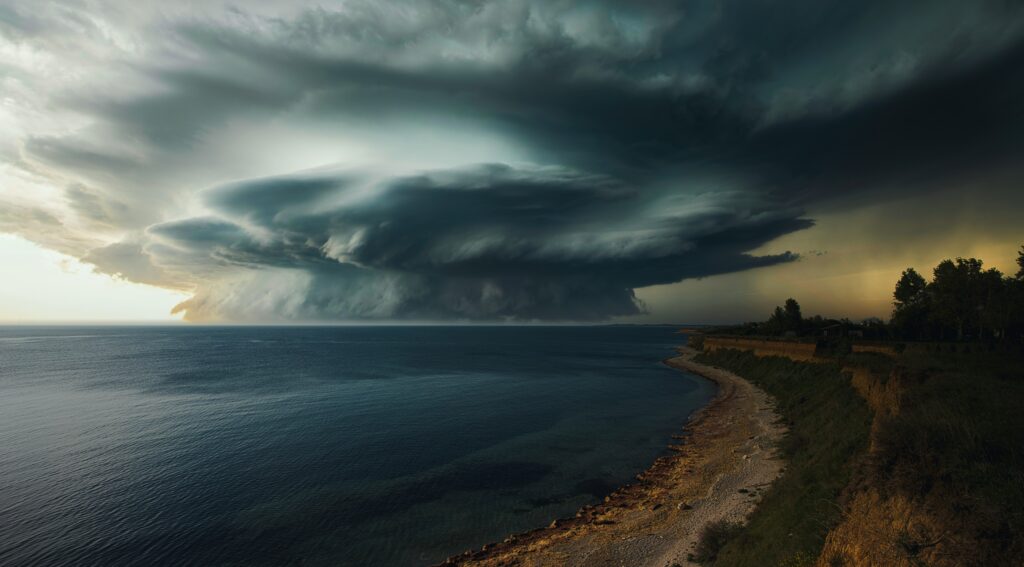
In a recent study published in the peer-reviewed journal PLOS Water, researchers have put forward an ambitious and hotly debated concept: using advanced techniques to subtly alter the paths or intensity of massive weather systems, including powerful hurricanes.
The proposal, which builds on long-established cloud seeding methods, envisions a future where human intervention could help shield vulnerable coastal cities and other populated regions from the worst impacts of natural disasters.
Traditional defenses against extreme weather—such as building stronger infrastructure, reinforcing levees, or relying on insurance—have proven increasingly inadequate as climate-driven events grow more frequent and severe.
The study’s authors argue that these measures alone may not suffice moving forward. Instead, they suggest enhancing existing weather modification tools with cutting-edge data collection, real-time analysis, and artificial intelligence to create small but strategic “nudges” that could redirect or weaken storms days in advance.
For instance, the research team modeled scenarios where timely interventions might have dramatically changed the outcomes of past events. They proposed that such operations could have diverted Superstorm Sandy away from New York City by roughly 300 miles in 2012, significantly raised temperatures during the devastating 2021 Texas cold snap, or lessened rainfall from a major 2022 atmospheric river event in California by about 5 percent.
These projections highlight the potential for protecting lives and property, but they remain highly speculative.
Not everyone is convinced. Atmospheric scientists have expressed strong skepticism, pointing out a lack of solid evidence that current cloud seeding technologies can meaningfully influence large-scale systems like hurricanes, which are powered by immense natural forces. Critics emphasize that separating any human effects from the storms’ inherent variability has historically proven extremely challenging.
Cloud seeding itself is not new. For decades, it has been employed in various parts of the world to boost rainfall or reduce hail by introducing particles like silver iodide into clouds. Several U.S. states actively use the practice, though others, including Florida, have moved to restrict or ban weather modification efforts. The new study does not claim cloud seeding is the only or even the best tool for the job; researchers acknowledge they are still exploring optimal delivery methods for these interventions.
One of the study’s co-authors, Upmanu Lall from Arizona State University, drew an analogy to the martial art of jiu-jitsu. The idea is to use minimal force and precise timing—leveraging momentum and positioning rather than raw power—to redirect a much larger opponent. In weather terms, this means applying targeted actions at critical moments to influence the trajectory of enormous systems without trying to overpower them directly.
Implementing such a strategy would require sophisticated infrastructure: dense networks of real-time observations, rapid AI-driven modeling to pinpoint ideal intervention spots, and reliable ways to deliver the necessary “nudges.” Even then, past attempts to weaken hurricanes through seeding decades ago yielded inconclusive results, largely because natural fluctuations made it hard to measure success.
Beyond the scientific and technical hurdles, the proposal raises profound ethical and political questions. Redirecting a storm to spare one major city could inadvertently increase risks for neighboring regions. Who decides where the storm goes? How would international agreements handle cross-border impacts? Experts warn that the legal, diplomatic, and societal complications could be insurmountable, even if the technology eventually worked.
The authors recognize these concerns but say their current focus is on building the foundational science and engineering capabilities first. They note that broader discussions about ethics and governance will be essential later.
Meanwhile, cloud seeding has already sparked public controversy, with unfounded conspiracy theories linking it to recent disasters like deadly floods—claims that meteorologists have firmly debunked, stressing that seeding can only produce modest changes, not create catastrophes.
Whether this vision of steering hurricanes ever becomes reality remains uncertain. It represents a bold intersection of climate science, technology, and human ingenuity at a time when extreme weather demands creative solutions. For now, it serves as a provocative call for further research, even as it invites rigorous scrutiny from the scientific community. The debate underscores both the promise and the peril of attempting to tame nature’s most formidable forces.