
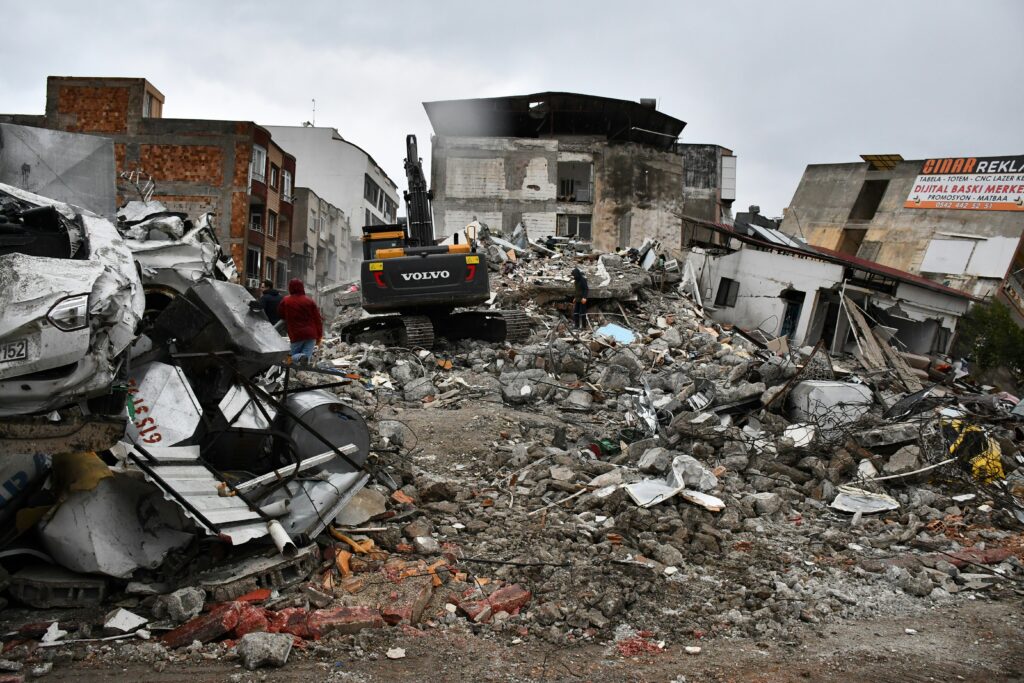
Earthquakes have long posed one of the most daunting challenges in science. Despite advances in monitoring technology, reliably forecasting when and where a destructive quake will strike remains elusive. Yet a new study offers fresh hope by using artificial intelligence to sift through seismic data for hidden patterns that sometimes emerge before large events.
Researchers at the GFZ Helmholtz Center for Geosciences in Germany, led by Dr. Sadegh Karimpouli and Prof. Patricia Martínez-Garzón, collaborated with international partners to develop a data-driven approach.
Rather than hunting for predefined warning signs, they turned to unsupervised machine learning—an AI technique that discovers natural structures and groupings within complex datasets without being told what to look for. This method treats earthquake sequences not as isolated incidents but as interconnected “families” of events that influence one another through stress changes in the Earth’s crust.
The team analyzed seismic catalogs from several well-studied earthquake zones. In cases like the devastating 2023 magnitude 7.8 Kahramanmaraş earthquake in Türkiye, the 2014 magnitude 8.1 Iquique event in Chile, and the 2009 L’Aquila quake in Italy, the AI identified distinct shifts in seismic behavior weeks to months before the main shocks.
These preparatory phases were marked by tighter clustering of smaller earthquakes, greater localization in both space and time, and accelerated release of seismic strain—signs that the fault system was transitioning toward a critical, unstable state.
By grouping related tremors based on proximity in location, timing, and size, the researchers could track how stress builds collectively across a region.
This perspective highlights that earthquakes are rarely solitary; each small rupture alters the surrounding stress field, potentially priming the ground for something larger. The unsupervised algorithm then categorized these families into different behavioral modes, revealing when activity deviated from the background norm.
Importantly, the approach does not claim to predict every earthquake. When applied to events such as the 2016 Amatrice quake in Italy or the 2024 Noto sequence in Japan, it found no comparable preparatory signals.
This variability underscores the immense complexity of earthquake physics: some faults may rupture with little detectable seismic warning, influenced by local geology, plate boundary type, and monitoring limitations. The researchers also tested the method in a forward-looking manner. Using earlier data to establish baseline patterns, they monitored for emerging anomalies as new earthquakes occurred.
This prospective testing suggests the technique could one day support real-time forecasting systems by flagging when a region’s seismic activity begins to behave unusually.
While true deterministic prediction of earthquakes may still be beyond reach, this work represents a meaningful step forward. By combining insights from earthquake physics with powerful machine learning, scientists can now detect subtle organizational changes that traditional analysis might overlook.
The study, published in Nature Communications, emphasizes the need to understand why certain quakes show clear precursors while others do not.
As monitoring networks improve and these AI methods are refined for operational use, they could enhance our ability to recognize heightened risk periods. For communities living near active faults, even probabilistic warnings that provide additional lead time could make a life-saving difference.
The research, funded in part by the European Research Council’s QUAKEHUNTER project, opens new avenues for integrating data-driven tools into earthquake preparedness strategies worldwide.