
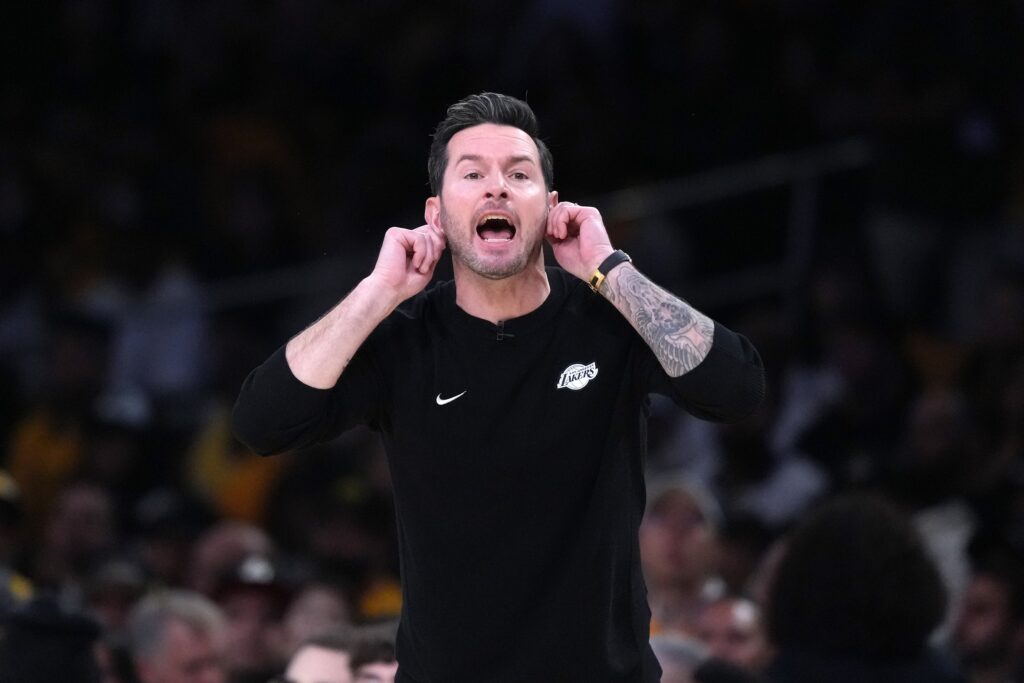
In the world of NBA free agency, even casual conversations can generate significant buzz. That was the case recently when Los Angeles Lakers general manager Rob Pelinka was spotted in a lengthy, friendly exchange with Denver Nuggets forward Peyton Watson at the Thomas & Mack Center in Las Vegas.
The moment, captured during summer league activities, quickly caught the attention of fans and analysts alike, prompting questions about what the two might have been discussing.
Watson enjoyed a strong breakout campaign last season, stepping up as a versatile wing who could score, rebound, and stretch the floor. He posted averages of 14.6 points and 4.9 rebounds per game while knocking down 41.1 percent of his three-point attempts.
His combination of length, athleticism, and improving perimeter skills made him an appealing target for teams seeking frontcourt depth and defensive versatility.
The Lakers had indeed shown prior interest in Watson as a restricted free agent. However, he ranked below their top priorities this offseason, and a sign-and-trade is considered a long shot.
Los Angeles focused its efforts on acquiring a big man, ultimately sending a substantial offer of two first-round picks and two pick swaps to the Utah Jazz for the rights to center Walker Kessler. That deal depleted much of the team’s draft capital, limiting their ability to pursue other high-value restricted free agents aggressively.
For Watson, the path to a new team has proven complicated. As a restricted free agent, any offer sheet he signs can be matched by the Nuggets, who hold his rights.
Reports indicate that prying him away from Denver would likely require compensation on par with what the Lakers gave up for Kessler—another package involving multiple first-round selections. Watson has remained unsigned amid limited traction, with earlier rumors of interest from the Brooklyn Nets fading and potential overtures from the Los Angeles Clippers still unresolved.
Despite the Lakers’ resource constraints, the organization’s desire for a long, athletic wing like Watson persists. The warm interaction between Pelinka and the young forward fueled speculation, especially as Lakers personnel were seen engaging broadly during the event.
Analyst Anthony Irwin highlighted Pelinka’s active networking style, noting that Watson stood out among those drawing extra attention.
As the offseason moves forward, the Lakers appear to be shifting their attention toward other forward options. Jonathan Kuminga has emerged as a primary target, with discussions reportedly advancing toward a potential sign-and-trade arrangement involving the Atlanta Hawks.
While Kuminga brings exciting athletic upside, some evaluators view him as a tier below Watson in terms of overall polish and shooting consistency. Adding to the complexity, Watson’s season was interrupted by hamstring problems that sidelined him in February and ultimately ended his campaign prematurely, raising valid questions about durability.
The Lakers’ remaining avenues at the wing position include more affordable veterans and younger players still available on the market, such as Ziaire Williams and Ochai Agbaji. A trade for someone like PJ Washington could also align well with their needs, though asset limitations might complicate negotiations.
In the end, Pelinka’s conversation with Watson may have been nothing more than standard networking in a league where relationships matter. Yet in a quiet free agency period for the Lakers, it served as a reminder of the team’s ongoing search for the right pieces to bolster their roster around their star core. Whether it leads to anything substantial remains to be seen, but it certainly added a layer of intrigue to the summer proceedings.