
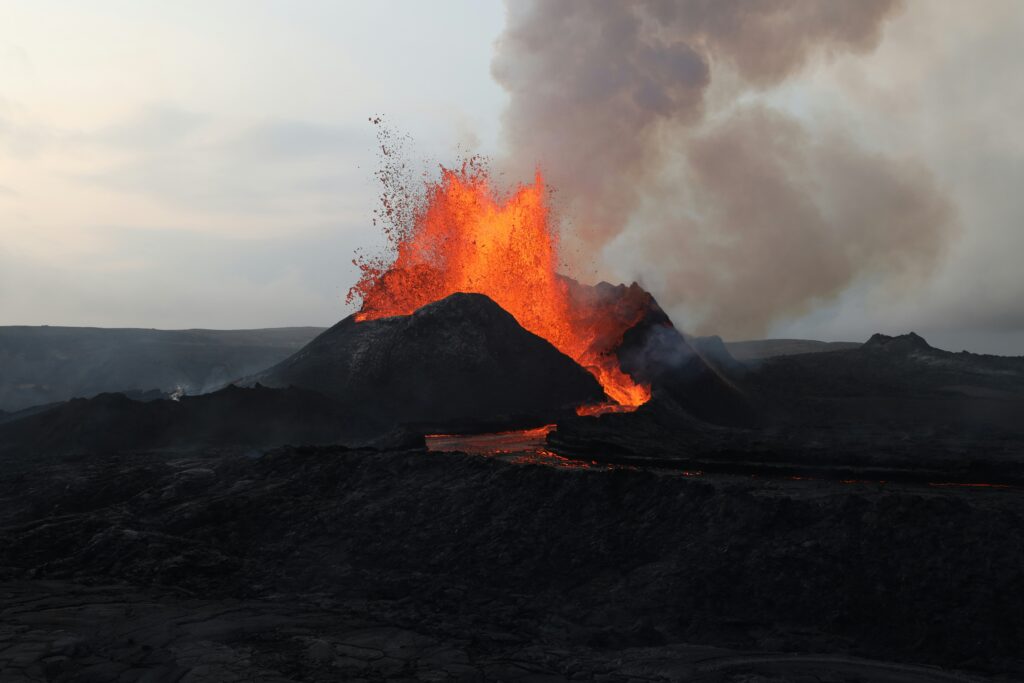
As of Monday, July 13, 2026, the summit eruption at Kīlauea volcano in Hawaiʻi Volcanoes National Park remains in a paused state. Scientists had anticipated a resumption of vigorous lava fountaining in the near term, but continued deflation at the summit has delayed the expected start of the next episode.
According to the U.S. Geological Survey’s Hawaiian Volcano Observatory, the current forecast points to the potential onset of episode 51 sometime between Tuesday, July 14, and Thursday, July 16. However, this window could shift further if the deflationary trend persists.
The volcano’s alert level stays at ADVISORY, reflecting the ongoing but currently paused activity.
Overnight observations revealed a continuous strong glow emanating from the north vent within Halema‘uma‘u crater, accompanied by intermittent strong glow and occasional flames from the south vent. No spatter has been observed from either vent since Saturday morning.
Seismic activity beneath the caldera remains low overall, with steady low-level tremor occasionally interrupted by brief reductions followed by spikes linked to gas piston activity in the south vent.
Ground deformation data shows modest deflationary movement. The summit has experienced roughly 0.9 microradians of deflationary tilt over the past day, contributing to a total of about 1.8 microradians since the trend began on Saturday.
This has slightly reduced the overall tilt recovery following the conclusion of episode 50. Sulfur dioxide emissions from the summit area are fluctuating within a normal range of approximately 1,000 to 5,000 tonnes per day.
In the rift zones, both seismic rates and ground deformation remain subdued, with sulfur dioxide emissions from the East Rift Zone staying below detectable levels.
The analysis from the Hawaiian Volcano Observatory suggests that these short deflationary periods have temporarily interrupted the broader inflationary pattern that typically builds between eruptive episodes. Similar pauses in the past have each delayed forecasts by one to two days.
Despite the current deflation, the persistent glow from the vents indicates that magma is still relatively shallow beneath the surface, keeping the potential for renewed fountaining alive in the coming days.
Kīlauea has followed an episodic eruption pattern since late December 2024, with lava fountaining from the paired north and south vents in Halema‘uma‘u. These bursts of activity generally last fewer than 12 hours, while the intervening pauses can stretch beyond three weeks.
The Hawaiian Volcano Observatory continues to monitor the situation closely in coordination with park officials and county civil defense authorities. Residents and visitors are encouraged to stay informed through official channels, as conditions at the volcano can change rapidly.
While the current pause offers a temporary lull, the dynamic nature of Kīlauea underscores the importance of respecting safety protocols in the national park.