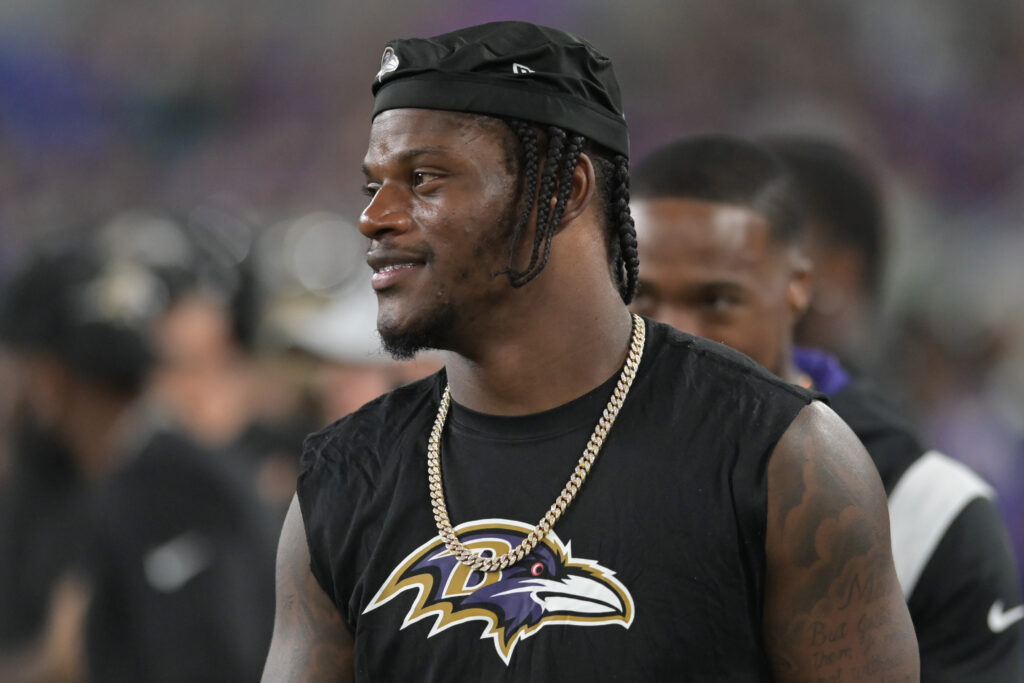
Lamar Jackson continues to deliver standout performances for the Baltimore Ravens, yet doubts persist about how his game has developed over time. Observers wonder whether the dynamic dual-threat quarterback has shed some of the explosive athleticism that once defined his early years. The conversation centers on whether Jackson has slowed down and what that means for his future effectiveness.
Former NFL scout John Middlekauff addressed these concerns during an episode of 3 And Out. He reflected on Jackson’s physical prime and suggested a possible return to certain training approaches from the past.
“I don’t really hear anyone talking about how there was a year Lamar Jackson built up his way,” Middlekauff said. “Do you think it might be something he should think about doing again? I think the guy that we saw early on in his career, 60-yard touchdown, double 360s in the open field; it was like Michael Vick on steroids. It was incredible. That guy’s not coming back.”
Middlekauff acknowledged that Jackson remains one of the fastest players in the league but emphasized the need for balance.
“Now, whatever he is now is still faster than basically everyone in the league. I think he’s got to find a happy medium of how to stay healthy, what the right body type is for him to feel comfortable, what’s good on his muscles. I think the key to them finding the perfect blend of offense for him, whatever that may be.”
He also recalled the offensive evolution under previous coaching.
“Remember, early on it was like, Greg Roman kinda doing like the Kaepernick thing, and then he was a much better passer than that. It just got expanded, expanded, expanded. He won MVPs with it. I’m fascinated to see what they’re going to look like this year.”
During the initial phase of his professional journey, particularly in his 2019 MVP campaign, Jackson carried a lighter frame that fueled remarkable quickness and burst. He frequently turned routine plays into spectacular gains, relying heavily on his speed and ability to evade defenders in space. This approach produced numerous memorable moments that showcased his unmatched perimeter threat.
One notable instance occurred in Week 7 of the 2019 season against the Seattle Seahawks. Facing a critical 4th-and-2 from the Seattle 8-yard line, the Ravens initially prepared to kick a field goal. Jackson, however, seized control at the line, recognized the defense collapsing inside, and improvised by escaping to the outside. The result was a pivotal touchdown that shifted the momentum in a 30-16 victory. In that contest, he accumulated 143 passing yards and added 116 rushing yards with a score, demonstrating the same improvisational brilliance once associated with Michael Vick.
In the most recent season, Jackson appeared in 13 games and completed 63.6 percent of his 302 attempts for 2,549 yards. Those figures represent a noticeable step back from his previous output of 66.7 percent accuracy and 4,172 yards in 2024. While he maintains solid mobility and elusiveness, his rushing production has declined from 915 yards to 349 yards across the past two campaigns.
Analyst Colin Cowherd recently highlighted signs of regression in Jackson’s 2025 performance, attributing much of it to a series of injuries affecting his hamstring, ankle, knee, and toe. Despite the Ravens’ overall team success that placed them in the postseason, the drop in individual production raised eyebrows among fans and commentators.
Even with these challenges, Jackson has shown clear growth as a pocket passer. Much of that progress traces back to the foundational work done with coach Greg Roman, which elevated his throwing precision. Following Roman’s departure from Baltimore in 2022, Jackson still earned MVP honors in 2023. Today, he operates with greater confidence through the air and posts impressive completion rates, traits the organization clearly values.
Contract negotiations add another layer of complexity to the situation. In late April 2026, Ravens general manager Eric DeCosta expressed strong belief in Jackson’s long-term commitment to Baltimore. Jackson currently has two years and $104 million left on his existing deal. However, last season’s results may not have fully strengthened the case for an immediate extension.
Baltimore created roughly $40 million in salary cap flexibility heading into the year by restructuring Jackson’s compensation, including converting $49.5 million of his base salary into a signing bonus. According to ESPN’s Bill Barnwell, any new agreement would likely require guaranteeing the $52 million owed in 2027, along with more than $100 million in fresh money for 2030 or 2031.
Bleacher Report’s Alex Kay suggested that Jackson’s upcoming contract could reshape the quarterback market entirely, influenced by the rising salary cap, his age, and the supporting talent around him. The Ravens appear to seek a version of Jackson that combines better health, sharper decision-making, and improved balance between running and passing. Relying solely on his physical dominance to rescue plays may no longer suffice as the primary strategy.
As the organization refines its offensive approach and addresses contractual matters, the central task remains crafting an ideal mix. Jackson must blend the thoughtful, high-percentage passer he has developed into with the dynamic rushing presence that once electrified crowds.
Finding that equilibrium could determine both his personal legacy and the Ravens’ continued contention in the years ahead.