
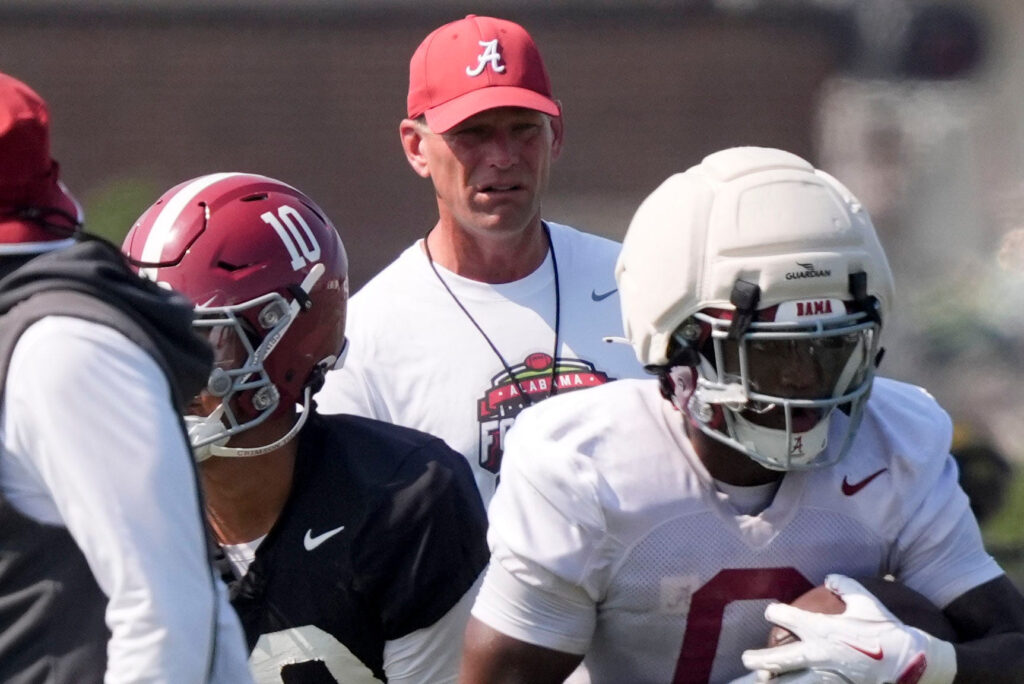
As the Alabama Crimson Tide prepare for another high-stakes season under Kalen DeBoer, one name in the wide receiver room already carries an unspoken sense of urgency.
Rico Scott, the former four-star recruit from Harrisburg, Pennsylvania, enters his redshirt sophomore year with numbers that fail to match the expectations that accompanied his arrival in 2024.
Across his first two seasons, Scott has recorded just 16 receptions for 158 yards and three touchdowns, a modest total that leaves him fighting for meaningful snaps in a crowded and talented group.
Matthew Schmidt of Bama Roundtable has highlighted the precarious position Scott occupies. Alabama’s receiving corps remains stacked with proven and emerging talent.
Ryan Coleman-Williams is widely regarded as a potential early-round NFL prospect, while Lotzeir Brooks appears primed for a significant role. The 6-foot-5 Derek Meadows brings rare size and upside, and incoming four-star freshman Cederian Morgan adds further depth.
Transfer Tyler Henderson also enters the mix, and Noah Rogers is expected to return from injury at some point. In that environment, Scott risks remaining buried on the depth chart unless he forces a change during fall camp.
Scott’s physical profile presents both opportunity and challenge. Listed at six feet and 198 pounds, he lacks elite size, yet his speed remains a legitimate asset that could stretch defenses vertically.
The difficulty, as Schmidt has noted, is that Alabama already possesses multiple receivers capable of providing that same element. Scott must therefore distinguish himself in other ways—consistency, route precision, reliability in contested situations, and the ability to earn trust in practice—if he hopes to carve out a regular role.
Fall camp has become the critical proving ground. Without a strong showing, the possibility of a postseason transfer becomes increasingly realistic. It would be a disappointing outcome for a player clearly possessing talent, yet the reality of Alabama’s depth at the position means opportunities are finite.
DeBoer’s staff has shown a willingness to elevate those who perform, but the competition leaves little margin for error.
For Scott, 2026 represents a do-or-die campaign in Tuscaloosa. A breakthrough would validate the promise that once made him a highly sought recruit.
Continued limited production, however, could push the Pennsylvania native to seek a clearer path elsewhere.
As Schmidt has observed, the talent is there, but the crowded room may ultimately decide whether that talent gets the chance to fully develop with the Crimson Tide.