
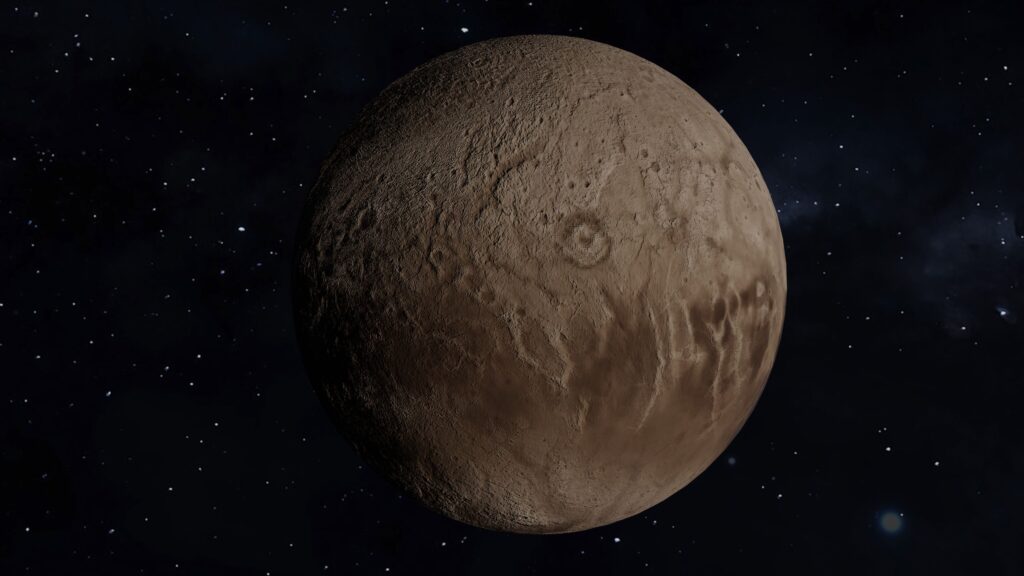
In a surprising discovery that reshapes our understanding of the distant dwarf planet, researchers have identified the first clear evidence of large-scale landslides on Pluto.
Using data from NASA’s New Horizons mission, which flew past the world in 2015, an international team of planetary scientists uncovered six substantial mass movements of material within impact craters on its frozen surface (h/t Phys.org).
Pluto, long viewed as a cold and relatively inert body at the edge of the solar system, turns out to have a more active geological story. The landslides occurred in three different craters, where steep icy walls and rugged terrain provided the perfect conditions for gravitational instabilities to trigger dramatic downslope flows of ice, rock, and debris.
These events mirror similar phenomena seen on Earth as well as on other solar system bodies like Mars and the dwarf planet Ceres, but until now, no such features had been confirmed on Pluto despite its promising landscape.
The team revisited high-resolution images captured by the spacecraft’s Long-Range Reconnaissance Imager (LORRI), which offered views at roughly 300 meters per pixel, and combined them with topographic data collected during the flyby.
In the photos, unmistakable signs stood out: distinctive crescent-shaped scars where material had broken away from crater rims, enormous blocks of ice that had shifted from their original positions, and extensive debris fields spread across the crater floors.
These movements were impressive in scale. The slides descended heights of 1.5 to 2.2 kilometers before racing across distances of up to 14.5 kilometers. One of the largest events blanketed an area of about 130 square kilometers—equivalent to covering a small city. The findings, detailed in a recent paper in the journal Icarus, highlight how such processes have likely played a significant role in sculpting Pluto’s surface over time.
Lead insights from the study emphasize that these observations mark the first recognition of landslides on a major icy body in the Kuiper Belt. Far from being a static relic, Pluto demonstrates ongoing geological activity driven by slope failures and material transport. The researchers point out that gravitational instabilities appear widespread, contributing to the planet’s varied and evolving terrain in ways that were previously overlooked.
While the current images confirm six definite landslides, the team suspects there may be additional examples hidden in the same craters—features that hint at past activity but lack sufficient detail for full verification given the resolution limits of the available data.
This opens exciting possibilities for future exploration. Missions equipped with sharper imaging and more precise elevation mapping could uncover even more evidence, painting a fuller picture of Pluto’s dynamic history.
This breakthrough adds to the growing appreciation of Pluto as a world full of surprises, from its heart-shaped plains to potential cryovolcanoes.
The presence of landslides underscores that even in the frigid outskirts of our solar system, geological forces continue to reshape icy landscapes in profound and fascinating ways. As scientists dig deeper into the New Horizons archive and plan ahead for new visits, Pluto’s story is only beginning to unfold.