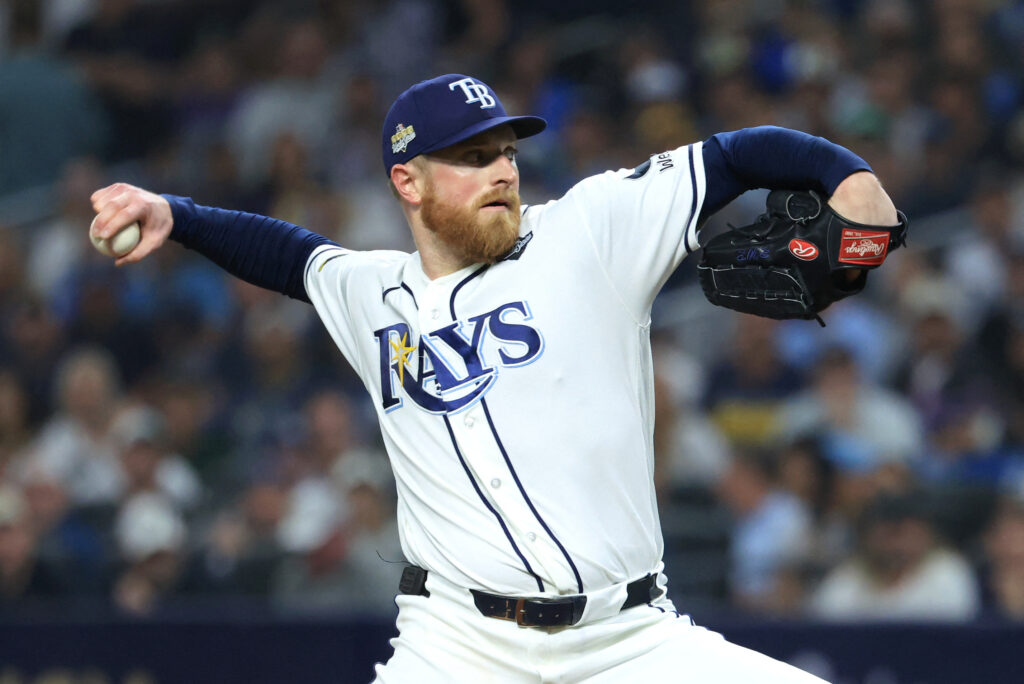
The Tampa Bay Rays entered the offseason with a familiar dilemma centered on their ace, Drew Rasmussen.
After exercising his $20 million club option—an easy decision following what figures to be his second consecutive top-10 Cy Young finish—the organization now faces the prospect of carrying the largest single-player salary in franchise history for 2027.
That figure alone has fueled speculation about a trade, especially since Rasmussen is entering the final year of his contract.
Historically, the Rays have not hesitated to move high-priced starters in similar situations, viewing such deals as a way to replenish the roster while the player’s value remains high.
This time, however, president of baseball operations Erik Neander has signaled a different approach. Speaking with reporters, he emphasized the club’s early plan to retain Rasmussen as the rotation’s centerpiece.
“It’s not a declarative this, that, whatever, but I can sit here very confidently and say that every intention right now is thinking about ‘Ras’ anchoring our rotation and how to make this team better going into next year,” Neander said, via Marc Topkin of The Tampa Bay Times.
He added that the Rays want Rasmussen back, noting that after coming so close to their ultimate goal, it is difficult to envision improving the team without him.
Neander drew a distinction between Rasmussen’s situation and the earlier trade of Tyler Glasnow.
In that case, late-season injuries and other roster developments shifted the competitive outlook, making a deal more sensible despite a prior extension.
Rasmussen, by contrast, has stayed healthy across consecutive seasons and established himself among the game’s top starters.
At age 31, another injury-free year would position him for a significant free-agent payday after 2027, yet the Rays appear focused on contending with him in the meantime rather than extracting prospect capital now.
Beyond Rasmussen, the rotation includes Shane McClanahan, Griffin Jax, and Ryan Pepiot, with Ian Seymour among the leading candidates for the fifth spot.
Durability remains a concern—McClanahan has not reached 120 innings since 2022, and Pepiot missed the 2026 season after hip surgery—though both are expected to be fully available for spring training.
The Rays finished 2026 with a payroll near $98 million and are already projected above $105 million for next year, largely due to a sizable arbitration class. Holding Rasmussen would consume a substantial portion of that budget, leaving limited flexibility for additional upgrades at starter, middle relief, or up the middle.
Even so, Neander’s comments represent a relatively firm pushback against immediate trade talk. While the Rays have rarely locked in large salaries for one season, their recent deep postseason run has apparently altered the calculus, at least for the moment.
Whether that intention holds through the winter will depend on the offers that arrive and how the front office balances short-term contention against its longstanding model of roster turnover. For now, the public message is clear: Rasmussen is viewed as the pitcher best positioned to lead the staff into another competitive season.