
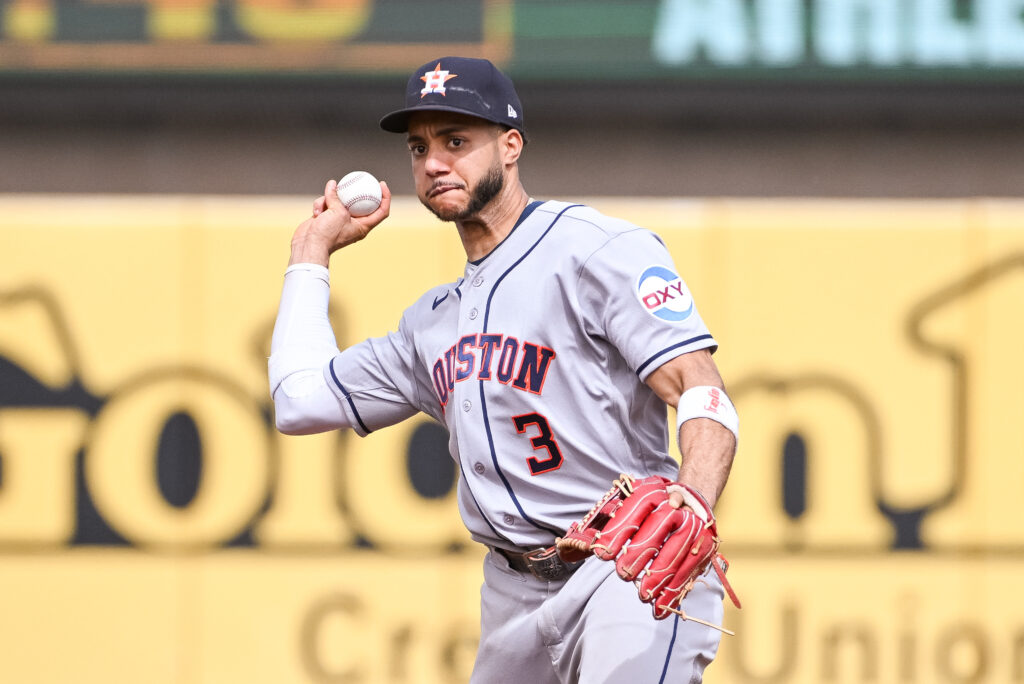
The Houston Astros enter another offseason with the same familiar questions that have defined their front office under Jim Crane.
After another early exit from the postseason, the club must decide whether to push forward with its core or cash in on players who are approaching free agency. Few decisions loom larger than the one involving shortstop Jeremy Peña.
John Perrotto of FanSided recently examined the uncertain futures of several stars from teams that have already been eliminated, and he singled out Peña as a prime trade candidate.
Perrotto noted that the 29-year-old shortstop is one year from free agency and is projected to earn at least $13 million through arbitration.
He also highlighted Peña’s solid 2026 production—a .277/.325/.477 slash line with 22 home runs and 12 stolen bases in 112 games—and suggested Houston could follow the path it took with Kyle Tucker by dealing him now rather than risking him walking away for nothing after 2027.
Peña’s place in Astros lore is already secure. As a rookie in 2022, he became the MVP of both the American League Championship Series and the World Series, delivering clutch hits and steady defense during Houston’s championship run.
That pedigree, combined with his still-prime age and above-average defense at a premium position, would make him attractive to contenders looking to upgrade at shortstop.
The Astros, however, face a crowded infield and the reality that Carlos Correa is expected to handle third base next season. Keeping Peña would require either a multiyear extension or a willingness to absorb another arbitration raise with no long-term control guaranteed.
Trading him this winter could return useful pieces.
Perrotto’s hypothetical package of outfielder Heliot Ramos, right-hander Brendan Beck, and shortstop prospect Dax Kilby from the Yankees illustrates the type of return Houston might seek—immediate help in the outfield or rotation along with a controllable prospect.
Whether any club is willing to part with that kind of talent remains to be seen, but the Astros have shown in recent years that they are willing to move popular players when the numbers no longer align with their championship window.
For Houston, the calculus is straightforward even if the outcome is not.
Peña remains a valuable everyday shortstop who can help a contender in 2027, yet his departure after next season is a realistic possibility if an extension cannot be reached.
By exploring the trade market now, the Astros can at least attempt to turn one season of his services into something that strengthens the roster for years beyond it.
That choice will shape how the franchise approaches the rest of its offseason as it tries to return to October with a more sustainable group.