
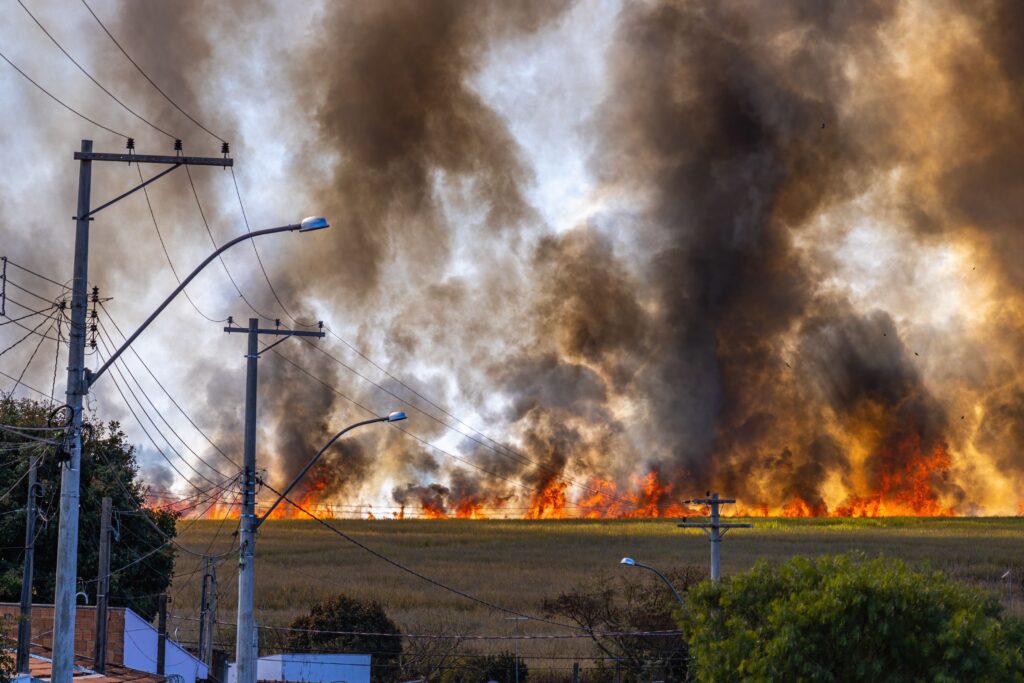
Active wildfires in Ontario and northern Minnesota are casting a thick shroud of smoke across the Great Lakes and New England, triggering a cascade of air quality warnings throughout the Northeast.
Ground-level ozone combined with a severe mid-July heat wave has created a highly challenging environment for millions of residents, as upper-level winds align to pull heavy particulate pollution straight into major metropolitan areas.
The atmospheric shift became strikingly visible in parts of New England as early as Tuesday afternoon. In Boston and southern New Hampshire, skies unexpectedly faded from a typical summer haze into an eerie, yellowish-brown cast.
This dramatic discoloration occurred because the smoke layer aloft was dense enough to scatter shorter wavelengths of blue light, allowing only the longer orange and yellow wavelengths to slice through.
Experts at the National Weather Service warn that as these higher-altitude plumes sink to the surface over Wednesday and Thursday, residents will begin to smell the distinct, campfire-like odor of burning timber alongside noticeably drop-offs in visibility.
This influx of smoke is traveling along the edge of a massive, intense heat dome centered over the midsection of the country.
Because winds circulate clockwise around high-pressure systems, this heat dome acts as a colossal steering wheel, scooping up plumes from massive fires, including a single blaze exceeding 130,000 acres in western Ontario, and aiming them directly at New York, Pennsylvania, and the coastal Northeast.
The arriving smoke introduces fine particulate matter, commonly known as PM2.5, which is particularly hazardous because the microscopic particles can bypass natural nasal filtration to settle deep in the lungs or enter the bloodstream.
Health departments across New York and New Jersey have cautioned that this particle pollution is riding on top of already elevated ground-level ozone caused by near-triple-digit heat. The compounding effect has pushed air quality indexes into the “Unhealthy for Sensitive Groups” tier and higher across multiple counties in western New York, Massachusetts, and northern Pennsylvania.
While emergency management officials in New York City note that current models do not point to a repeat of the hazardous, deep-orange apocalyptic skies seen in June 2023, the combination of extreme heat and poor air quality presents real health risks.
Health officials urge regional residents to monitor local Air Quality Index levels closely, especially children, older adults, and those with underlying cardiac or respiratory conditions like asthma.
During periods of peak pollution, the safest course of action is to minimize outdoor exertion, close windows, and utilize central air conditioning or air purifiers set to recirculate indoor air to keep living spaces clear of fine particles.