
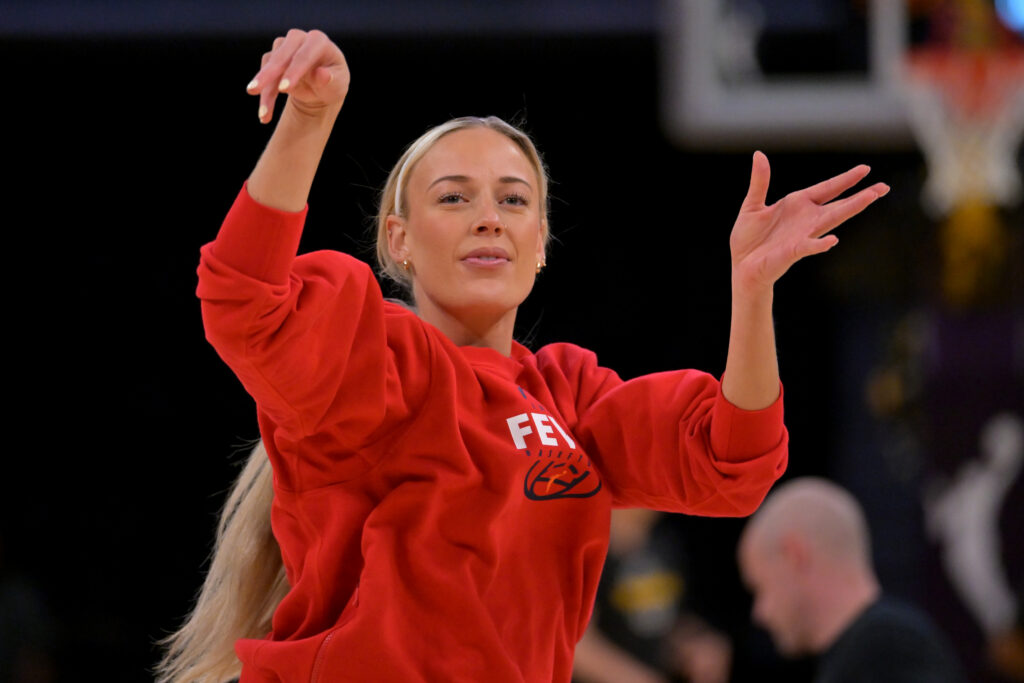
As the WNBA prepares to pause its regular season for the upcoming All-Star Weekend festivities, officials at the White House have publicly expressed backing for Indiana Fever guard Sophie Cunningham.
Just days ago, a detailed profile from ESPN’s Hallie Grossman explored Cunningham’s straightforward approach and distinctive public image. Although the piece centered largely on her professional path in the league, it also touched on how she has responded to various discussions circulating about her on social platforms.
In recent months, online commentary has sometimes labeled her with the nickname “MAGA Barbie.” Additional claims have suggested that she aligns herself with President Donald Trump and Republican positions.
Cunningham addressed these characterizations directly, describing her own political outlook as firmly centered. At the same time, she offered a clear position regarding the participation of transgender athletes in competitions designated for women.
“I got a lot of negative feedback about me hating trans,” Cunningham said to ESPN. “And I’m like, ‘I never once said that.’ I think that I am here to extend love. But I also think with that love is truth, being honest. And I want to protect young girls in a locker room, or young girls in sport who shouldn’t have to go against biological men.”
Those remarks quickly sparked widespread criticism across digital spaces, leaving little doubt about the intensity of the reaction they provoked.
In contrast to the online pushback, White House press secretary Karoline Leavitt offered a strong endorsement of Cunningham during remarks delivered on Thursday.
“I don’t believe he (President Trump) has reached out to her. I know he is following the story. As you know, this is something the president feels strongly about as well, and the American people do, too: that men should not be playing in women’s sports,” Leavitt said. “It’s completely ludicrous that anyone could support that. It’s even more ludicrous you have Sophie Cunningham, a female athlete herself, very accomplished in her own right, coming forth and speaking that truth that men shouldn’t play in women’s sports — we want to protect women and girls — and the backlash she is receiving from Democrats and left-wing fingers across the country is astonishing. They are clearly very out of touch with the American public on this issue.”
Karoline Leavitt says it's ludicrous that Sophie Cunningham is being attacked by the Left for coming out in support of keeping transgenders out of women's sports.
— Media Research Center (@theMRC) July 23, 2026
"This is an 80/20 issue; this is common sense… that men shouldn't be competing against women." pic.twitter.com/DArPgmZ7hU
Before the Indiana Fever faced the Connecticut Sun in a midweek matchup, Cunningham faced questions about the views she had shared on transgender athletes in women’s competitions.
“I said what I said. I think it’s kind of common sense,” Cunningham said. “I think it’s really important to protect children… I don’t dislike anyone. … I’m there to love, but I’m also there to love biological women.”
The guard’s replies indicated no intention of softening or revising the position she has taken.
Throughout the conversation surrounding her statements, Cunningham has continued to emphasize a balance between compassion and what she views as straightforward realities in sports. Her comments have highlighted concerns specifically focused on safeguarding opportunities and spaces for young female athletes.
The timing of the White House remarks adds another layer to the discussion, arriving just as the league enters a brief interruption in its schedule. Leavitt’s comments underscored a broader institutional perspective that aligns with the stance Cunningham has articulated.
Observers note that the athlete has maintained consistency in her public responses, both in the ESPN feature and in subsequent media interactions. She has repeatedly framed her views as rooted in a desire to support biological women while rejecting any characterization of personal animosity.
As the All-Star Weekend approaches, the exchange involving Cunningham, the online reaction, and the White House statement illustrates how individual athlete perspectives can intersect with larger national conversations.
Cunningham’s determination to stand by her words suggests the topic will remain part of the broader dialogue well beyond the current season pause.