
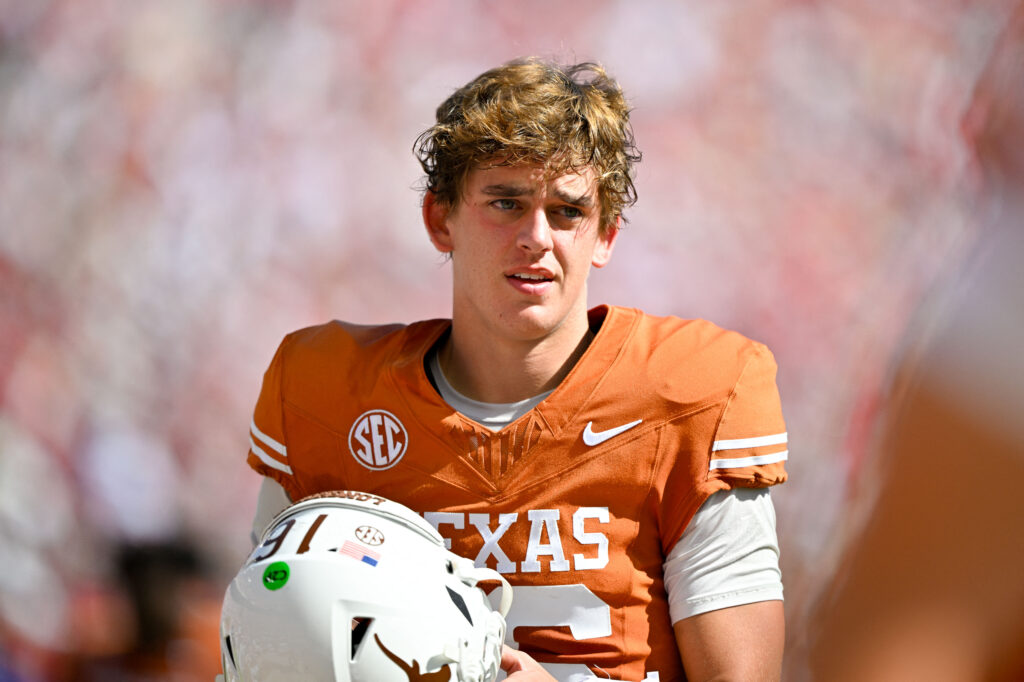
Texas quarterback Arch Manning closed the 2025 season with a strong stretch that placed him among the nation’s elite passers in a key advanced metric, according to analysis shared by Longhorns beat writer Tyler Horka.
Horka noted that Manning’s average Total QBR over his final five games of 2025 stood at 87.9. Had that figure represented his full-season mark, only three quarterbacks in college football would have ranked higher: Indiana’s Fernando Mendoza, the Heisman Trophy winner; Ohio State’s Julian Sayin, a Heisman finalist; and USC’s Jayden Maiava.
Total QBR, developed by ESPN, evaluates a quarterback’s overall contribution on a 0-100 scale by incorporating factors such as completion percentage, yards, touchdowns, interceptions, rushes and situational performance adjusted for opponent strength. An 87.9 average signals elite efficiency and decision-making over an extended period.
Manning’s late-season surge came after a mixed start to his first full year as Texas’ starter. The Longhorns opened with a narrow loss to Ohio State and later dropped games to Florida and Georgia. Yet they rebounded to finish 10-3 overall and 6-2 in the SEC, securing a Citrus Bowl victory over Michigan.
For the full 2025 campaign, Manning completed 248 of 404 passes for 3,163 yards with 26 touchdowns and seven interceptions. He added 399 rushing yards and 10 rushing scores, accounting for 37 total touchdowns. His season-long Total QBR settled lower than the late-season average, underscoring the improvement in the final weeks.
Texas QB Arch Manning's average QBR over his final 5 games of 2025: 87.9.
— Tyler Horka (@tbhorka) August 13, 2026
If that was his season-long QBR, only 3 QBs in college football would have had it beat: Fernando Mendoza (Heisman winner), Julian Sayin (Heisman finalist) and Jayden Maiava.
More: https://t.co/xx7KBoixy1 pic.twitter.com/8PLw9ibEeA
In those closing games, Manning directed wins over Mississippi State, Vanderbilt, Arkansas and Texas A&M while competing hard in a road loss at Georgia. He threw for multiple touchdowns in several of those contests and limited turnovers, demonstrating growing command of the offense under head coach Steve Sarkisian.
The timing of the performance fueled optimism heading into the 2026 season. Manning, a sophomore in eligibility after redshirting earlier, enters the year with experience against top competition and a clearer understanding of the speed of the SEC. Texas returns key pieces on both sides of the ball and faces a demanding schedule that includes several ranked opponents.
Mendoza’s Heisman-winning campaign featured a Total QBR of 88.4, while Sayin posted 89.6 and Maiava led the nation at 91.2. Those three players set a high bar for efficiency across the Power conferences. Manning’s late-season mark would have slotted him immediately behind that trio, illustrating how close he came to matching the top performers over a meaningful sample of games.
Observers noted that Manning’s completion percentage and yards-per-attempt climbed as the year progressed. He also showed mobility, scrambling for first downs and scoring on designed runs when defenses focused on the pass. That dual-threat element added another dimension to the Longhorns’ attack in November and December.
Texas finished ranked in the top 15 of the final Associated Press poll. The late surge helped secure a bowl berth and provided a foundation for higher expectations next fall. Manning’s family pedigree — as the nephew of Super Bowl champions Peyton and Eli Manning and grandson of Archie Manning — has long drawn attention, but the on-field results in 2025 began to match the advance billing more consistently in the second half of the schedule.
Horka’s post highlighted the statistical context without overstatement, simply placing the 87.9 average against the season-long leaders. The comparison resonated with fans tracking the Longhorns’ trajectory, many of whom viewed the closing stretch as evidence of Manning settling into the starting role.
As the 2026 preseason approaches, Texas will look to build on that momentum. Manning is projected as a potential early-round NFL draft prospect after next season, provided he sustains the efficiency shown in those final five games. Consistency against elite defenses remains the next step, but the late-2025 numbers offer a promising indicator.
The Longhorns’ offense averaged more than 30 points in several of those late contests, reflecting improved rhythm between Manning and his receivers. Protective play from the offensive line also contributed, allowing him cleaner pockets and time to work through progressions.
With the offseason underway, focus shifts to spring practice and fall camp. Manning’s ability to carry the elevated QBR performance across a full slate of games will determine how high Texas climbs in the SEC and national rankings.
For now, the 87.9 average stands as a concrete marker of progress achieved when it mattered most at the end of 2025.