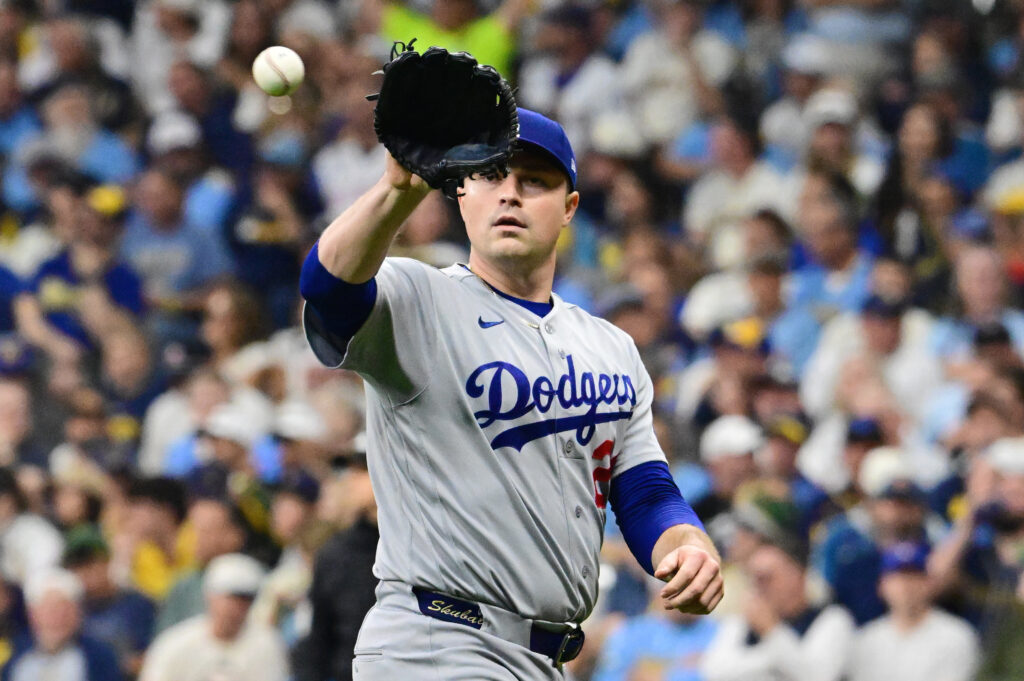
The Los Angeles Dodgers spent the summer trading for Tarik Skubal with one clear purpose: to complete a three-peat.
The two-time American League Cy Young Award winner arrived from Detroit in exchange for a package that included top prospects Zyhir Hope and River Ryan, along with Brady Smith, giving the rotation an elite left-hander for the stretch run and beyond.
After the Milwaukee Brewers swept the Dodgers in the National League Championship Series, that goal is gone, and Skubal is officially a free agent.
In the immediate aftermath of Thursday night’s elimination at Dodger Stadium, Skubal offered little insight into where he might pitch next.
“I’m not going to comment on my future really at all,” Skubal said. “Today sucks, you know, and that’s kind of where my head’s at.”
The brevity was understandable.
A season that began with elbow surgery in Detroit and included a midsummer trade still produced a 12-7 record, a 2.72 ERA and 186 strikeouts across 158⅔ innings. In the postseason he posted a 2.45 ERA over 11 innings in two starts. None of it was enough to reach the World Series.
From the Dodgers’ perspective, the rental experiment ends with a difficult calculation. The organization already carries one of baseball’s highest payrolls and returns a rotation featuring Tyler Glasnow, Blake Snell and Yoshinobu Yamamoto, with Shohei Ohtani expected to resume pitching.
Re-signing Skubal would require the kind of long-term commitment that has historically surpassed the record pitcher deal Yamamoto received, yet the club has a track record of allowing high-profile deadline acquisitions to leave once the season ends.
Past examples such as Max Scherzer and others illustrate that even championship-caliber talent is not automatically retained when the price and roster fit no longer align.
The broader labor landscape adds another layer. With the collective bargaining agreement set to expire and ownership pushing toward a salary cap, the market for a pitcher of Skubal’s caliber remains uncertain.
Some executives expect he could land a deal before any potential lockout freezes activity; others believe teams may wait to see the new economic rules.
Either way, the Dodgers must decide whether the cost of keeping him outweighs the value of the prospects they already surrendered, or whether the existing rotation and remaining financial flexibility are better directed elsewhere.
Skubal’s time in Los Angeles was brief and ultimately unsatisfying in the standings. For a franchise that has spent freely to stay in contention year after year, the question is no longer whether they can afford him.
It is whether they still view him as essential to the next championship push. The answer will shape the winter, but on the night the season ended, Skubal made clear that the future could wait.