
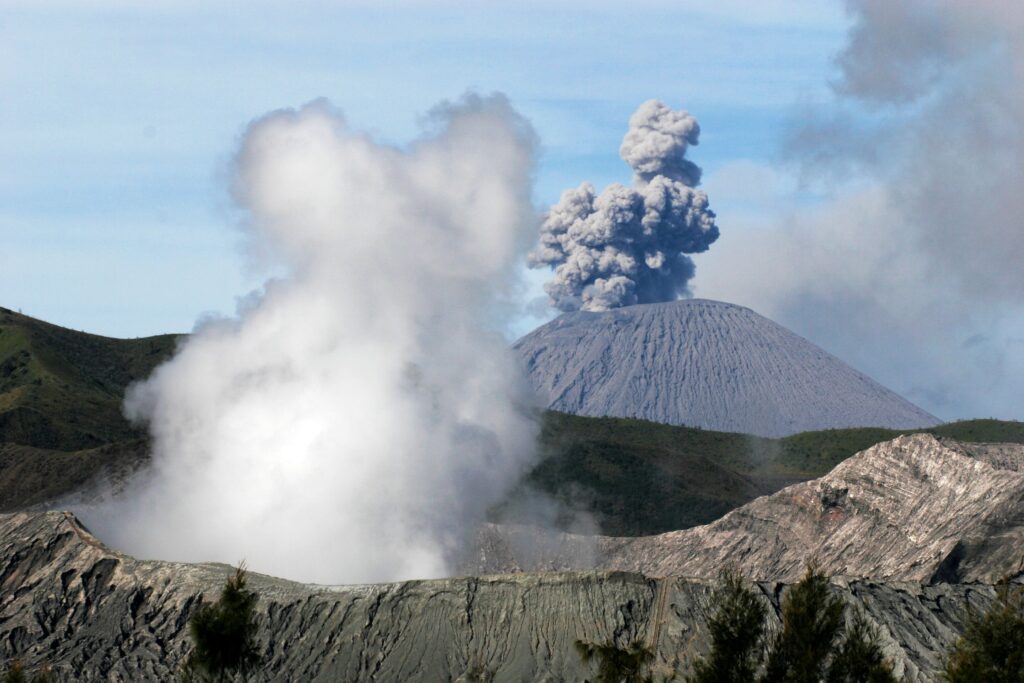
In the early hours of this past Saturday, Indonesia’s Mount Merapi unleashed a series of powerful eruptions, sending streams of glowing molten rock cascading down its slopes.
According to local volcanologists, the volcano released incandescent lava on five separate occasions, with the fiery material traveling as far as 1.9 kilometers along the Krasak River on the mountain’s western side.
Rising to 2,968 meters, Merapi stands as one of the most restless volcanoes in the archipelago, straddling the boundary between the Special Region of Yogyakarta and Central Java province. This latest burst of activity fits into an ongoing pattern of effusive eruptions, where the mountain’s active lava dome repeatedly builds up and then collapses, feeding fresh flows of lava.
Officials have maintained the volcano at Alert Level III—known as “Standby”—within Indonesia’s four-level warning scale, signaling sustained but not immediately catastrophic unrest.
The Center for Volcanology and Geological Hazard Mitigation (PVMBG) has been tracking increased seismic signals beneath the peak, which point to a steady supply of magma rising from deeper within the Earth.
Over recent weeks, similar lava avalanches and sporadic pyroclastic flows—fast-moving currents of hot gas, ash, and rock—have been observed, mainly channeling down riverbeds like the Krasak, Boyong, and Sat/Putih.
In response, authorities are strongly advising residents, hikers, and tourists to steer clear of exclusion zones that stretch between three and seven kilometers from the summit, depending on the direction.
Communities settled along the valleys draining from Merapi have also been put on notice to watch for sudden lava surges, dense pyroclastic currents, or lahars—destructive mudflows that can form when heavy rains mix with volcanic debris.
Thankfully, Saturday’s events caused no immediate injuries, fatalities, or destruction to surrounding villages. Disaster management teams remain on high alert, continuously observing the mountain and ready to issue evacuation orders if conditions worsen. Residents are encouraged to heed all official communications for their safety.
Situated roughly 30 kilometers north of the city of Yogyakarta, Merapi looms over a heavily populated landscape, making it one of the most intensively studied volcanoes on the planet.
It has held its current alert status since 2020, as scientists keep a close eye on the persistent growth and instability of the summit dome. While the volcano’s frequent activity poses ongoing challenges, the combination of advanced monitoring and public preparedness helps mitigate risks to those living in its shadow.
This latest display serves as a vivid reminder of the dynamic forces shaping Indonesia’s geology and the importance of respecting nature’s power in one of the world’s most volcanically active regions.