
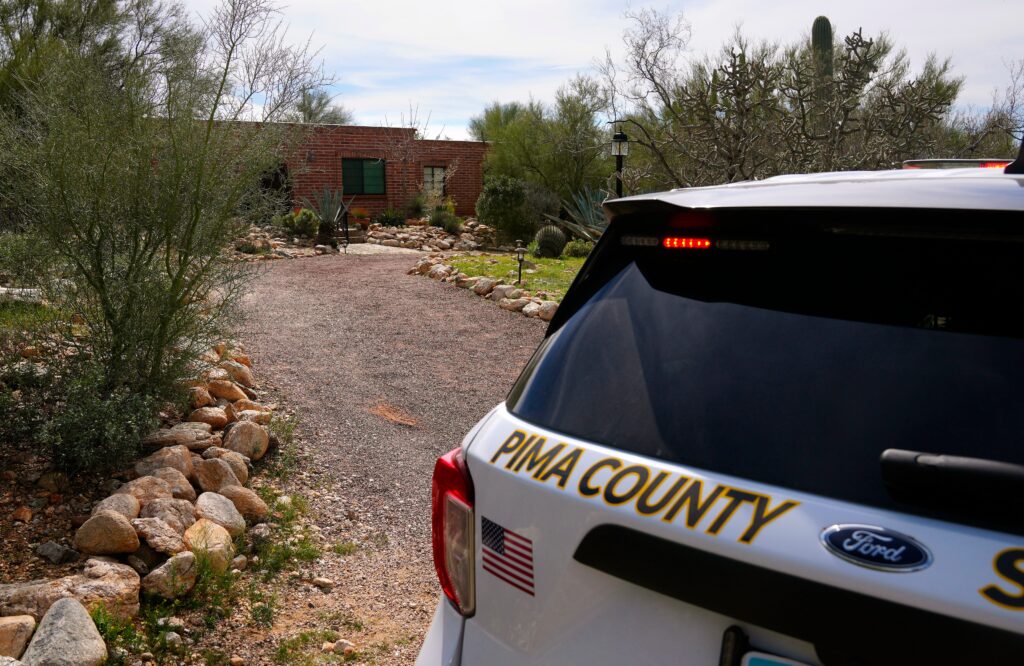
The disappearance of Nancy Guthrie has left many people questioning which details from the active investigation to trust. In a recent on-camera interview, the leader of the probe into what happened to Savannah Guthrie’s mother offered a clearer picture of the current efforts. Pima County Sheriff Chris Nanos addressed numerous elements of the case that have captured public interest, emphasizing the steady progress being made even without major public announcements.
The conversation took place on July 1, 2026, when Sheriff Nanos spoke with reporters from KOLD News 13. He fielded questions about potential developments in the investigation. While he did not reveal any significant new breakthroughs, the sheriff highlighted the intensive daily work continuing out of view.
“There’s always a lot going on with this case. Every day, our team meets with the FBI. They’re assigned to that task force,” Nanos said. “It’s a task force of probably about 10 to 15 of our team, and the FBI has dedicated workforces to it. But it’s about sitting down at the table and talking about, ‘What do we have working today?’ And a lot of times it’s maybe working with labs across the country on DNA, it may be working with maybe Google or somebody on our videos and what we can do with that. It could be working on a number of pieces.”
This coordinated approach involves multiple agencies collaborating on various leads. Authorities divide responsibilities to maximize efficiency, ensuring no avenue is overlooked in the search for answers.
One topic that has drawn considerable public attention lately involves the ransom notes received in connection with the case. Nanos confirmed that these communications remain under close scrutiny as part of the broader investigative strategy.
“I think there’s been a lot of talk about ransom notes. We’re looking into that, and those are notes that we’ve been pretty consistent about. You know, you divvy up the work, right? We took the DNA. We gave the ransom notes to the FBI. They look at those, and we every day come to the table and share the information and try to work and come up with some ideas on what else we can do to get things going, but it’s, it’s constant. This is every single day. This isn’t ‘Well, we don’t have anything to do.’ No,” he explained.
The sheriff stressed that the investigation maintains a high level of activity, countering any perception that momentum has slowed. Collaboration with federal partners and specialized resources keeps the case moving forward on multiple fronts simultaneously.
Nanos also encouraged members of the public to keep sharing any relevant information they might possess. When asked about the flow of tips, he acknowledged a natural decline since the early stages of the case.
“As you would expect, they have drastically gone down,” Nanos said. “The first few days, we were just inundated with them, which helps. Now we have to catalog them, prioritize them, and look through them. We still get tips day to day, but not the volume, but they’re still coming, and we would never discourage that. Continue with that.”
Over recent months, discussions around forensic testing have featured prominently in updates from law enforcement. In this interview, the sheriff touched on genetic genealogy as an additional tool being employed when direct matches prove elusive. This technique examines familial DNA connections to help identify potential persons of interest through shared genetic markers.
“It’s not unusual that this would go on month after month. It takes that long… especially when you throw in genealogy. Now you’re trying to, ‘Hey, it’s not the bad guy, but this person might be the bad guy’s relative 3 times over, so it’s a cousin or it’s a nephew or it’s a…’” Nanos noted.
The process can extend timelines significantly as experts build out family trees and cross-reference data, but it has proven valuable in resolving other complex investigations.
When pressed further on the ransom notes that have circulated widely in media reports, the sheriff made clear that credible ones receive thorough examination while warning against deceptive actions.
“The FBI takes these notes extremely seriously. They track them down, and if they find it to be fraudulent, they don’t just put it aside. They will arrest you. They have made arrests. I think they made 2 or 3 arrests already from people who, as shameful as it is, are exploiting Nancy Guthrie and the family…. Don’t do it,” Nanos said. “If you send a note, whether it’s fraudulent or otherwise, we’re going to be looking at it very seriously, and you will be arrested. We’re not just dismissing it.”
Such statements underscore the commitment to integrity in handling every piece of incoming information, regardless of its apparent validity.
As the discussion drew to an end, Sheriff Nanos turned his attention to the affected family, expressing ongoing empathy for their situation without prompting. He reaffirmed the dedication of his team to resolving the mystery.
“Our thoughts are still, have been, and will always be with the whole Guthrie family. I can’t imagine, I don’t even want to think about being in that place. Here you are 5 months later, and you still have no answers. The best I could tell the family is that we continue to work this case. We’re not giving up,” he concluded.
This latest interview serves as a reminder that, despite the passage of time, authorities remain actively engaged in pursuing every lead to bring closure to the Guthrie family and the broader community.