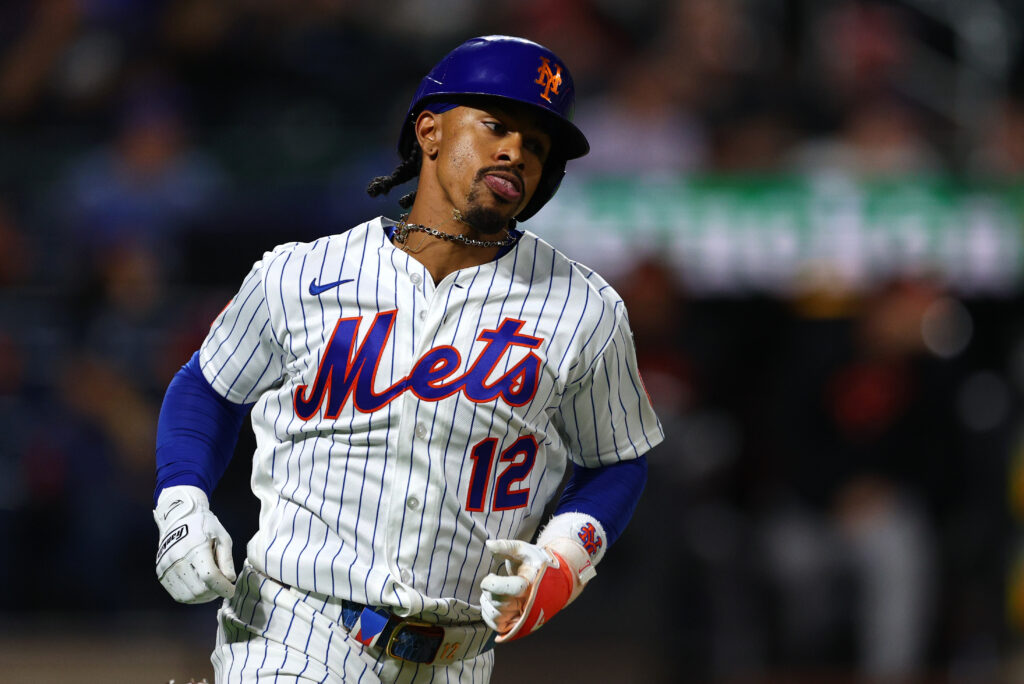
Toronto’s power shortage has put Francisco Lindor’s name on a Blue Jays wish list, but any deal still starts in Queens, where the New York Mets would have to decide whether the face of the franchise is part of the next contender or a contract they would rather move.
Adam Steinmetz of Blue Jays on SI floated Lindor on October 3 as the expensive-star answer to a lineup that finished last in baseball in home runs, isolated power, average exit velocity and hard-hit rate.
Steinmetz’s case is that the shortstop is not washed. A hamate injury flattened the first half — five home runs and an 89 wRC+ — and left him at 21 homers in 105 games, with a .242 BABIP well below his career norm.
After the injury, he tied for seventh in the majors with 16 second-half home runs, passed Kyle Schwarber, Junior Caminero and Hunter Goodman in that span, and reached 300 career homers in late September.
Over the previous four seasons combined he is tied with Manny Machado for 10th in baseball with 116 home runs. Steinmetz’s reason the Mets might listen is simpler than the bat: money.
Lindor turns 33 in 2027 and, in that accounting, is still owed $185 million, at $27 million a year through 2031 and then $5 million annually in deferred payments from 2032 through 2041.
From the Mets’ side, that is the only coherent argument for even taking a call. Lindor has a full no-trade clause and has said he wants to stay. He is also the player Steve Cohen’s front office built the Soto-era roster around, the one who kept producing 30-homer, 100-RBI seasons before the hamate.
Moving him would not be a baseball judgment that he cannot play. It would be a window judgment. The club entered 2026 with championship expectations, fell out of the race and sold at the deadline.
Lindor’s own profile aged in public view: stolen bases fell from 31 to three, his above-average defensive outs at shortstop declined, and his sprint speed slipped from the 49th percentile to the 43rd. Some of that is the injury. Some of it may be the first step of a decline that arrives while the checks still run through his late thirties.
The Mets do not have to deal him. He has insisted the team is not rebuilding and still has a strong core, and a no-trade clause means Toronto cannot simply buy him.
The Blue Jays’ familiarity helps the rumor more than the negotiation: president Mark Shapiro and general manager Ross Atkins were in Cleveland when that organization drafted and developed Lindor, before he was traded to New York.
If Toronto ate the entire remaining obligation, Steinmetz argues the prospect cost could be light. If the Mets kept salary, the return would have to be real.
That is the tension in Flushing. A healthy Lindor is still a middle-of-the-order shortstop.
The contract, the no-trade clause and a missed season are what make a conversation possible, not a conclusion that the Mets are ready to move him.