
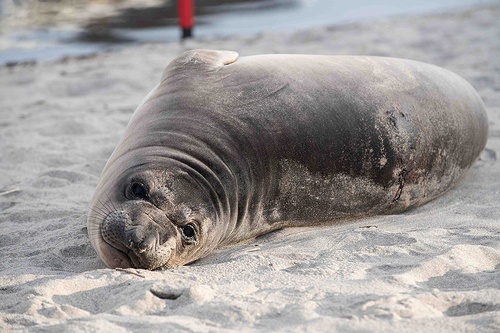
A massive southern elephant seal named Neil has become an unlikely internet sensation in Tasmania, Australia, captivating social media users with his bold antics while raising safety concerns among local authorities.
Weighing around 2,200 pounds (roughly the mass of a small car), the five-year-old male has turned beachside towns into temporary stages for his twice-yearly visits to shore.
Neil returns to the Tasmanian coast where he was born, a behavior typical for elephant seals that come ashore to rest, fast, and molt their fur. After months at sea feeding, he hauls out in southern Tasmania, where his presence has quickly escalated from a local curiosity to a full-blown phenomenon. His social media following reportedly exceeds 1.4 million on platforms like TikTok — significantly larger than Tasmania’s entire human population — largely because he acts like kind of a jerk.
Videos and posts highlight Neil’s playful yet disruptive behavior. He has been known to interact roughly with parked cars, knock over traffic bollards, smash through temporary barriers, and lounge in the middle of roads, effectively halting traffic. One local quipped that it’s “Neil’s world and we’re just living in it.”
Experts explain that such actions are normal for a juvenile male elephant seal. Without peers to spar with, Neil practices dominance behaviors — like rearing up and crashing into objects — that will serve him in future breeding competitions as an adult. Sophia Volzke, an elephant seal researcher at the University of Tasmania, notes that this is typical experimentation for young males.
Neil stands out as the only male elephant seal regularly visiting Tasmania in recent years. While females have occasionally been spotted, they are much smaller during their juvenile stages and cause far less disruption. His mother likely came from sub-Antarctic breeding populations south of Tasmania. Researchers see his appearances as a potential sign of recovering populations in areas where elephant seals were once more common before human impacts reduced their numbers.
Tasmanian officials from the Department of Natural Resources and Environment have publicly urged fans to respect Neil’s space and avoid approaching him. Kris Carlyon highlighted “silly behavior,” including people bringing small children too close for photos, which poses risks to both humans and the animal.
The department has asked the public not to reveal Neil’s current location to prevent crowds from gathering. Officials worry that excessive attention could lead to dangerous encounters, potentially forcing rangers into risky relocation efforts. They reference past cases, such as Freya the walrus in Norway, where intense public interest contributed to a tragic outcome for the animal.
Carlyon described Neil’s fame as a “double-edged sword,” warning that excessive “love” from admirers could ultimately harm him.
Elephant seals can grow dramatically — adult males may reach 16 feet in length and triple Neil’s current weight. However, survival rates for young males are low, with around 90% not reaching breeding age around 10 years old.
For now, Neil continues his routine, sometimes curling up near traffic cones or puddles in spots he favors, even after being gently moved by rangers. Locals express a mix of amusement and inconvenience, viewing him as something of a quirky hometown celebrity and “one of our biggest exports.”
As wildlife and human spaces increasingly overlap, Neil’s story underscores the need for balanced coexistence. Officials hope that giving the young seal room to rest and grow will allow him to continue his visits safely for years to come. In the meantime, his fans will have to admire him from a respectful distance — or through the ever-growing collection of online clips.