
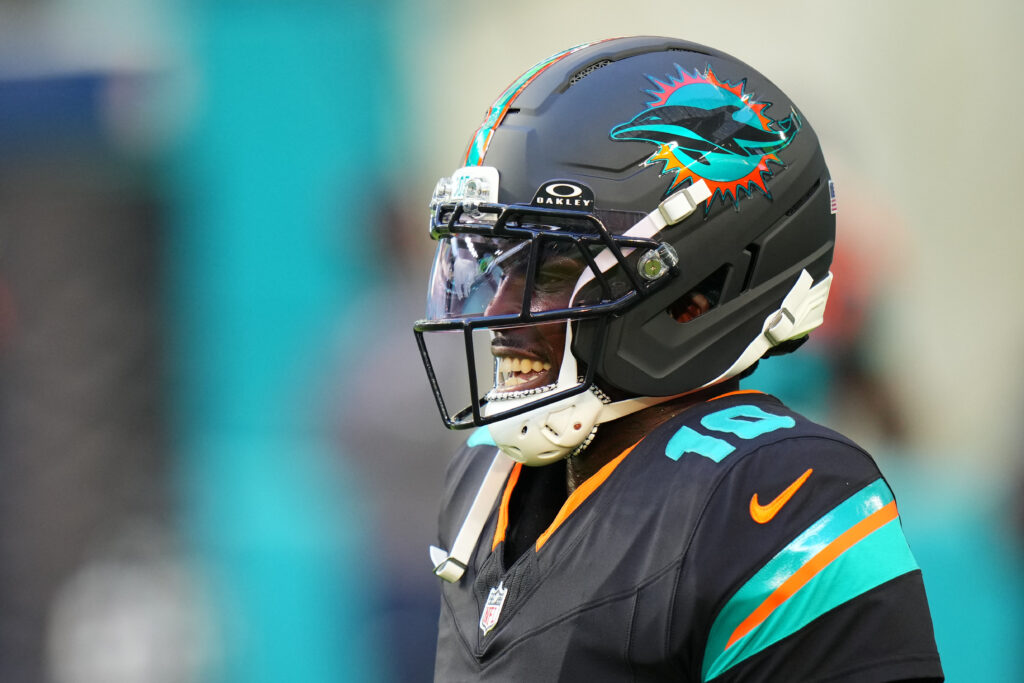
The Miami Dolphins made a major roster decision on Monday by releasing eight-time Pro Bowl wide receiver Tyreek Hill, granting him unrestricted free agency status for the first time during his decade-long NFL journey.
This development had been anticipated for some time leading up to the move. Hill faced a substantial financial obligation from the team in the upcoming year, with nearly $30 million in non-guaranteed salary slated for 2026.
By parting ways, Miami gained considerable salary cap flexibility to reshape its roster.
The announcement sent ripples across the league, as an accomplished veteran like Hill suddenly entering the open market naturally fuels widespread discussion and interest from other teams. Speculation about his next destination emerged almost immediately after the news broke.
Among the possibilities floated, a return to the Kansas City Chiefs stood out as a particularly nostalgic option, given Hill’s earlier success there. Other outlets, including Sports Illustrated, highlighted the Chicago Bears as another conceivable fit, citing their promising direction and the advantages tied to developing a young quarterback.
At first glance, the idea of adding Hill’s renowned speed to Chicago’s growing offensive unit appears intriguing and full of potential upside. His ability to stretch the field could complement emerging talents and create dynamic playmaking opportunities.
However, a closer examination reveals significant reasons why pursuing Hill would not align with the Bears’ best interests at this stage. He is no longer in his prime athletic years; at 31 years old and approaching his 32nd birthday in March, the wideout is dealing with the aftermath of a severe injury.
That setback occurred in September 2025, when Hill suffered a dislocated knee along with a torn ACL and other ligament damage during a game. The injury sidelined him for the remainder of that season and has placed his recovery timeline under intense scrutiny.
Speed and quick burst have always defined Hill’s dominance as a receiver, allowing him to create separation and turn short plays into big gains. A major knee reconstruction at this point in his career raises legitimate concerns about whether he can fully recapture that explosive quality upon returning.
Even assuming a successful rehabilitation process and a potential comeback sometime in 2026, the risk remains high that his performance level could diminish permanently. Investing heavily in a player of advancing age who is rebounding from such damage involves substantial uncertainty and potential long-term drawbacks.
Financial considerations add another layer of complication. While the Dolphins handled the prior contract terms through the release, Hill is unlikely to accept a low-cost deal given his track record and status. Any new agreement would probably demand significant guaranteed money or incentives, even if restructured.
The Bears, meanwhile, operate under ongoing cap constraints and have been actively maneuvering through restructures to generate additional room. Committing premium resources to a 32-year-old receiver emerging from major knee surgery could restrict their ability to address other critical needs.
In particular, bolstering the defensive line stands out as a higher-priority area for Chicago, where reinforcements could provide more immediate and reliable impact. Diverting substantial funds elsewhere might hinder progress in those essential spots.
Ultimately, while Hill’s talent and resume make him an enticing name in free agency, the combination of age, injury history, and cost makes this a matchup the Bears would be wise to pass on in favor of more sustainable roster-building choices.