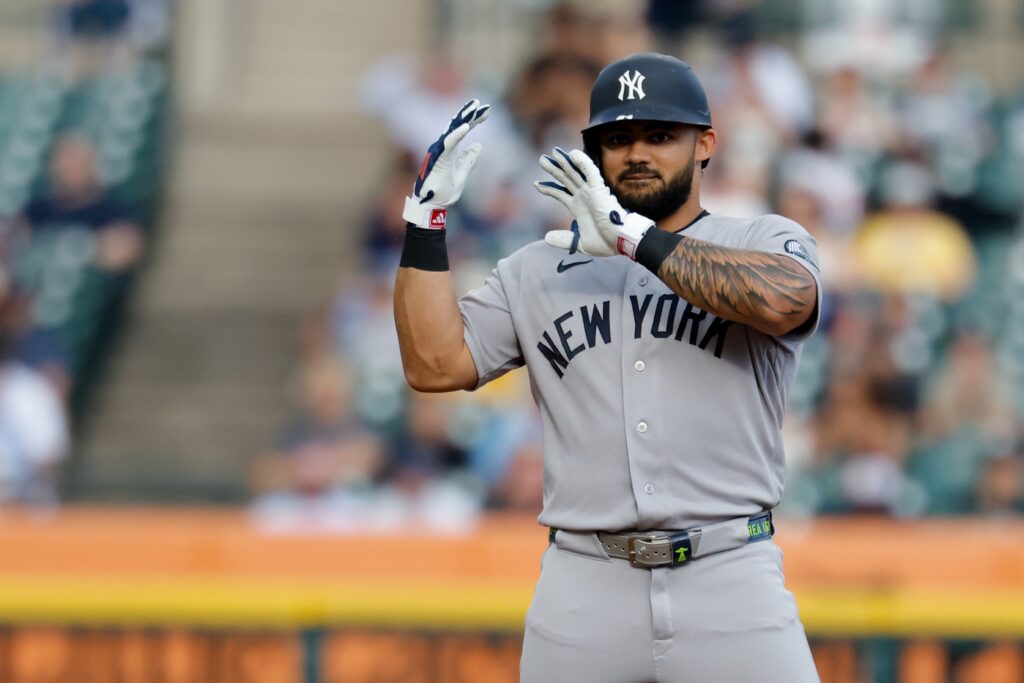
The New York Yankees are entering a critical stretch as the MLB trade deadline approaches, and one of the more challenging decisions they must confront involves their young outfielder Jasson Dominguez.
Once hailed as a potential franchise cornerstone with comparisons to legends like Mickey Mantle, Dominguez now finds himself at a crossroads where his perceived value may not align with the team’s immediate roster needs or long-term outfield picture.
With Aaron Judge firmly entrenched in right field for as long as he chooses to play there and Cody Bellinger recently locked in on a multi-year deal for left field, the Yankees’ outfield alignment leaves limited room for both Dominguez and fellow prospect Spencer Jones.
Center field might offer a path for Jones down the line, but the organization appears reluctant to slot Dominguez there or shift Bellinger back to that position. This logjam suggests that at least one of the young outfielders will likely be moved to address pressing needs elsewhere on the roster.
Matthew Schmidt of Yankees Roundtable has highlighted this emerging reality, noting that the Yankees are poised to learn a difficult lesson regarding Dominguez’s trade market. While the team has long prioritized the 23-year-old, his stock has declined noticeably over recent seasons, making it unlikely that rival clubs will view him as the centerpiece of a blockbuster deal.
Dominguez’s major league performance has been uneven. In the previous year, he struggled significantly in left field defensively, leading to a benching in the second half despite some offensive flashes.
This season has brought more modest results: a batting line around .230/.265/.392 with five home runs and modest production in a limited sample. His overall OPS has actually dipped from the prior year, and defensive concerns persist even as he showcases plus speed, intelligent baserunning, and a strong arm.
What made Dominguez such an exciting prospect initially—elite tools across the board—has not fully translated at the big league level. Advanced metrics reflect challenges, including a very low walk rate and barrel percentage for a player of his athleticism, limiting his extra-base power output.
These factors, combined with ongoing questions about his ideal defensive home, mean opposing teams are unlikely to overpay for him in trade discussions. He could serve effectively as a strong complementary piece in a larger package, but the era of him headlining a deal for a proven star seems to have passed.
This situation reflects broader challenges in player development and roster construction. Many Yankees supporters still hold onto the vision of Dominguez as the dynamic superstar who burst onto the scene, yet the on-field evidence points to a more nuanced reality.
Brian Cashman and the front office will need to weigh these factors carefully over the coming weeks, balancing sentiment with pragmatism as they seek to bolster the team for a postseason push.
Ultimately, the Yankees’ willingness to consider moving Dominguez underscores a hard but necessary evaluation. While his tools still offer intriguing upside, particularly if he can refine his approach and settle into a consistent role, the organization cannot afford to let nostalgia dictate decisions when glaring holes exist elsewhere. How they navigate this will say much about their approach to the deadline and the future shape of the roster.
As the deadline nears, all eyes will be on whether New York can extract meaningful return without parting with core pieces, or if they will hold firm in hopes that Dominguez can still blossom into the player many once envisioned.