The first episode of HBO’s “Hard Knocks” featuring the Seattle Seahawks captured a moment that quickly spread across social media and sports highlights: edge rusher Derick Hall driving offensive lineman Bryce Cabeldue to the ground during a heated exchange at training camp.
The skirmish unfolded during Seattle’s first padded practice, when Cabeldue became involved in a back-and-forth with members of the defense. Hall stepped in and forced the play to the turf, creating one of the episode’s most-watched sequences.
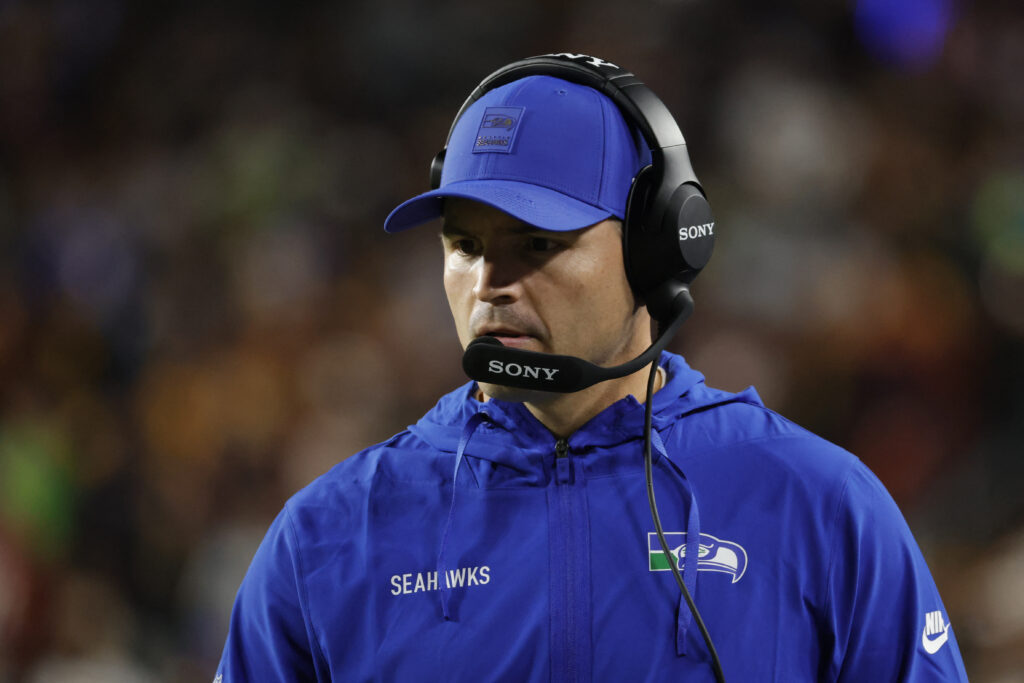
Head coach Mike Macdonald appeared on camera reacting with clear frustration, reminding his players that the fighting was costing the team valuable practice time.
One day after the episode aired, Hall addressed the incident directly with reporters. He made no attempt to downplay what had occurred, acknowledging that the confrontation had crossed a line the Seahawks prefer to avoid.
“I think it’s authentic,” Hall told reporters. “I think it shows who we are as a unit, as a team.”
He explained that competitive practices can bring emotions to the surface, yet the Seahawks place a premium on resolving those moments quickly and completely. “At the end of the day, we all love each other here,” Hall said. “We’re a team, we’re a brotherhood.”
Rather than allowing the dispute to fester, the players involved followed a familiar process once they returned to the locker room.
“We go in the locker room, we hug it out,” Hall added. “‘Hey man, I apologize. That was beyond the line of where we’re trying to go and what we’re trying to get,’ and we move forward.”
Hall described this ability to leave intensity on the field as a genuine strength of the group. “That’s a part that I think is our advantage — it goes no further than out here,” Hall said. “Once it’s done, it’s over with. Everybody moves forward.”
Training-camp scuffles are hardly rare in the NFL, especially once pads come on and offensive and defensive linemen repeatedly collide. Seattle’s concern centered less on the competitiveness itself and more on the interruption of structured work. Macdonald was not asked specifically about Hall’s role during his own August 5 media session, though ESPN’s Brady Henderson reported that the coach indicated “thins have been smoothed over.”
Macdonald offered a broader assessment of the “Hard Knocks” experience. “I thought it was great,” Macdonald said. He praised the production crew’s professionalism and noted that the process had run more smoothly than he initially expected. Most important to him was the sense that his players had not altered their behavior for the cameras. “I’m proud of our guys, because I felt like we’ve been ourselves the whole time,” Macdonald said.
The episode also revealed lighter sides of Hall’s personality, including his interest in customized trucks and his easy rapport with veteran defensive lineman Leonard Williams. For Hall, the series’ value lies in showing both the competitive fire and the underlying camaraderie. The Seahawks can push one another hard enough that tempers flare, then address the problem and resume functioning as teammates.
Hall’s own admission that the takedown went beyond acceptable bounds makes clear the moment was not ideal. What mattered more, in his view, was the response that followed. The next challenge for Seattle will come as camp intensifies, including a scheduled stadium practice at Lumen Field on August 8 that will give younger players another game-like setting before the preseason begins.
The cameras will remain present, but Hall’s message after the viral clip was straightforward: the way the Seahawks handle what happens after the whistle may ultimately say as much about the team as the confrontation itself.