
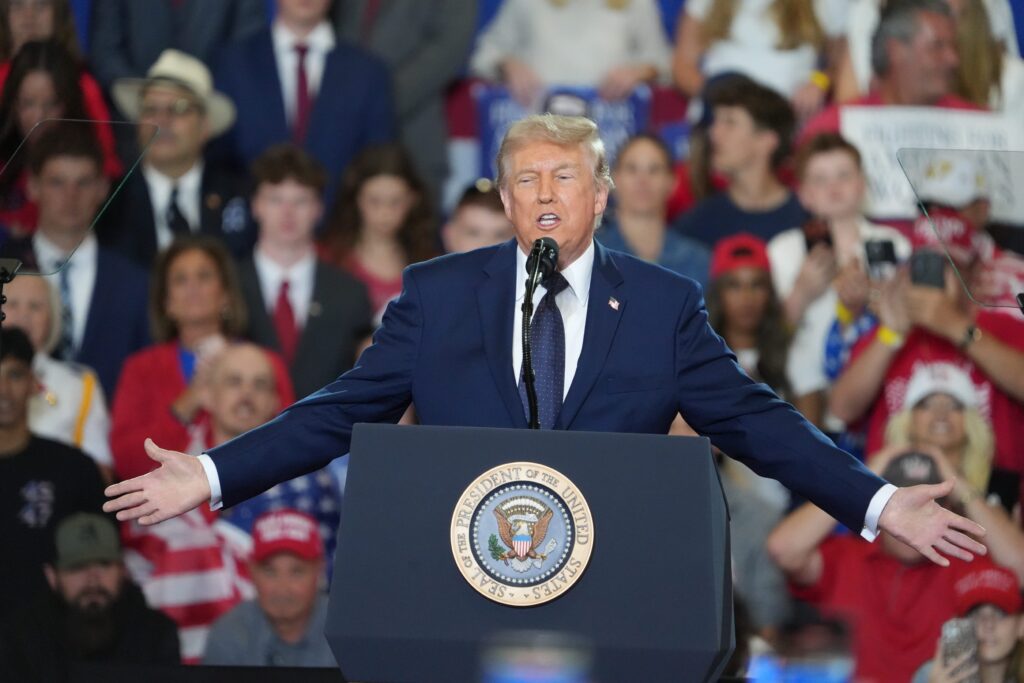
In a recent Truth Social post, United States President Donald Trump issued a stark warning about Democratic intentions regarding the Senate filibuster. Sharing a Politico report on House Democratic caucus leaders pushing to overhaul the Supreme Court and eliminate the 60-vote filibuster threshold, Trump declared, “They do this, and the Republican Party is DEAD!”
The post highlights ongoing tensions in Washington over voting rights, election integrity, and institutional rules. It comes amid debates sparked by recent Supreme Court rulings that narrowed aspects of the 1965 Voting Rights Act, prompting progressive and minority caucus leaders in the House to call for structural changes, including court expansion, term limits for justices, and scrapping the filibuster.
The 1965 Voting Rights Act stands as one of the landmark achievements of the Civil Rights Movement. Signed by President Lyndon B. Johnson, it aimed to overcome barriers like literacy tests, poll taxes, and other discriminatory practices that had long suppressed Black voter participation, particularly in the South.
The Act built on the 15th Amendment, empowering federal oversight of voting practices in jurisdictions with histories of discrimination.
Passage of the Voting Rights Act, like the Civil Rights Act of 1964 before it, required overcoming significant Senate resistance. Southern Democrats, often referred to as Dixiecrats, mounted determined filibusters against civil rights legislation throughout the mid-20th century.
These efforts leveraged the Senate’s unlimited debate rules to delay or block bills. The filibuster against the 1964 Civil Rights Act lasted over 60 working days—the longest in Senate history at the time—before a bipartisan coalition mustered the votes for cloture (then requiring two-thirds support).
For the Voting Rights Act in 1965, similar dynamics played out. After the brutal attacks on peaceful marchers in Selma, Alabama, including the beating of John Lewis and others on the Edmund Pettus Bridge, public pressure mounted. The Senate debated the bill for weeks amid filibuster threats. Ultimately, it passed with strong bipartisan support: Democrats 47-16 and Republicans 30-2 in the Senate, reflecting a coalition that overcame sectional opposition.
These battles cemented the filibuster’s reputation as a tool that could both protect minority rights in the Senate and, at times, obstruct broader civil rights progress. Over decades, the cloture threshold evolved from two-thirds to three-fifths (60 votes) in 1975, making it a central feature of modern Senate procedure.
Trump’s post frames Democratic interest in eliminating the filibuster as an existential threat to Republican electoral prospects.
In broader commentary, he has repeatedly argued that without the filibuster’s protection, Democrats—upon regaining power—would rapidly advance priorities like adding new states, expanding the Supreme Court, altering the Electoral College, and reshaping election laws in ways that favor their side permanently. He has urged Senate Republicans to proactively address election integrity measures, such as the SAVE America Act, which emphasizes voter ID and proof of citizenship.
Critics of this view point to the filibuster’s historical use by both parties and argue that its preservation maintains deliberation and compromise. Supporters of reform, particularly on the left in response to recent court decisions on redistricting and voting rights enforcement, see it as an outdated barrier to democratic responsiveness.
Trump’s intervention underscores deep partisan divides. With Republicans holding majorities but facing internal debates over strategy—particularly around Senate Majority Leader John Thune and the filibuster—his call to action reflects a belief that institutional rules must adapt to secure fair elections and prevent what he describes as long-term Democratic dominance.
The debate over the filibuster is unlikely to fade. It touches on fundamental questions of Senate power, minority protections, and how the nation balances majority rule with safeguards against hasty or majoritarian overreach. As House Democrats signal ambitions for change and Trump rallies opposition, the 1965 Voting Rights Act’s legacy continues to inform today’s fights over voting access, election security, and the rules governing the upper chamber. Whether the filibuster endures or evolves may shape American politics for years to come.