
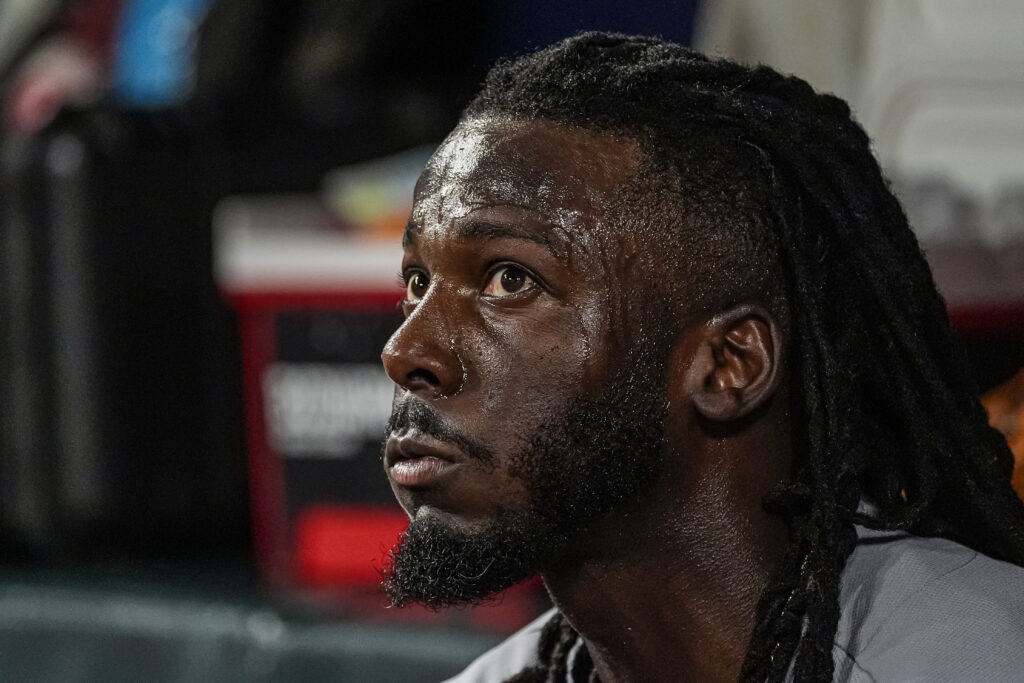
The only reason Elly De La Cruz’s name is floating anywhere near the New York Yankees this winter is because the Cincinnati Reds have not yet convinced him to stay.
In a new Bleacher Report offseason guide, Kerry Miller named the Reds shortstop as a potential trade target for the Yankees, and while he qualified his statement by saying that a deal is unlikely, he said De La Cruz is an “at least make them say no” candidate.
Miller also said the only reason New York should bother asking is the “never-ending reports of De La Cruz refusing to even engage in long-term extension talks with the Reds.”
That is a Reds problem, not a Yankees opportunity. Cincinnati still controls the 24-year-old switch-hitter through 2029, which is why Miller said any deal would hand the buyer at least three years of a superstar shortstop.
Those years are the franchise’s most valuable asset. A player who can hit for power, steal bases, and cover ground at shortstop from a 6-foot-6 frame is the kind of centerpiece a smaller-market club is supposed to build around, not the kind it moves because a larger club just lost in the ALDS and has a middle-infield logjam.
Miller was also blunt about the price. To “even raise an eyebrow from Cincinnati’s front office,” the Yankees would need to start with shortstop George Lombard Jr., add outfielder Spencer Jones, and throw in at least one of the arms competing for the back of their 2027 rotation.
That is not a polite inquiry. It is the floor for a conversation the Reds have no obligation to take. Lombard is the kind of near-ready shortstop a rebuilding club would want. Jones is a big-league outfielder with everyday upside.
A controllable starter is the piece Cincinnati’s rotation can always use.
Even that package does not replace what De La Cruz already is in the present tense.
The extension stalemate is real, and it is the part of this story Cincinnati cannot ignore. As long as De La Cruz will not engage on a long-term deal, national writers will keep filing him under “available if the offer is absurd.”
Availability in a column is not the same thing as availability on the trade wire.
The Reds do not need to win a winter of speculation. They need either a contract that ends the reports or a willingness to live with the noise until the player decides he wants to talk.
Trading him to fix New York’s infield would be the club choosing someone else’s roster problem over its own best player. Miller’s piece is a reminder of how loud the outside interest can get.
It is not a reason for Cincinnati to seriously consider any offers. That being said, the Reds should do their due diligence, just like the other 29 MLB teams.