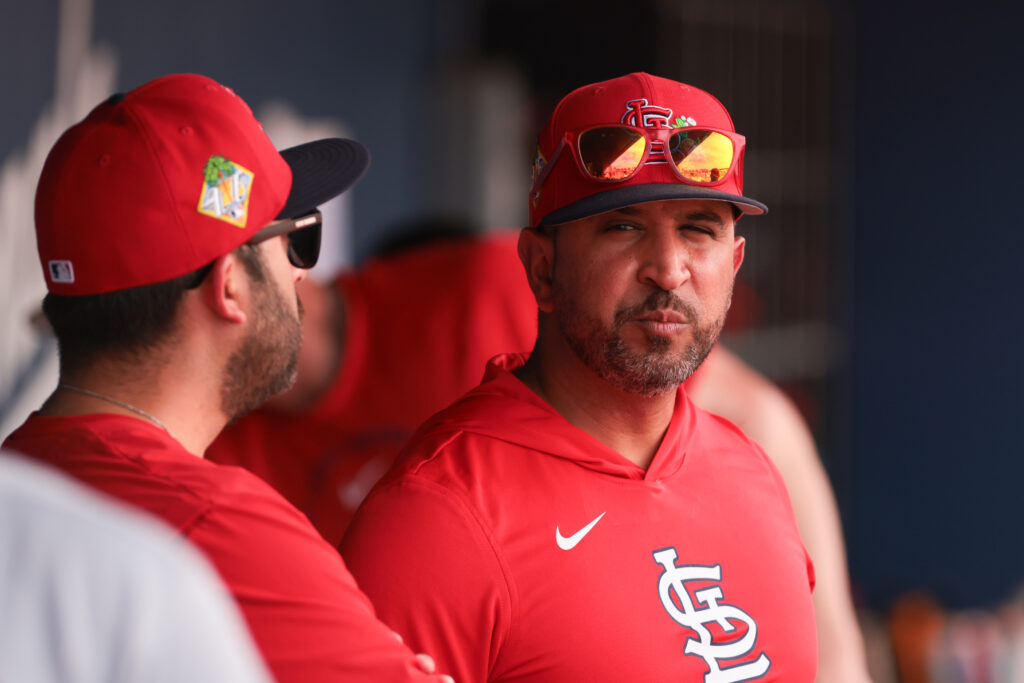
The St. Louis Cardinals are staring at a sharp raise for Alec Burleson.
MLB Trade Rumors’ Matt Swartz model projects the first baseman at an $8.3 million salary for 2027, more than double the $3.3 million he earned in 2026 after avoiding arbitration in January.
That figure, published October 2, is the highest arbitration projection on the Cardinals’ nine-player class.
Andre Pallante is next at $7.5 million, followed by Iván Herrera ($5.5 million) and Jordan Walker ($5.1 million). Nolan Gorman ($3.4 million), Matthew Liberatore ($3.6 million), Masyn Winn ($3.3 million), Kyle Leahy ($2.8 million), and Pedro Pagés ($1.3 million) round out a group that could approach $41 million if the club tenders everyone.
Swartz’s algorithm estimates salaries from playing time, role, and performance while adjusting for inflation. MLBTR stresses the numbers are a payroll guide, not a prediction of what any filing will settle at.
Burleson earned the jump. In his first arbitration year he played 160 games, started 150, and hit .279/.343/.473 with 26 home runs, 37 doubles, and 116 RBIs, good for a .816 OPS and about 3.7 WAR.
The counting stats matter in arbitration. A year earlier he had hit .290/.342/.459 with 18 homers and 69 RBIs in 139 games. Rate production was nearly identical; volume and run production were not.
Service time of 4.029 years puts him in his second arbitration season, with one more trip through the process after 2027 before free agency following the 2028 season.
A non-tender is not a realistic outcome. Burleson is a regular who just led the club in RBIs and was in the league’s RBI conversation late in the year.
The live questions are whether St. Louis settles near $8.3 million, files and exchanges numbers, or tries to buy out the remaining control.
In late September, he told the St. Louis Post-Dispatch he would be “all ears” on an extension and was “100%” open to staying.
MLBTR has framed the remaining two arbitration years in the $15–18 million range and floated a longer deal, something in the neighborhood of five years and $75 million, only if the club believes the bat holds up.
There is no clear first-base successor pressing him.
For a roster that has shed larger contracts, $8.3 million is manageable, not trivial.
It is the price of a bat-first first baseman who has now produced two straight seasons around an .800 OPS, with the next raise still a year away.