
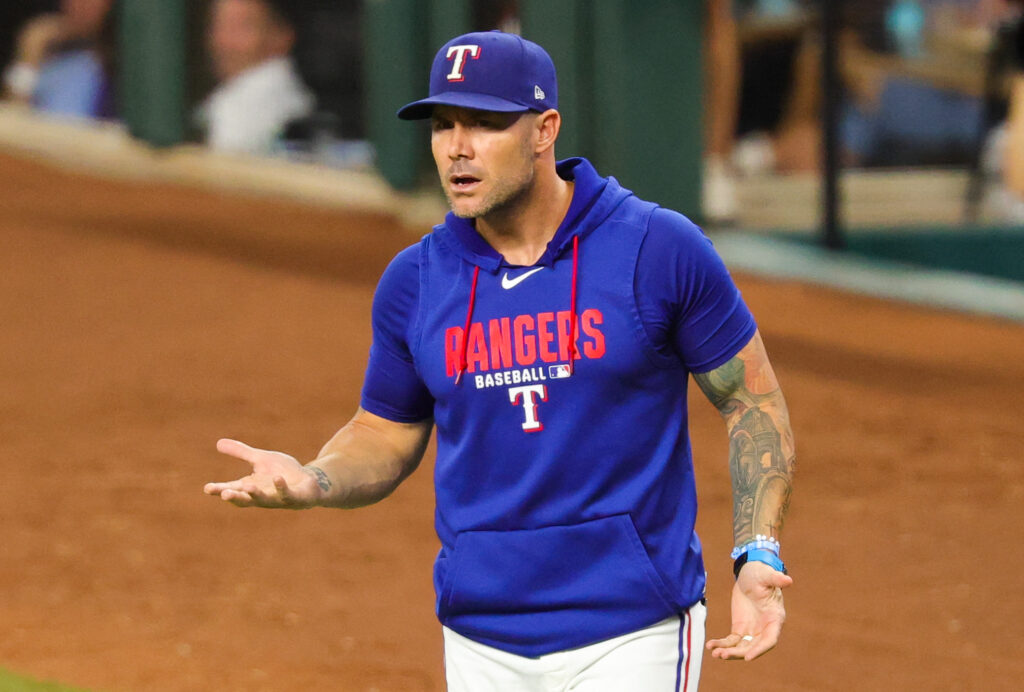
Kyle Higashioka is set to enter free agency after the Texas Rangers declined the mutual option on his contract, opting instead to pay him a $1 million buyout rather than exercise the $7 million salary for 2027.
The move closes out the two-year, $13.5 million deal he signed ahead of the 2025 season and sends the 36-year-old catcher back onto the open market heading into his age-37 campaign.
Over the life of that contract, Higashioka posted a .233/.296/.391 slash line with 18 home runs in 513 plate appearances.
The numbers were never going to turn heads, yet they represented steady, usable production from a part-time backstop who spent most of his time sharing duties rather than carrying a full workload.
Teams have long valued him more for his work behind the plate than for his bat.
He carries a solid reputation as a receiver who handles pitching staffs well and manages game flow effectively, even if his arm has remained below average when it comes to controlling the running game.
His 2026 season ended prematurely.
After July 20, he did not appear in another game because of a flexor strain in his forearm, an injury that limited his availability down the stretch and likely factored into the Rangers’ decision to move on.
With neither side showing much interest in continuing the partnership at the higher figure, the buyout became the cleanest outcome for both parties.
Higashioka’s next contract is widely expected to be a one-year agreement. At his age, multi-year commitments are uncommon for catchers whose value rests primarily on defense and reliability rather than offensive upside.
Several clubs could view him as a useful backup or tandem option.
The Phillies, Yankees, Diamondbacks, Cubs, Brewers, Marlins, Reds, Red Sox, Twins and Tigers have all been mentioned as teams that may look for experienced catching depth this winter.
The Rangers themselves will also need to address the position. Elias Díaz is headed for free agency as well, which leaves Danny Jansen and Logan O’Hoppe as the remaining internal options—an underwhelming pairing that may not inspire much confidence without an external addition.
For Higashioka, the free-agent process will likely be straightforward. He has carved out a clear niche as a professional, low-maintenance catcher who can step in, handle pitchers, and provide occasional power without demanding everyday at-bats.
That profile tends to find a home even late in a career, particularly on clubs seeking a veteran presence to stabilize the position or spell a younger starter.
Whether he returns to a familiar environment or lands with a new organization, his track record suggests he will remain a viable short-term solution rather than a long-term building block.