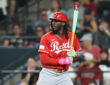

The Atlanta Braves entered last offseason in search of shortstop stability and responded by handing Ha-Seong Kim a one-year, $20 million deal.
At the time, the move made a certain amount of sense.
Kim had established himself as a capable defender with occasional offensive value during his earlier years in the majors, and Atlanta needed someone to hold down the position while the rest of the roster pursued another deep run.
The team ultimately won 94 games and claimed the National League East, so the contract did not derail the larger season. Still, the individual return on that investment proved almost nonexistent.
Kim appeared in just 51 games and recorded only 129 at-bats. He hit .116 with no home runs and only two extra-base hits, finishing with an OPS+ of 2 and a negative WAR.
There were stretches when he looked completely overmatched at the plate, and even accounting for possible injury issues, the production fell well below any reasonable expectation for a player earning that salary.
What had been framed as a short-term bridge became an expensive reminder of how quickly a veteran can lose his footing.
Across his six major-league seasons, Kim has compiled a more respectable body of work. In 639 games he has hit .234 with 52 home runs, 226 RBIs, and an OPS+ of 91.
Those career numbers suggest the 2026 campaign was an extreme outlier rather than a permanent collapse, yet the gap between that history and last season’s results was wide enough that Atlanta has little incentive to bring him back.
With Kim now officially on the open market, the Braves can move on without lingering financial obligations tied to last year’s outcome.
For Kim, free agency arrives under awkward circumstances.
His defensive reputation and prior track record may still interest clubs looking for a low-cost depth option or a minor-league flyer, but the most recent numbers make a guaranteed major-league contract unlikely in the near term.
Other organizations will have the chance to evaluate whether the 2026 season was an injury-influenced aberration or the start of a steeper decline.
Either way, the Braves appear content to let someone else absorb that uncertainty after dedicating $20 million to a campaign that produced almost no positive contribution.