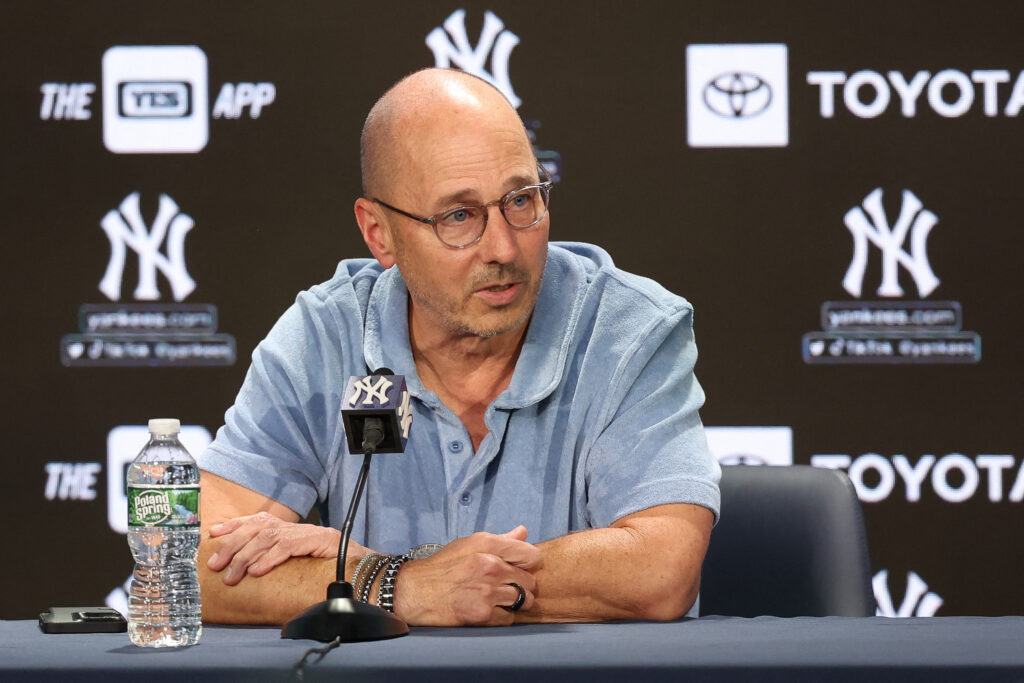
Brian Cashman, the longest-tenured general manager in Major League Baseball, announced during a conference call with reporters that he and the New York Yankees have agreed on a new contract, with only final language remaining to be settled.
“We’re locked and loaded,” Cashman said, signaling continuity at the top of the baseball operations department just days after the club’s season ended in a three-game ALDS sweep by the Tampa Bay Rays.
The news arrives against a backdrop of deep and sustained frustration among Yankees fans, many of whom view the decision as further evidence that the organization is unwilling to confront the structural issues that have produced one early October exit after another.
Cashman has held the GM post since 1998, a span that includes four World Series titles and an unbroken string of winning seasons.
Those accomplishments, once the foundation of his reputation, have grown increasingly distant for a fan base that measures success almost exclusively by championships.
The Yankees have not won a World Series since 2009, a 17-year drought that feels especially long given the club’s consistently high payroll and the presence of Aaron Judge as the face of the franchise.
For many supporters, regular-season competence and occasional deep playoff runs no longer register as adequate returns.
The scale of the discontent has been quantified in multiple recent polls.
A New York Post survey of more than 11,000 respondents found that 73 percent favored Cashman’s removal, while a June poll on the fan site Pinstripe Alley showed disapproval at 91 percent.
Similar sentiment has appeared in stadium reactions, radio-call-in shows, and social media, where fans frequently describe the front office as resistant to meaningful change.
Criticisms typically center on roster construction, the retention of manager Aaron Boone (himself the target of even higher disapproval numbers), and a perceived reluctance to address deficiencies in contact hitting, defensive consistency, and postseason execution.
The phrase “nothing changes” has become a common refrain after successive seasons that end short of a title.
That frustration surfaced immediately in responses to the contract announcement.
Fans questioned how an organization that had just been swept could be described as locked and loaded, with some declaring the decision the definition of insanity given the high payroll and recurring shortfalls.
Others suggested that young players might prefer to be elsewhere rather than remain under the same leadership. Owner Hal Steinbrenner has long shown loyalty to Cashman, and industry observers have treated his return as the expected outcome.
Still, the gap between the front office’s confidence and the fan base’s impatience remains wide. With the contract nearly finalized, the burden shifts to Cashman to demonstrate that continuity can produce the championship the Yankees and their supporters have gone so long without.