
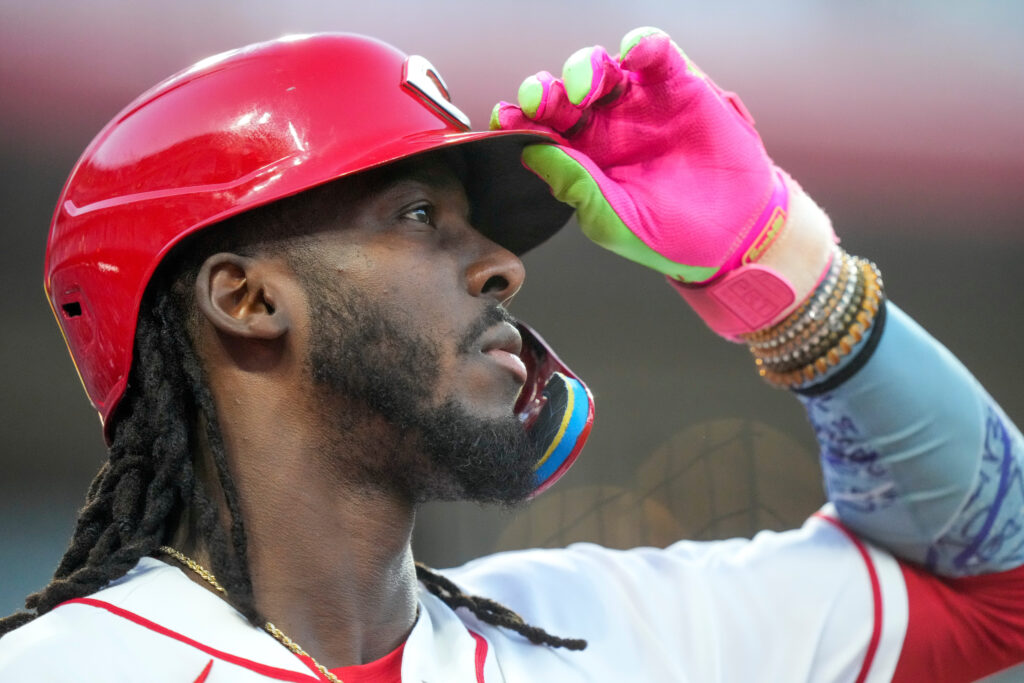
The Cincinnati Reds spent another season watching Elly De La Cruz blossom into one of baseball’s most dynamic young stars, only to see the team around him fall short of the expectations that accompanied his emergence.
The 24-year-old shortstop delivered a full-fledged 30-30 campaign and continued to flash the rare combination of power, speed, and defensive tools that made him a franchise cornerstone almost from the moment he arrived.
Yet Cincinnati’s broader roster never quite matched that individual brilliance, leaving the organization to confront a familiar and uncomfortable question: how long can it realistically build around a player who has already turned down a historic extension offer and appears intent on testing free agency once he becomes eligible after the 2029 season?
Christopher Kline of FanSided recently framed the issue in terms that force a Reds-centric calculation.
In outlining a series of ambitious offseason ideas for the Boston Red Sox, he argued that Cincinnati would be wise to consider moving De La Cruz now, at the absolute peak of his trade value, rather than allowing the remaining years of team control to erode the eventual return.
The specific package Kline sketched would send Boston’s No. 1 prospect, shortstop Franklin Arias, along with left-hander Jake Bennett and middle-infield prospect Henry Godbout to the Reds in exchange for De La Cruz.
From Cincinnati’s perspective, the proposal is less about Boston’s need to bench Trevor Story and more about whether the Reds can extract enough immediate and long-term talent to justify parting with their most marketable player.
Arias, ranked among the top prospects in the sport, would step in as an everyday shortstop with the kind of pedigree the Reds have rarely been able to acquire through trade.
Bennett would slot into a rotation already anchored by Hunter Greene, Chase Burns, and Andrew Abbott, adding a young arm who has shown the durability and stuff to contribute sooner rather than later.
Godbout, meanwhile, offers middle-infield depth that could reach the majors quickly and pair with Arias for years.
The package does not solve every problem on the roster, but it would inject controllable talent at positions of need while the Reds still possess the leverage of three remaining seasons of De La Cruz’s services.
The counterargument in Cincinnati remains straightforward. De La Cruz is still only 24, under team control through 2029, and capable of anchoring a lineup that the front office hopes can finally support a sustained run.
Trading him would represent a concession that the current group cannot contend before his free agency and that the organization cannot, or will not, meet the salary demands that will follow.
Yet the risk of holding him is equally real: arbitration salaries will rise sharply, extension talks have already stalled, and the market for a 27-year-old shortstop of his caliber in 2030 is likely to exceed what the Reds have historically been willing or able to spend.
The decision is not merely about one package from Boston; it is about whether Cincinnati’s best path forward is to maximize the present value of its brightest star or to continue betting that the pieces around him will eventually arrive in time.