
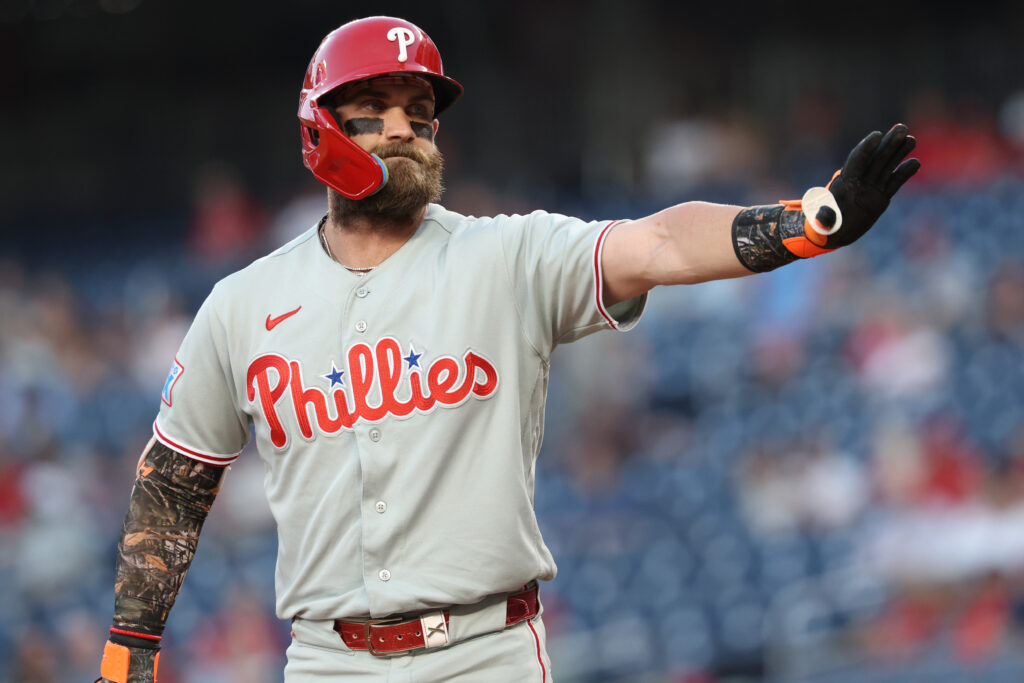
The Philadelphia Phillies are staring at another winter that feels more like a trap than an opening.
An early exit against the Atlanta Braves in the Wild Card Series, after two straight years that at least reached the Division Series, has made the limits of the current core hard to ignore.
The faces of that group remain Bryce Harper and Kyle Schwarber, still productive, still expensive, and increasingly hard to build around if the club wants to refresh a roster that has stopped advancing.
Matthew Schmidt of Phillies Roundtable framed the bind plainly: Philadelphia may want to reshuffle, but the two players most likely to bring something back can refuse to leave.
Harper was granted a full no-trade clause when he signed his 13-year, $330 million deal in March 2019. Schwarber, after re-signing on a five-year, $150 million contract, holds veto power under the 10-and-5 rule.
In Schmidt’s telling, that protection turns the only realistic trade chips into players who can pick their destinations, and at 33 neither man has much reason to be generous about where he spends the last prime years of his career.
Harper’s clause is the sharper problem. His contract runs through 2031, with salaries of $27.5 million through 2028 and $23.5 million over the final three seasons. That is not an unmovable number by modern standards, but it is attached to a player who negotiated specifically for the right to stay put.
He declined opt-outs and accepted a long guarantee in exchange for control. Any club that calls will not be dealing only with Dave Dombrowski’s front office. It will also need Harper’s consent, and a player who has already said he wanted Philadelphia to be home is under no obligation to treat a trade as a favor.
The rest of the payroll only tightens the knot. Trea Turner, J.T. Realmuto, and Aaron Nola are widely viewed as difficult to move on their present deals.
Cristopher Sánchez and Jesús Luzardo are the kind of pitchers a contender does not shop.
With ownership watching the ledger more closely, the Phillies do not have an easy path to free-agent additions that would change the ceiling. That leaves Harper, and to a lesser extent Schwarber, as the names that could reset the timeline. Both, though, can say no.
The usual counterargument is that only contenders would pursue either player, so the list of suitors and the list of places Harper would accept might overlap. That is only partly reassuring.
A contender is not the same thing as a preferred home, and Harper has spent years making clear that he did not want to live inside trade rumors again. Philadelphia can explore the market. It cannot force the deal.
If the organization decides the core has gone as far as it can, the first negotiation of the winter may not be with another general manager. It may be with Harper himself, and the clause he insisted on seven years ago.