
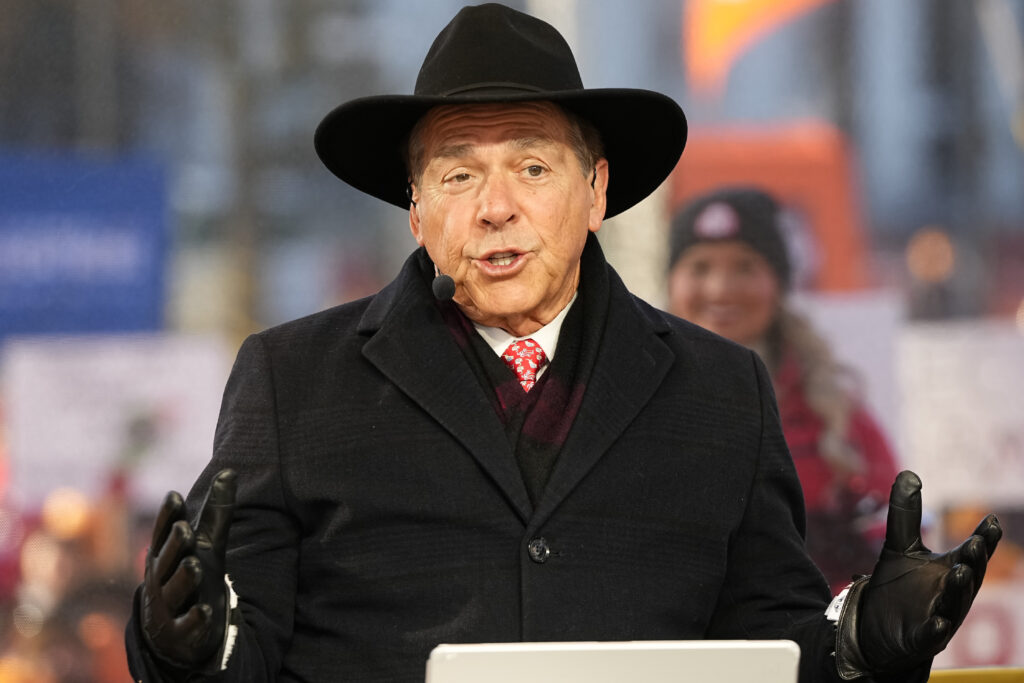
Nick Saban used a national television platform Saturday to argue that the College Football Playoff still has a fundamental problem with how it judges teams, saying the current emphasis on raw win totals risks pushing programs away from the kind of high-profile games players and fans actually want.
The former Alabama coach made the comments on ESPN’s “College GameDay” from the Texas campus, hours before No. 4 Texas stunned No. 1 Ohio State 24-23 in a game that itself illustrated the point he was trying to make.
Saban said the sport has created incentives that can make athletic departments think twice about scheduling those kinds of matchups.
“Players love to play in big games,” Saban said. “That’s what great competitors love to do. Fans love to see big games.”
He then laid out the concern that has followed the playoff since it expanded to 12 teams. In his view, too much of the conversation now revolves around protecting a record rather than testing a roster.
“I think what we’ve created now is a system of how many games you win helps you get into playoffs, and the playoffs become the barometer for the success of your program,” Saban said.
That led him to the line that immediately circulated across college football.
“We need a better metric to actually evaluate quality wins and quality losses,” Saban said. “Some losses are better than some wins.”
Saban pointed to Texas as the clearest recent example. Last season the Longhorns opened with a 14-7 loss at Ohio State. He asked whether that result should be viewed more harshly than a comfortable win over Texas State.
“Like last year, Texas lost to Ohio State. Is that better than them beating Texas State?” Saban said. “I think there’s got to be some metric with the committee that evaluates those things a little better, so we get the best teams in the playoff.”
Desmond Howard, sitting a few seats away, agreed with the larger idea. The Heisman Trophy winner said elite players have always wanted those tests.
“Great players want to play in big games,” Howard said. “There’s no doubt about that.”
Howard recalled his own Michigan teams regularly lining up against UCLA, Notre Dame and Miami.
“To be the best, you have to beat the best,” he said. He also dismissed the idea of ducking a tough opponent out of fear a loss would wreck a playoff resume.
“I don’t understand this whole philosophy of, ‘Well, we may not want to play this game because if we lose,’” Howard said. “That was not even into my vernacular back then.”
Saban added that those games do more than fill a Saturday.
“And it makes you better as a player,” he said. “Great competition makes you better.”
The College Football Playoff remains a 12-team event for the 2026 season after the Big Ten and SEC could not agree on expansion to 16 or 24 teams. Power Four conference champions receive automatic bids, along with the highest-ranked Group of Six team. Notre Dame is guaranteed a spot if it finishes in the committee’s top 12. The top four teams in the final rankings earn first-round byes.
Selection still rests with a 13-member committee that reviews strength of schedule, conference championships, head-to-head results, common opponents and a slate of advanced metrics. Officials have long listed strength of schedule near the top of their protocol.
After the 2024 season, when 11-1 Indiana and 11-2 SMU reached the field while 9-3 Alabama and Ole Miss did not, the playoff added a “record strength” metric. The CFP said the change was designed to reward wins over high-quality opponents, reduce the penalty for losses to those same teams, and give less credit for beating weaker foes.
That tweak has not ended the argument. SEC programs are moving to nine conference games this fall, which will produce more league losses across the board. League officials have continued to press the committee to treat those results differently from losses to average teams. Saban’s comments Saturday landed in the middle of that debate.
Critics of the “quality loss” idea say the sport cannot drift into a place where winning starts to feel optional. A close road defeat against a top-five team may reveal more than a 40-point home win over a Group of Six opponent, but the committee still has to decide which teams earned the right to play for a national title. Saban himself has said in other settings that it is hard to reward a three-loss team whose defeats came against ordinary opponents.
The practical effect of the current system, Saban argued, is that some athletic directors will keep filling September with games they expect to win rather than games that would tell the committee more about their roster. He wants a clearer way to separate those resumes so the best teams, not just the cleanest records, reach the 12-team field.
Whether the committee already has enough tools is itself part of the fight. Some analysts noted Saturday that record strength was added precisely because coaches such as Saban kept demanding more credit for difficult schedules. Saban’s answer was that the existing numbers still do not do enough to protect the games that make the regular season distinctive.
Texas and Ohio State provided a live demonstration later that night. The Longhorns erased a 20-point fourth-quarter deficit to beat the Buckeyes 24-23, the largest fourth-quarter comeback against an AP No. 1 team on record, according to Sportradar. That result will now sit on both teams’ résumés for the rest of the season, exactly the kind of data point Saban said the committee should weigh more carefully than a routine win over a lesser opponent.
The conversation is unlikely to fade. The first CFP rankings of 2026 are still weeks away, and every high-profile nonconference result will be measured against Saban’s standard: whether the loss told evaluators something a padded victory never could.