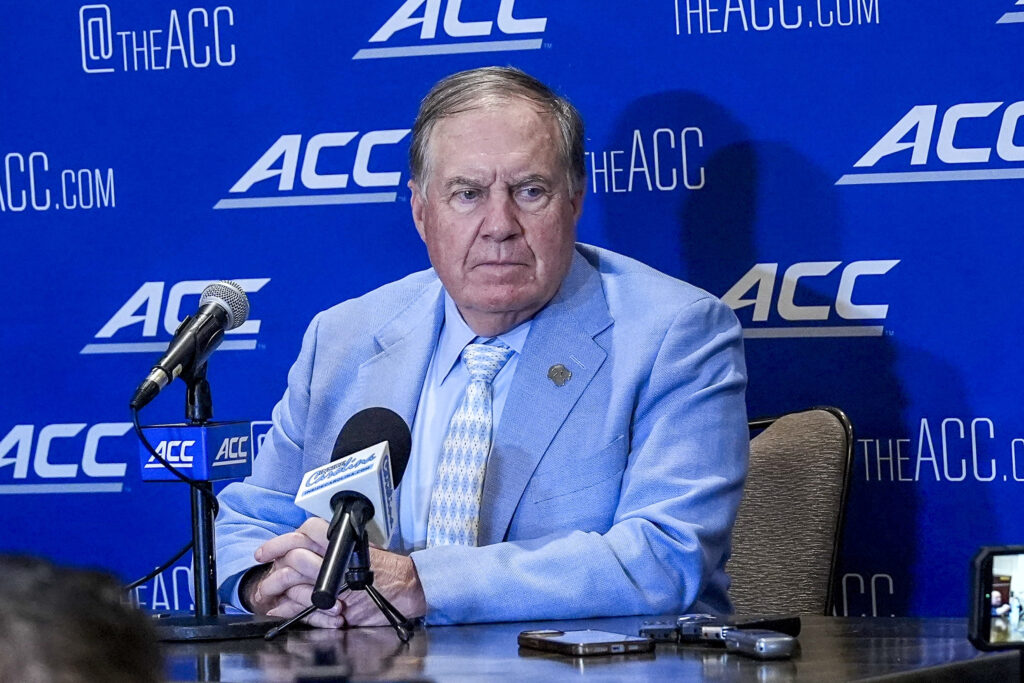
Bill Belichick’s shift from the NFL to the college ranks has faced its share of challenges, and fresh developments this week have heightened the questions surrounding his North Carolina program.
The university announced Monday that it had placed football general manager Michael Lombardi on paid administrative leave, effective immediately. ESPN’s Pete Thamel described the move as a “significant blow” to the credibility of the six-time Super Bowl-winning coach.
Lombardi had served as a central figure in translating Belichick’s approach to roster construction into the college environment. After a difficult debut season for the Tar Heels, the development has intensified scrutiny over the direction of the program under the longtime NFL legend.
Speaking on the latest episode of the “College GameDay Podcast,” Thamel outlined why the situation carries particular weight as Belichick prepares for his second year in Chapel Hill.
“For the credibility of Bill Belichick’s tenure in college, heading into year two, there’s no other way to say it. This is a blow,” Thamel said. “I mean, this is a significant blow. This is his handpicked, highly-paid, right-hand guy.”
Belichick’s path to North Carolina represented one of the more high-profile transitions in recent college football history. The coach who built a dynasty in New England arrived with a clear blueprint rooted in professional experience, yet the early results left the program searching for momentum.
Thamel pointed to the core premise that had fueled optimism around Belichick’s arrival.
“The thesis for Bill Belichick potentially succeeding in college was a simple one,” he continued. “He knew how to build a modern roster because he did it in the NFL for so long. He knew how to pick players, he knew how to identify them, he knew how to scout them.”
That foundation rested heavily on Lombardi’s role. The veteran executive, long associated with Belichick from their NFL days, was positioned as the key architect for talent evaluation and roster building in the new setting.
The timing of the leave has drawn additional attention. Belichick and his staff entered the program late in the previous recruiting cycle, limiting the initial opportunity to fully implement their vision. Progress was expected to accelerate in year two, but the latest development introduces another layer of complexity.
Thamel underscored the optics of the situation.
“There’s no way to understate it,” Thamel explained. “It’s a terrible look that Bill Belichick’s right-hand guy is in the crosshairs of this investigation and his future is uncertain. This was the guy who he was going to ride shotgun with. This was clearly not a Bill Belichick decision, this was a university decision.”
Despite the setback, Thamel indicated that Belichick should still receive time to develop the Tar Heels into a more competitive group. The coach’s late arrival last year complicated the first roster-building process, and observers have generally recognized the need for patience in such a transition.
Even so, the administrative leave for Lombardi stands as another notable obstacle heading into the 2026 season. The program must now navigate the absence of a trusted lieutenant while continuing to refine its approach to player acquisition and development in the college landscape.
Belichick’s reputation for meticulous preparation and organizational discipline remains a significant asset. Supporters of the hire have long pointed to his track record of identifying talent and constructing winning teams as the reason the move to North Carolina carried such promise.
Yet the challenges of adapting NFL methods to the college game, with its distinct recruiting calendar, transfer portal dynamics and institutional constraints, have been evident from the start. The first-year record reflected those hurdles, and the current uncertainty around a key staff member adds to the pressure.
University officials have treated the matter as a personnel issue and limited further public discussion. For Belichick, the focus now shifts to stabilizing the operation and demonstrating progress on the field as the new season approaches.
Whether the program can absorb this latest development and still advance toward the standards associated with its high-profile coach will be a central storyline in Chapel Hill throughout the coming months. The coming weeks and months will offer clearer indications of how the Tar Heels respond.