
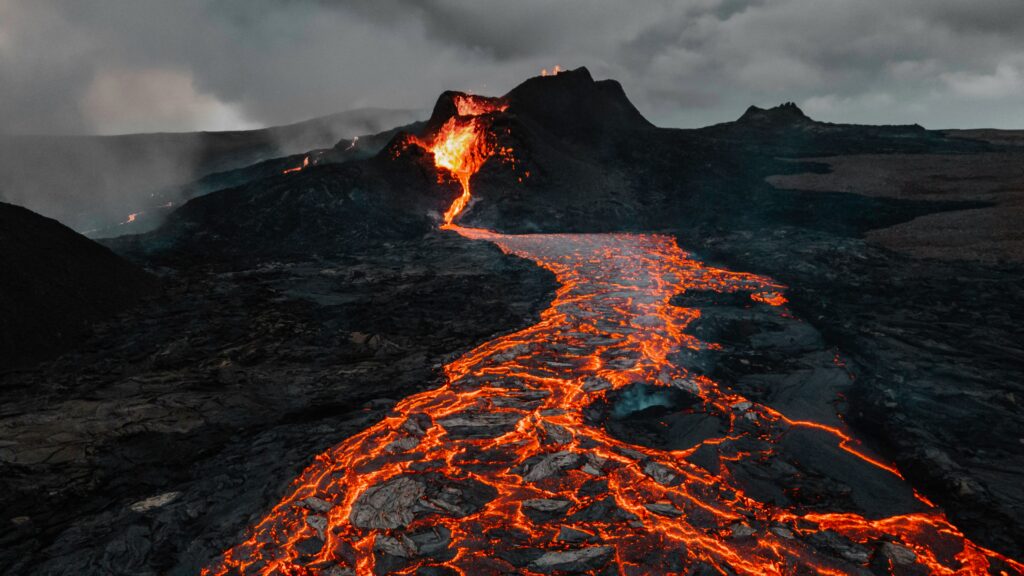
Mount Etna, the restless giant towering over Sicily in southern Italy, stands as Europe’s most active volcano. It erupts frequently, sometimes multiple times a year, captivating scientists and locals alike with its dramatic displays. Yet for decades, geologists have struggled to explain its very existence.
A new study from researchers at the University of Lausanne now offers a compelling theory that could rewrite our understanding of how this massive volcano—and potentially others—came to be.
Unlike many well-known volcanic systems, Etna does not align neatly with the standard explanations for how magma reaches Earth’s surface. Geologists typically categorize volcanoes into three broad groups. Some form at spreading centers where tectonic plates pull apart, allowing mantle material to rise and create new crust.
Others emerge at subduction zones, where one plate dives beneath another, with water from the descending slab lowering the melting point of rock and fueling often violent eruptions. A third type arises over hotspots, where plumes of unusually hot mantle material punch through the middle of plates, building chains like the Hawaiian Islands.
Etna sits near a subduction zone involving the African and Eurasian plates, but its lava chemistry tells a different story. It resembles material from hotspot volcanoes, even though no such thermal anomaly lies beneath the region. This mismatch has left experts searching for answers for years.
The Lausanne team’s research points to a different mechanism altogether. They suggest that small, pre-existing pockets of magma linger in the upper mantle roughly 80 kilometers (about 50 miles) below Sicily. These ancient reservoirs do not form right before each eruption, as often happens elsewhere.
Instead, the slow-motion collision and bending of tectonic plates gradually squeeze them upward. Fractures in the crust act like channels, allowing the magma to migrate toward the surface in a process akin to wringing liquid from a saturated sponge.
This idea draws parallels to “petit-spot” volcanoes—tiny submarine features identified off Japan that also tap into mantle magma pockets. Until now, such processes were thought to produce only modest structures, rising perhaps a few hundred meters at most.
If Etna indeed follows a similar path, it would represent the first known giant volcano born this way, potentially establishing a rare fourth category of volcanism. Its activity stretches back more than 500,000 years, and today it rises over 3,000 meters (nearly 10,000 feet) above sea level.
To test their hypothesis, the scientists examined a wide range of rock samples spanning Etna’s long history. Their analysis revealed a strikingly consistent magma composition over time, despite shifts in the regional tectonic setting. This stability supports the notion of a long-lived, deep source rather than one constantly remelted by fresh mantle upwelling. The findings were published in the Journal of Geophysical Research: Solid Earth.
Lead author Sébastien Pilet, a professor at the University of Lausanne, highlighted the surprise of linking such a massive feature to processes previously seen only in miniature. The collaboration with experts from Italy’s Istituto Nazionale di Geofisica e Vulcanologia could also refine hazard monitoring around this densely populated area.
If confirmed, the theory broadens our view of volcanic possibilities. It hints that similar hidden magma pockets might fuel other unexpected volcanoes around the world, encouraging geologists to revisit long-standing assumptions. Mount Etna, long an outlier, may soon become a key example of how our planet’s dynamic interior creates wonders in more ways than we once imagined.