
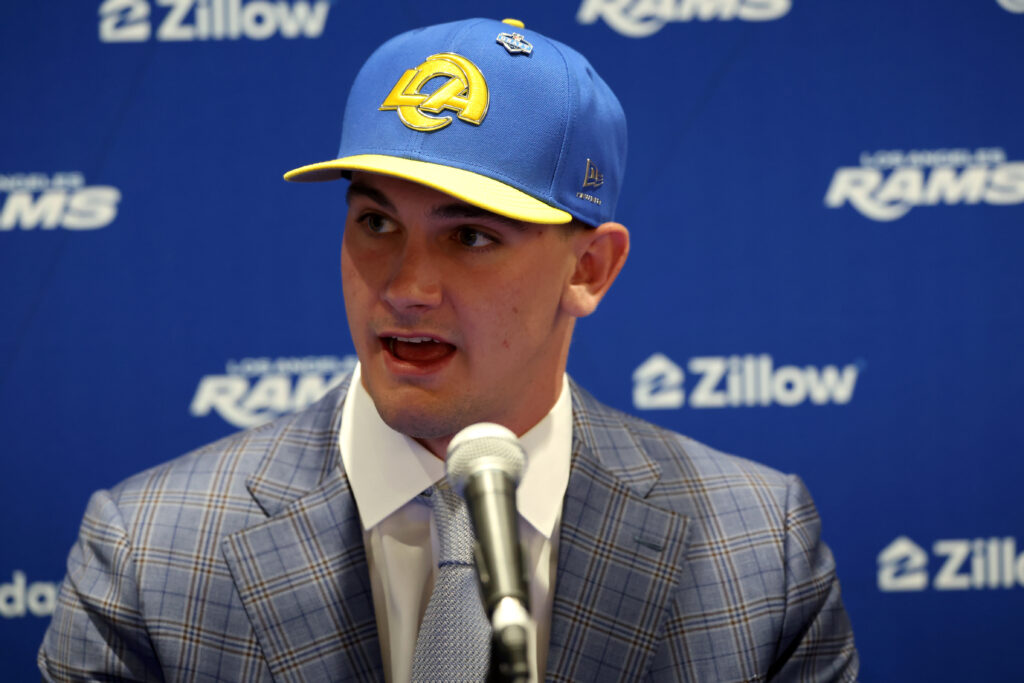
A full week has passed since the opening round of the 2026 NFL Draft, yet the Los Angeles Rams’ decision to select Alabama quarterback Ty Simpson with the 13th overall choice remains a topic of intense discussion among fans and analysts alike.
The move caught many observers off guard, especially considering the team’s clear requirements for dynamic offensive weapons who could make an immediate difference. In their heartbreaking 21-17 defeat to the Seattle Seahawks during the NFC Championship Game, the Rams repeatedly failed to convert opportunities close to the end zone—miscues that ultimately kept them from reaching the Super Bowl.
Bringing in another quarterback does little to resolve those specific shortcomings on the field. While adding depth at the most important position always carries long-term value, it leaves the more pressing short-term needs unaddressed in an offense that struggled to finish drives in critical moments.
According to reporting from The Athletic’s Nate Atkins, the Rams did explore options at skill positions before settling on Simpson.
“The Rams did consider players at potential impact positions,” Atkins wrote. “They looked into USC’s Makai Lemon, who won the Biletnikoff Award as college football’s top wide receiver. They examined Oregon’s Kenyon Sadiq, who posted the fastest 40 time of any tight end since at least 2003.”
Atkins further explained the team’s internal thinking.
“Had the Rams not taken Simpson, they would have gone with an offensive skill player, according to a team source. But it was difficult to see either rookie providing an immediate impact, given the Rams’ crowded tight end room and the limited volume remaining for a third receiver to play behind Davante Adams and Puka Nacua.”
Making sense of this strategic choice requires a deeper look at the alternatives that were on the board. Lemon stood out as one of the most productive pass-catchers in college football during his final season. The standout USC wideout hauled in 79 passes for 1,156 receiving yards and 11 touchdowns. Those numbers placed him eighth among all wide receivers in yards gained, tied for ninth in scoring receptions, and 11th in total catches.
Even with established stars like Puka Nacua and Davante Adams already occupying the top spots on the depth chart, Lemon would not have been expected to shoulder a massive workload right away. Instead, he represented a clear step up in talent over the current group of receivers competing for the No. 3 role, including players such as Xavier Smith, Jordan Whittingham, and CJ Daniels.
His presence could have added genuine competition and elevated the unit’s overall ceiling without demanding heavy target volume early on.
On the other side of the evaluation stood Oregon tight end Kenyon Sadiq, whose physical tools and production also turned heads. Sadiq recorded 51 receptions for 560 yards and eight touchdowns in his final college campaign. He paced all tight ends nationally in touchdowns while ranking fifth in catches and eighth in yards among the position group.
At a sculpted 245 pounds with exceptional speed, Sadiq possessed the rare combination of size and athleticism that could have immediately challenged incumbents Cody Parkinson and Tyler Higbee for snaps. Many evaluators believed he had a strong chance to emerge as the primary tight end before too long into his rookie campaign, injecting fresh energy into a position that has shown inconsistencies at times.
The Rams’ front office ultimately prioritized the quarterback of the future over these skill-position reinforcements. This approach reflects confidence that Simpson can develop into a franchise cornerstone, even if the short-term help for the offense’s finishing problems remains limited. Yet the decision continues to invite scrutiny given how close the team came to a Super Bowl berth and how readily available talent existed to bolster the receiving corps or tight end group.
Supporters of the pick argue that securing a high-upside signal-caller addresses the most vital long-term need in today’s NFL, where quarterback play often dictates success. Detractors, however, point to the missed opportunities in the championship game as evidence that immediate offensive upgrades might have provided a faster path to contention.
As training camp approaches and the full roster takes shape, the true value of Simpson’s selection will begin to reveal itself on the practice field and in preseason action. For now, the conversation around the Rams’ draft-night choice shows no signs of fading, highlighting the high stakes and differing philosophies that define NFL team-building in the modern era.