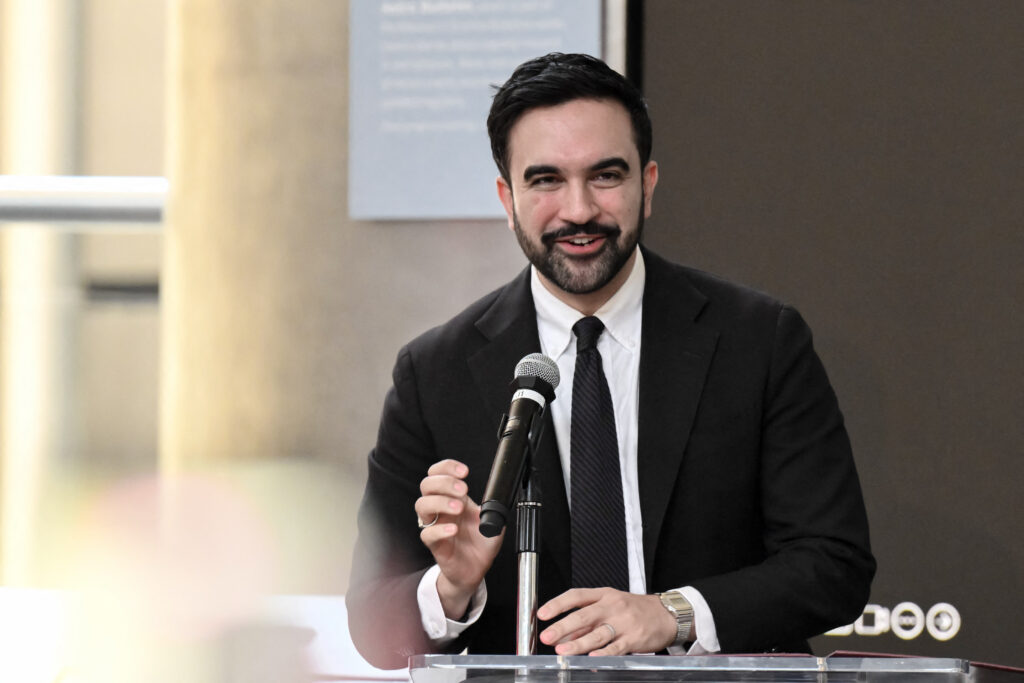
New York City Mayor Zohran Mamdani has confirmed that his administration continues to explore legal options for detaining Israeli Prime Minister Benjamin Netanyahu should he travel to the city for the upcoming United Nations General Assembly session in September.
During a recent appearance on The New York Times’ “The Interview” podcast, Mamdani revealed that city lawyers are engaged in ongoing discussions about the feasibility of such an action. The mayor had previously pledged during his campaign to pursue this course if the opportunity arose.
“I believe that Prime Minister Netanyahu belongs in The Hague,” Mamdani said. “He’s a war criminal who has been charged by the International Criminal Court. And what you will find is that is an opinion that is held by many purely because of what his actions have wrought over these last many years.”
When pressed on the legal boundaries of what his office could actually do, the mayor emphasized a measured approach rooted in existing statutes.
“That’s an active conversation with our legal department. However, what we’ve seen at the national level is a desire sometimes to write your own laws, to go outside of the bounds of legality. That’s not something we have an interest in.”
The International Criminal Court issued arrest warrants in 2024 for Netanyahu and several other Israeli officials. Prosecutors accused them of committing war crimes and related offenses in connection with military operations that followed the October 7, 2023, attacks by Hamas on Israeli territory. Both President Donald Trump and former President Joe Biden have strongly rejected the legitimacy of these warrants.
The United States has never ratified the Rome Statute, the treaty that established the ICC and requires member states to enforce its arrest orders. This legal separation has long shielded American allies and officials from the court’s reach, though tensions have intensified in recent years.
Mamdani has emerged as one of the most vocal critics of Israeli policy in American elected office. He has consistently described Israel’s military campaign in Gaza as a “genocide,” a characterization that Israeli authorities have repeatedly and firmly denied.
In response to the mayor’s statements, US Ambassador to the United Nations Mike Waltz dismissed the remarks as little more than performative politics. He pointed out that the United States maintains no membership in the ICC and therefore holds no obligation to enforce its decisions.
Prime Minister Netanyahu himself appeared unconcerned when addressing the controversy earlier in the week during an interview on WABC radio with host Sid Rosenberg. He brushed aside the mayor’s threats without offering detailed rebuttals.
Israel’s ambassador to the United Nations, Danny Danon, took to social media on Saturday to affirm Netanyahu’s plans. He stated that the prime minister “will come to New York, address the United Nations General Assembly with pride, and stand before the world to state Israel’s truth and its unwavering right to defend its citizens.”
The exchange highlights deepening divides within American politics over the Israeli-Palestinian conflict. While local leaders in sanctuary cities like New York have sometimes tested the limits of their authority on international matters, federal oversight and diplomatic immunity typically constrain such efforts involving sitting heads of state.
Legal experts note that any attempt to arrest a visiting prime minister would likely trigger complex questions of diplomatic immunity, federal preemption, and international protocol. The White House and State Department have historically managed such high-profile visits, often coordinating security through federal agencies.
Mamdani’s position reflects a broader shift among some progressive officials who seek to leverage local platforms to influence foreign policy debates. Critics argue this approach risks diplomatic incidents and exceeds the proper scope of municipal governance.
Supporters of the mayor, however, view his stance as a principled stand for international accountability and human rights. They contend that no official, regardless of position, should remain above scrutiny when serious allegations of violations persist.
As the UN General Assembly approaches, security preparations in New York are expected to intensify. City and federal authorities will likely coordinate closely to ensure the event proceeds without disruption, despite the public war of words.
The situation underscores ongoing tensions between different levels of government on issues of foreign affairs and the role of international courts in holding national leaders accountable. Whether Mamdani’s legal team ultimately identifies a viable path remains uncertain, but the public signaling has already sparked widespread discussion.