
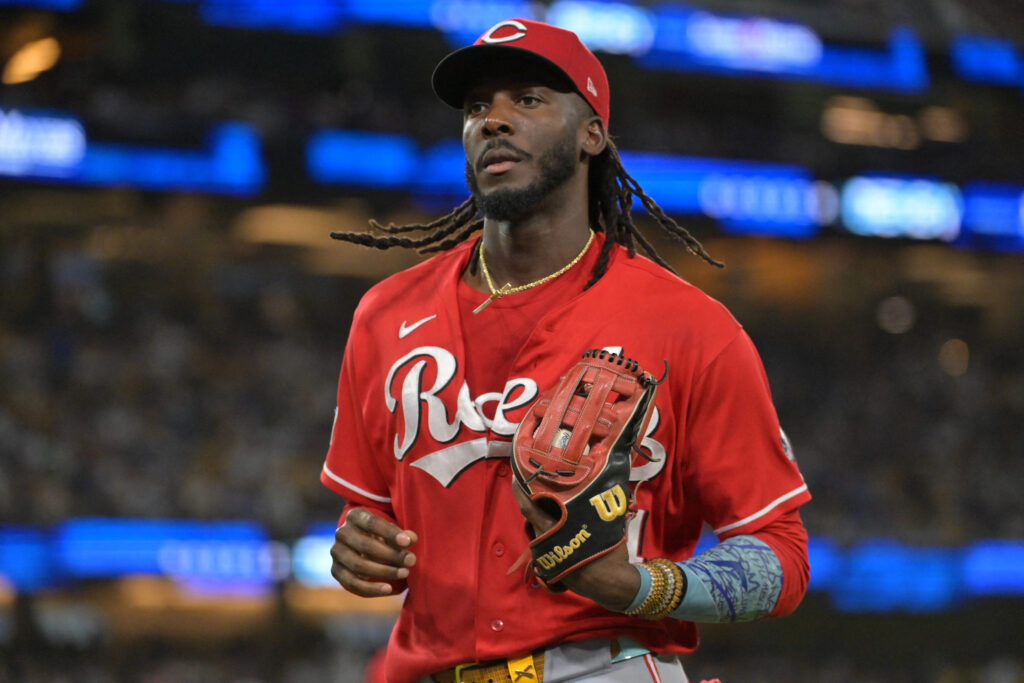
The Cincinnati Reds face a pivotal offseason decision centered on shortstop Elly De La Cruz, their most dynamic and marketable player.
Coming off a 2026 season that ended with a last-place finish in the National League Central, the club must confront the reality that De La Cruz has already rejected a historic extension offer that would have surpassed Joey Votto’s franchise-record deal.
The 24-year-old switch-hitter, a two-time All-Star with rare power and speed, has signaled through his representation that he intends to test free agency after the 2029 season, eyeing a contract that could exceed $500 million and a destination with deeper resources than Cincinnati typically provides.
Christopher Kline of FanSided recently identified De La Cruz as the most realistic superstar trade candidate this winter, specifically linking him to the Los Angeles Dodgers.
Kline pointed out that the Reds operate under clear financial constraints and that dealing the shortstop now, while he still has three years of arbitration remaining, would give Cincinnati a chance to rebuild its farm system and establish a broader foundation rather than banking on a single star whose long-term presence remains uncertain.
One of those arbitration seasons could also be shortened if the anticipated labor dispute disrupts the schedule, further compressing the team’s control window.
From Cincinnati’s vantage point, the calculus is uncomfortable but practical.
De La Cruz has already delivered seasons featuring 25-plus home runs and elite stolen-base totals.
Yet the Reds’ surrounding roster has not kept pace, leaving the franchise with limited evidence that it can contend during his remaining years of team control.
Holding him through arbitration risks a diminishing return as free agency nears, a pattern other mid-market clubs have experienced when stars ultimately leave without a major prospect haul.
The Dodgers, despite their recent NLCS exit, possess baseball’s deepest farm system and could assemble a package of high-upside position players and pitchers capable of accelerating a Reds rebuild more effectively than any free-agent additions the club could realistically afford.
The choice ultimately hinges on whether the Reds view De La Cruz as the centerpiece of a near-term contention window or as an asset whose peak value should be converted into multiple pieces that better align with the organization’s developmental strengths.
For a franchise still searching for sustained relevance, the opportunity to restock with young talent while avoiding the escalating costs of a player openly aiming for a massive payday elsewhere may outweigh the emotional cost of parting with a homegrown star.
We’ll see if Cincinnati does ultimately decide to move De La Cruz … and if it would really trade him to the Dodgers, of all teams.