
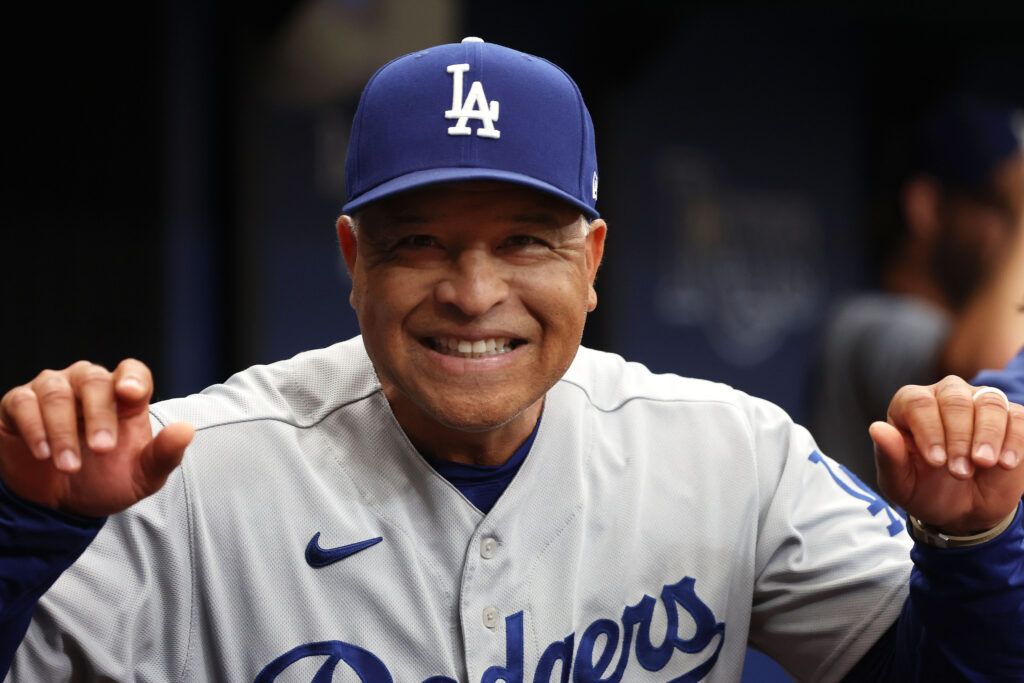
The Los Angeles Dodgers enter this offseason with the same familiar mix of unfinished business and unmatched resources that has defined the franchise for years.
After a strong regular season, the club fell short in the National League Championship Series, and questions about the infield’s long-term shape have only grown louder.
Mookie Betts has handled shortstop duties effectively, yet at 34 the demands of the position continue to draw scrutiny as the organization looks for ways to keep its championship window wide open.
Christopher Kline of FanSided recently singled out a potential trade for Cincinnati Reds shortstop Elly De La Cruz as one of the bolder moves that could reshape the league.
In a roundup of early offseason predictions, Kline argued that De La Cruz stands out as the most realistic superstar available this winter.
The Reds have already been rebuffed in efforts to extend the 24-year-old switch-hitter, and Cincinnati’s financial constraints make it difficult to match the massive free-agent payday he appears to be chasing.
With three arbitration seasons still ahead—one of which could be shortened by a possible labor dispute—Kline suggested the Reds might entertain a “godfather offer” that restocks their system rather than risk watching his remaining control years tick away.
From the Dodgers’ perspective, the fit is almost too clean. Los Angeles possesses what many evaluators rank as the deepest farm system in baseball, headlined by elite outfield prospects such as Josue De Paula, Eduardo Quintero, and Mike Sirota.
Shipping a package of that caliber would hurt, but the return would be a dynamic, high-upside shortstop already producing at an All-Star level while still years from free agency.
Acquiring De La Cruz would allow the club to slide Betts to a less demanding spot, ease the physical load on a cornerstone player, and inject elite speed and power into a lineup already featuring Shohei Ohtani and Freddie Freeman.
It would also echo the franchise’s most successful trade of the modern era—the one that brought Betts from Boston—by converting prospect surplus into immediate, sustained contention.
The Reds would almost certainly demand multiple top-100 talents and would need to believe the haul accelerates their own timeline more effectively than keeping De La Cruz.
For the Dodgers, however, the calculation is simpler: they have the prospect capital, the financial muscle to absorb the arbitration escalations, and a clear positional need.
If Cincinnati is truly willing to listen, Los Angeles is better positioned than any other club to force the conversation.
A deal would not merely upgrade the roster; it would signal that the Dodgers remain willing to spend whatever it takes, in prospects as well as dollars, to reclaim the top of the sport.