
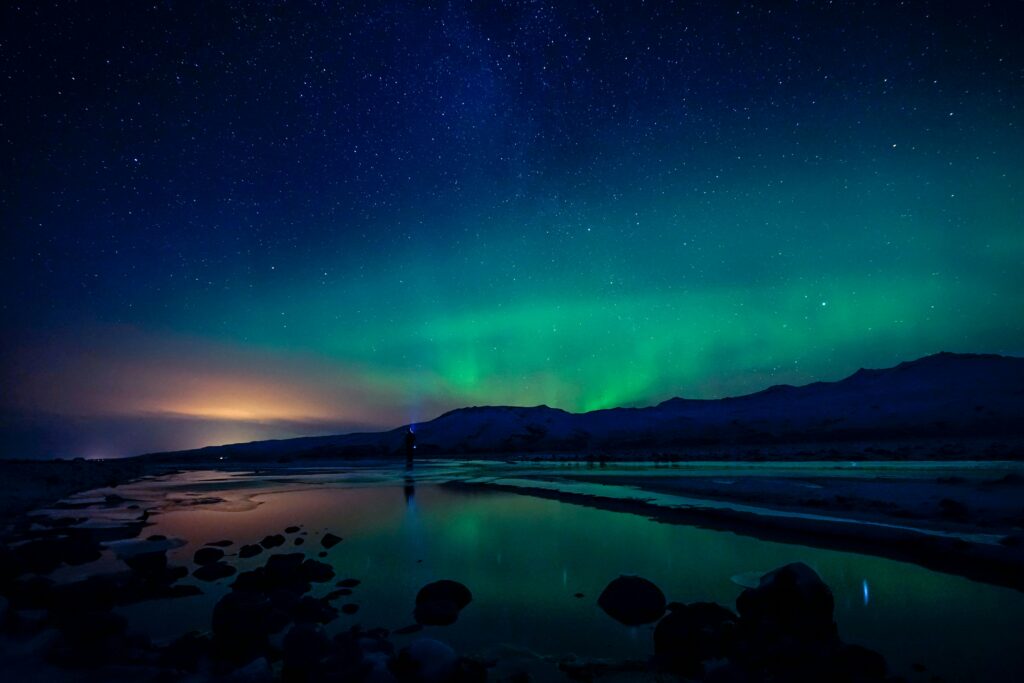
Sky enthusiasts should prepare their devices and monitor forecasts closely, as the northern lights may put on a visible performance across parts of the northern United States starting late on July 21 and extending into July 22. A fast-moving stream of solar wind is set to interact with Earth’s magnetosphere, creating conditions favorable for auroral activity in select regions.
This celestial event stems from charged particles originating from the sun that collide with atmospheric gases high above our planet. The resulting energy releases manifest as colorful, dancing lights that have captivated observers for centuries.
Unlike more dramatic episodes triggered by powerful coronal mass ejections, this occurrence does not involve those massive solar outbursts. Forecasters at NOAA are instead monitoring a prominent coronal hole on the sun’s surface.
Such features represent areas where the sun’s magnetic field opens up, permitting high-velocity solar wind to escape into interplanetary space, according to details shared by NASA. When this stream eventually reaches Earth, it can disturb the planet’s magnetic environment and generate the necessary activity for auroras under suitable circumstances.
Experts anticipate a minor G1-level geomagnetic storm as a result. This classification suggests the display could become noticeable primarily for those in higher-latitude areas close to the Canadian border, offering a chance to glimpse the phenomenon without the intensity of stronger storms.
Challenges remain for optimal viewing, however. Summertime twilight lingers longer at these latitudes, and the presence of a first-quarter moon may further diminish the visibility of subtle auroral glows near the horizon.
Activity levels are projected to ramp up during the later hours of Tuesday, July 21, and persist through Wednesday, July 22. Precise timing and strength carry some variability, since streams from coronal holes do not always follow exact arrival predictions.
“By late on 21 Jul, unsettled to active conditions are likely, with a chance for G1 (Minor) levels near the end of the period. By 22 Jul, unsettled to active periods are expected, with G1 (Minor) storm levels likely as the negative CH HSS moves into a geoeffective position,” NOAA’s Space Weather Prediction Center stated.
This official outlook from NOAA’s Space Weather Prediction Center underscores the relatively modest scale of the disturbance. Even so, favorable magnetic alignment within the solar wind could enhance connections with Earth’s field, potentially allowing auroras to appear farther south than typical quiet periods.
The prime viewing window will fall during the darkest overnight hours, though shorter summer nights in July naturally compress the available time compared to winter displays. Observers should remain flexible and check conditions frequently.
States along the northern tier, including Washington, Idaho, Montana, North Dakota, Minnesota, Wisconsin, Michigan, Maine, Vermont, and New Hampshire, stand the best opportunity for sightings during this G1 event. Expansions beyond these zones hinge on multiple variables such as solar wind properties, local weather, and ambient lighting.
Clear skies prove essential regardless of activity strength, as auroras tend to spread equatorward only when geomagnetic forces intensify. Urban light pollution can easily wash out faint emissions, making rural or remote locations preferable.
Patience becomes a key asset during such events. Displays often begin as subtle horizon hazes before intensifying into more defined arcs, curtains, or pulsating forms, sometimes shifting rapidly within minutes.
Smartphone users may gain an advantage in documenting the show. Device cameras frequently pick up faint greens and other hues that remain elusive to unaided vision in weaker storms.
For best results, enable night mode or pro-level exposure settings on your phone and stabilize the device firmly—using a tripod if possible or resting it against a solid surface. Longer exposure times help capture details that the human eye might miss in low-light conditions.
Staying updated through official resources like NOAA’s real-time aurora maps and dedicated space weather applications can make all the difference.
By combining preparation, optimal locations, and a bit of luck with the solar wind’s behavior, many across the northern United States could enjoy this natural light spectacle in the coming hours.