
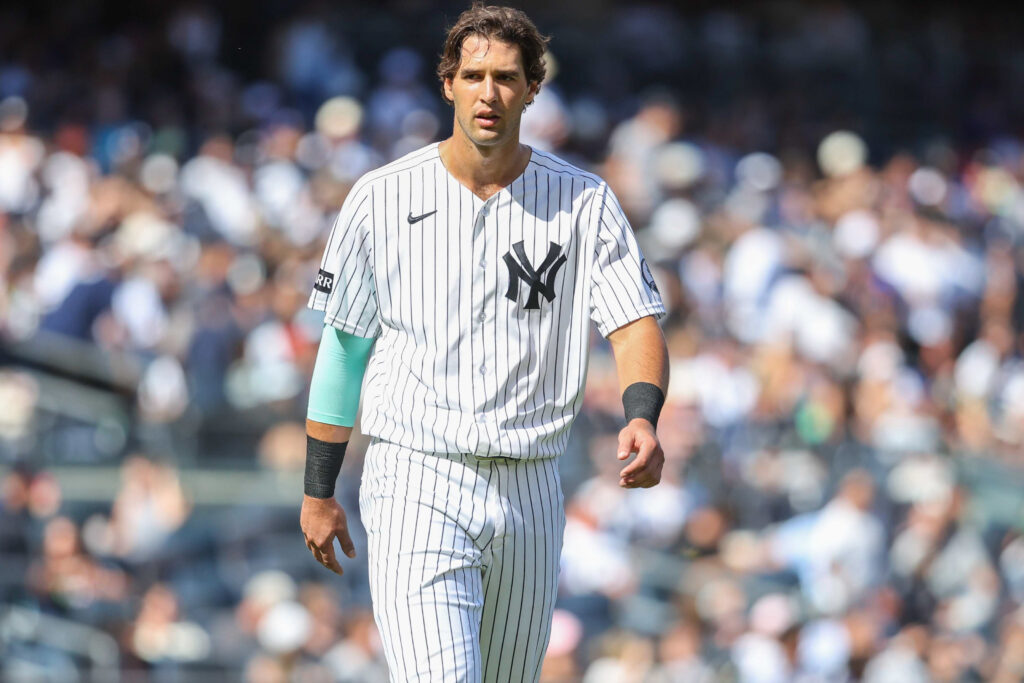
The New York Yankees enter the offseason with Spencer Jones as one of the more intriguing pieces on a roster that already mixes established stars with high-upside youth.
The 25-year-old outfielder debuted in 2026 and posted a .245 average with 11 home runs, 40 RBIs and 10 stolen bases across 86 games, flashing the raw power and athleticism that made him a first-round pick.
His combination of size, strength and speed gives the Yankees a potential everyday corner or center-field option who can hit 30-plus home runs while threatening for 20 steals, even if the strikeout rate remains a lingering concern.
For a front office that has often balanced win-now moves with prospect retention, Jones represents both a present contributor and a future building block whose value is still rising.
That balance is exactly what makes a potential trade for Bryce Harper so interesting from the Yankees’ side.
Christopher Kline of FanSided outlined a package in which New York would send Jones, pitching prospect Carlos Lagrange and outfielder Heliot Ramos to Philadelphia in exchange for Harper.
From the Bronx perspective, the deal centers on Jones as the headliner the Phillies would demand. Parting with him is no small concession.
Jones has already shown big-league flashes and projects as a multi-year contributor who can grow alongside the current core. Including him signals the Yankees are serious about adding a proven, championship-caliber bat rather than simply cycling through more unproven talent.
Harper would immediately slot into a lineup built around Aaron Judge. With Giancarlo Stanton’s future uncertain, Harper and Judge could split time between right field and designated hitter, giving the Yankees two of the game’s most dangerous right-handed power threats in the middle of the order.
Harper’s track record of postseason success and his ability to handle the New York spotlight fit the franchise’s history of importing elite talent.
His contract, which runs through his age-38 season at roughly $25 million annually, is not cheap, yet it is far more manageable than the open market for a comparable slugger. The Yankees have the payroll flexibility and the competitive window to absorb it.
The rest of the package softens the blow of moving Jones. Lagrange remains a high-ceiling arm whose velocity and secondary pitches could develop into a starter or high-leverage reliever, while Ramos is a controllable right-handed bat under team control through 2029 who has shown platoon value.
Trading both still leaves the Yankees with depth elsewhere, and the immediate upgrade of Harper’s bat could outweigh the long-term risk of developing Jones in-house.
For a team that has watched several recent postseasons end short of a title, the calculation is straightforward: Jones is a valuable asset, but Harper is a finished product capable of changing the offense right now.
Whether the Phillies would actually accept such a return remains uncertain, yet from the Yankees’ vantage point the proposal is the kind of calculated gamble that has defined their approach for decades.