The Cincinnati Reds have spent the better part of the past decade chasing relevance in a division that rarely rewards patience.
Ownership has shown a willingness to spend when the window feels open, yet the club’s recent postseason appearances have been fleeting and its payroll constraints remain real.
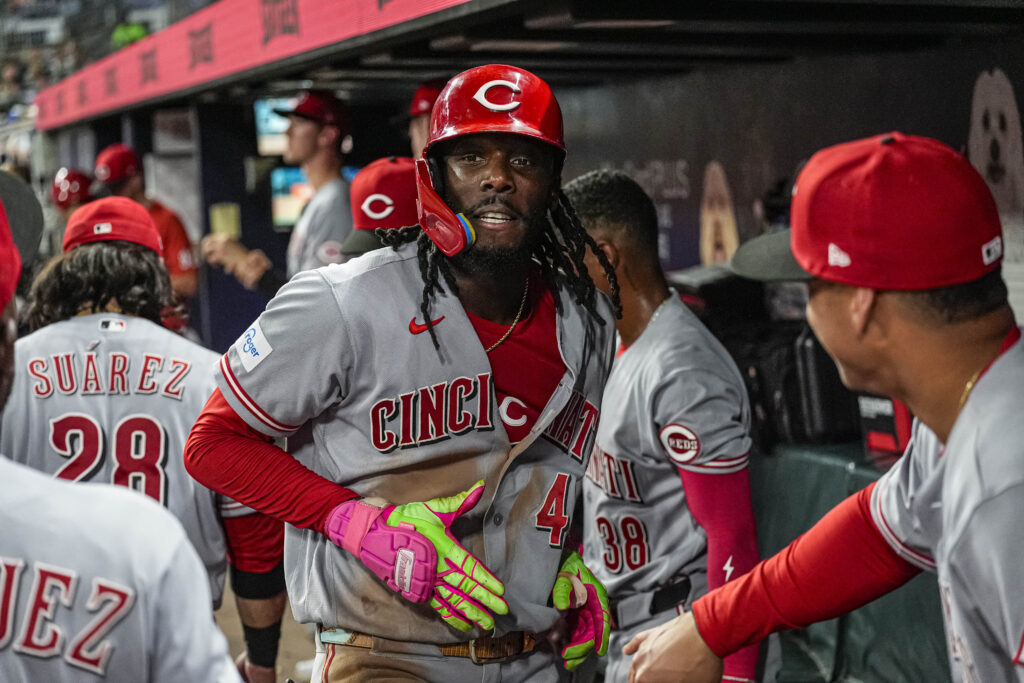
At the center of every long-term conversation sits shortstop Elly De La Cruz, the electrifying two-time All-Star whose combination of power, speed and defensive range has made him the face of the franchise.
His remaining club control runs through the 2029 season, which means the Reds still hold several years of arbitration leverage before free agency arrives.
The question that keeps resurfacing in front offices and among fans is whether that control is best used by keeping him or by converting him into a broader foundation of talent that can sustain contention longer than one superstar contract would allow.
In a recent Bleacher Report column outlining improbable but grounded trade concepts for the 2026-27 offseason, Zachary D. Rymer floated exactly that possibility by sending De La Cruz to the Tampa Bay Rays.
Rymer noted that even Reds legend Joey Votto has publicly argued the club should move the shortstop for “as many prospects as possible,” reasoning that the alternative—an extension Cincinnati likely cannot afford—creates more risk than reward.
The idea gained quiet traction during the summer, when multiple reports indicated the Boston Red Sox inquired and even made an offer. While the Rays lack Boston’s resources, they enter the winter as a team coming off a World Series appearance and preparing for a new stadium targeted for 2029, a timeline that aligns cleanly with the final years of De La Cruz’s control.
From the Reds’ vantage point, the return Rymer sketched offers a plausible path forward rather than a pure rebuild. Cincinnati would acquire shortstop Grady Emerson, ranked as one of the top dozen prospects in the sport, who could slide into the everyday role at shortstop with a similar blend of tools and a longer runway of cost control.
Catcher Caden Bodine, another top-50 prospect, brings legitimate offensive upside at a premium position where the Reds have long searched for stability. The package would be rounded out by right-hander Brody Hopkins, a pitcher whose pure stuff ranks among the best in the minors even if command remains a work in progress.
In essence the club would exchange one established offensive star for the realistic chance of developing two more, both of whom could arrive in the majors before the decade ends, while also adding a high-ceiling arm who might contribute sooner if the organization can refine his delivery.
Such a deal would not be painless. De La Cruz’s presence has raised the ceiling of every Reds lineup he has led, and the emotional cost of trading a homegrown face would be significant.
Yet the front office has already demonstrated it will listen when elite talent is involved, and the arithmetic of building a sustainable winner in Cincinnati has rarely favored keeping every star through free agency.
If the Rays are willing to part with a package headlined by Emerson and Bodine, the Reds would at least possess a clear successor at shortstop and an additional impact bat behind the plate, giving them more ways to remain competitive after 2029 than a single expensive extension would guarantee.
Whether that calculation ultimately sways the organization remains to be seen, but the framework exists for Cincinnati to turn one of its most valuable assets into a wider collection of controllable pieces without simply waving goodbye to contention.