
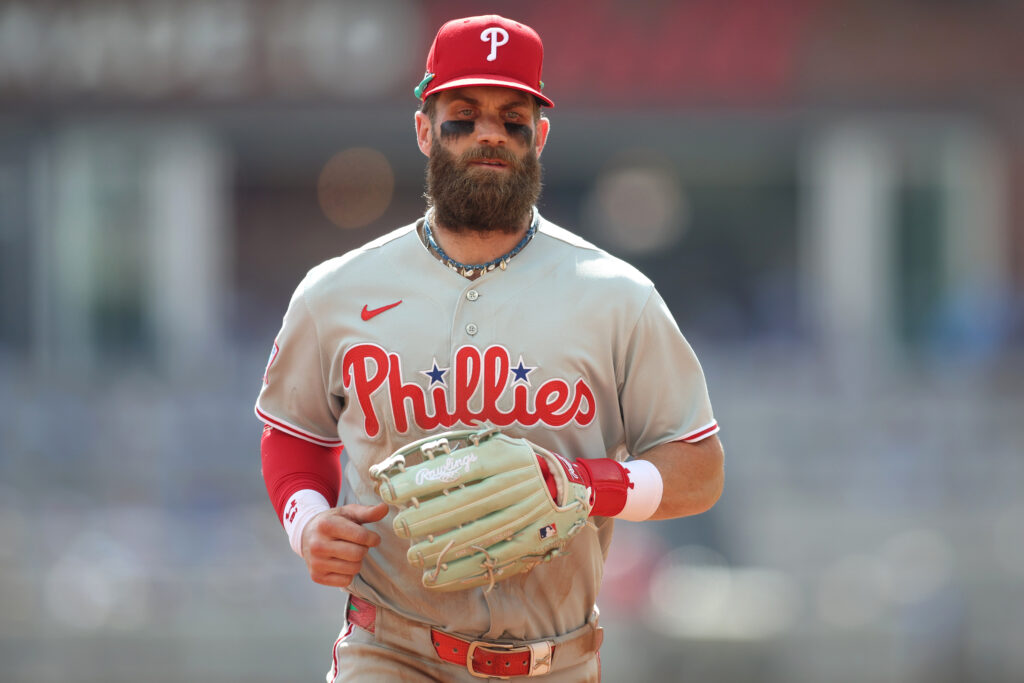
Philadelphia Phillies slugger Bryce Harper could be on the trade block this winter, and the rumors are already starting.
A trade pitch circulating ahead of the offseason would send Harper to the Boston Red Sox for Jarren Duran, Kristian Campbell, and Tanner Houck.
From Philadelphia’s side of the table, the idea looks less like a reset and more like a fire sale dressed up as a blockbuster.
Patrick McAvoy of Red Sox on SI floated the framework after Boston’s latest Wild Card exit.
The Red Sox would take Harper and the five years left on his 13-year, $330 million contract. The Phillies would get an outfielder coming off a down year, a former top prospect who spent 2026 in Triple-A, and a pitcher with one year of control who made a single start while working back from injury.
McAvoy himself called a Harper deal a pipe dream unless Philadelphia shops him and he agrees to waive his no-trade clause.
That last point is the whole problem. Harper is not a stranded asset. He is 33, still an impact bat, and he just hit .269 with 29 home runs and 87 RBIs. He can play first base or right field.
The money is heavy on paper, but the annual hit is manageable by star standards: a little over $27 million in 2027 and 2028, then a little over $23 million in each of the final three seasons. Teams that want him are not being asked to absorb a dead contract. They are being asked to pay a nine-time All-Star who remains in the middle of a lineup.
The return does not match that reality. Duran has been in trade rumors and would give the Phillies an outfield body, but a .207 season with 20 homers and 69 RBIs is not a replacement for Harper.
Campbell is only 24 and still has six years left on an eight-year, $60 million deal, so there is a developmental case. He has not panned out yet, and Philadelphia would be taking on another guaranteed contract for a player who has not forced his way into a big-league role.
Houck could help a rotation in 2027 if he is healthy, but one year of control is not the kind of piece that closes a deal for a franchise cornerstone.
Reports that the Phillies want to shake up the roster do not require moving the player who has defined the contention window. A real Harper trade would have to bring back either a young everyday player who is already producing or a controllable starter with more than a single healthy season left.
This package does neither. Boston can talk itself into the fit because the free-agent market is thin and Harper would immediately raise the ceiling of an offense that keeps falling short in October. Philadelphia does not have the same incentive to make Boston’s problem easier.
If the front office is serious about changing the mix, the smarter path is around Harper, not through him.
Shopping the face of the franchise for a struggling outfielder, a Triple-A infielder, and a rehabbing arm would signal that the window is closing. The contract, the no-trade clause, and the production all say it is not.