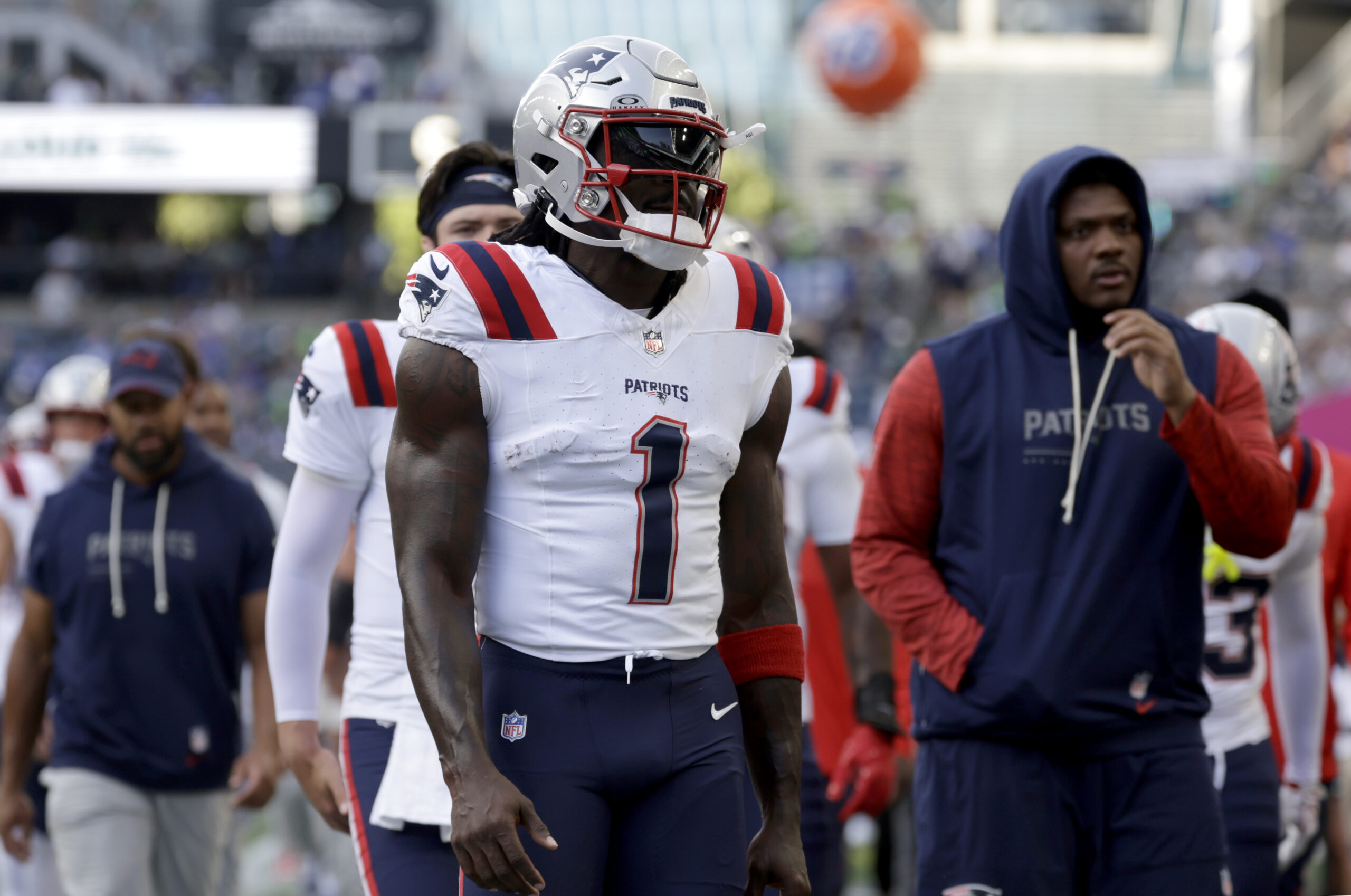
The New England Patriots’ big offseason bet on A.J. Brown has yet to pay dividends. Acquired from the Philadelphia Eagles in exchange for a 2028 first-round pick and a 2027 fifth-rounder, the veteran receiver has appeared in only four games in 2026.
In those contests he has managed just 11 catches for 128 yards and no touchdowns, repeatedly sidelined by ankle, knee, and hamstring issues.
The production has fallen well short of the expectations that accompanied a player long viewed as a true No. 1 target for quarterback Drake Maye.
Free-agent addition Romeo Doubs has also battled injuries, leaving the receiving corps thin and reinforcing the sense that the position remains a priority heading into the next draft cycle.
That reality is already shaping early projections for the 2027 NFL Draft.
In ESPN’s Jordan Reid’s midseason mock, the Patriots select Indiana wide receiver Nick Marsh with the 16th overall pick.
Reid frames the choice as a direct response to the incomplete returns on both Brown and Doubs, arguing that New England still needs a reliable top-end option for Maye.
Marsh, listed at 6-foot-3 and 210 pounds, has thrived in Bloomington after transferring from Michigan State.
Through 10 games, he has recorded 42 receptions for 749 yards and eight touchdowns, averaging 17.8 yards per catch. Roughly 307 of those yards have come after the catch, highlighting his ability to create once the ball is in his hands.
Scouts also note his versatility lining up both outside and in the slot, his physicality against defensive backs, and his willingness as a run blocker.
Marsh’s trajectory offers additional context.
As a freshman at Michigan State in 2024 he posted 41 catches for 649 yards and three scores; the following year he added 59 receptions for 662 yards and six touchdowns before seeking a change of scenery.
The move to Indiana has coincided with a clear uptick in efficiency and scoring production, positioning him among the more productive receivers in a deep 2027 class.
For a Patriots front office that has historically struggled to develop or land high-impact wideouts through the draft, Marsh represents a chance to reset the position with a younger, cost-controlled player who profiles as an immediate contributor rather than a developmental project.
Whether the organization ultimately moves on from Brown after this season remains an open question. His contract runs through 2029, though limited remaining guarantees could make a clean break more feasible than it first appears.
In the meantime, Reid’s projection simply underscores how quickly the Brown acquisition has shifted from a win-now reinforcement to a situation that may require further investment next spring.