
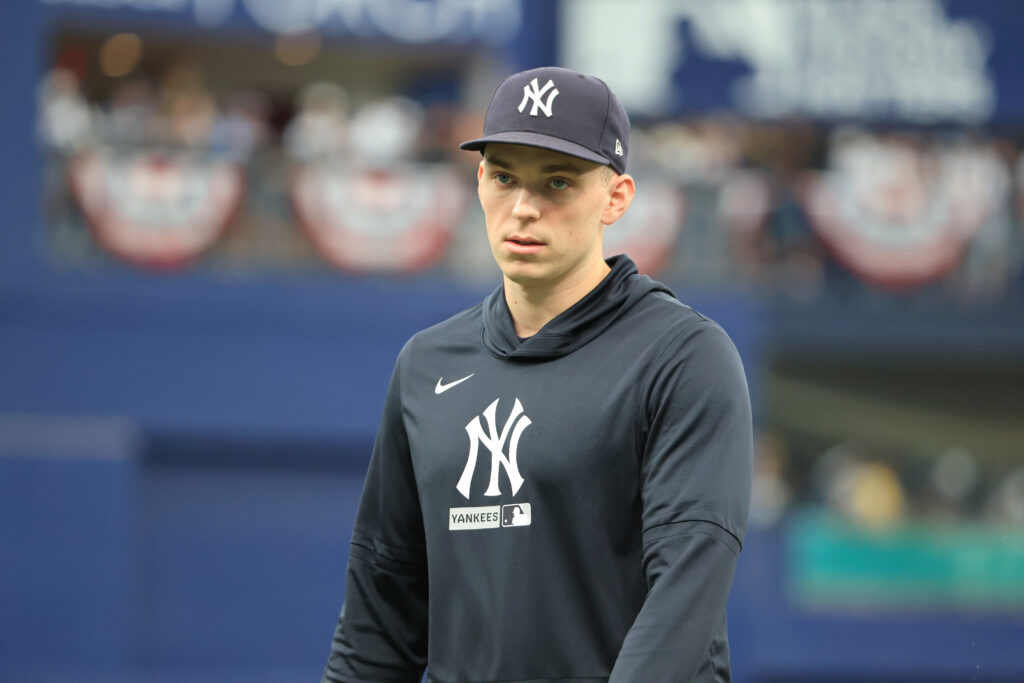
Ben Rice has emerged as one of the New York Yankees’ most reliable offensive forces, a left-handed slugger whose power and plate discipline have quickly made him indispensable in the lineup.
Fans have grown accustomed to seeing the 27-year-old drive balls into the seats and work deep counts, and the idea of him wearing another uniform feels distant after a breakout campaign that included 41 home runs, an .897 OPS, and standout postseason moments.
Yet the possibility that Rice might not remain in pinstripes for the long haul has entered the conversation.
Joel Sherman of the New York Post examined the issue while discussing the sport’s looming labor dispute and the likelihood of a lockout, noting that owner Hal Steinbrenner “badly” wants a salary cap.
Steinbrenner appears comfortable with the prospect of trimming payroll, and in some respects may even prefer it.
Any new agreement that includes a hard cap is widely expected to shorten free agency eligibility from six years of service time to five. That change would accelerate Rice’s path to the open market, along with teammate Cam Schlittler.
“In some ways, I think Hal might want the salary cap so he just can’t do it,” Sherman said.
For decades the Yankees have retained their most promising homegrown players when they chose to do so.
Rice and Schlittler both developed within the organization and have already begun compiling meaningful October résumés—Rice in particular delivered multi-hit, multi-homer performances that helped keep the Yankees competitive deep into the postseason.
Still, Sherman has wondered aloud whether either player is guaranteed a long-term future in the Bronx.
Steinbrenner has faced persistent criticism for restraint in free agency even while the club maintains one of baseball’s highest payrolls.
Last winter’s relative quiet, limited largely to retaining Cody Bellinger and adding Ryan Weathers, only reinforced those perceptions. If that pattern continues, the club’s own rising stars could eventually feel the effects.
Rice’s combination of left-handed power, on-base ability, and youth makes him the type of player who could command a substantial multiyear deal once he reaches free agency.
Under a stricter financial framework, that price tag might give the Yankees an easier rationale to let him depart rather than stretch their budget.
Whether Steinbrenner’s interest in a cap is driven purely by competitive-balance arguments or by a desire to limit future commitments remains open to interpretation.
For now, Rice continues to produce at a level that has made him a central piece of the Yankees’ present. How long that centrality lasts may depend as much on the next collective-bargaining agreement as on his performance on the field.