
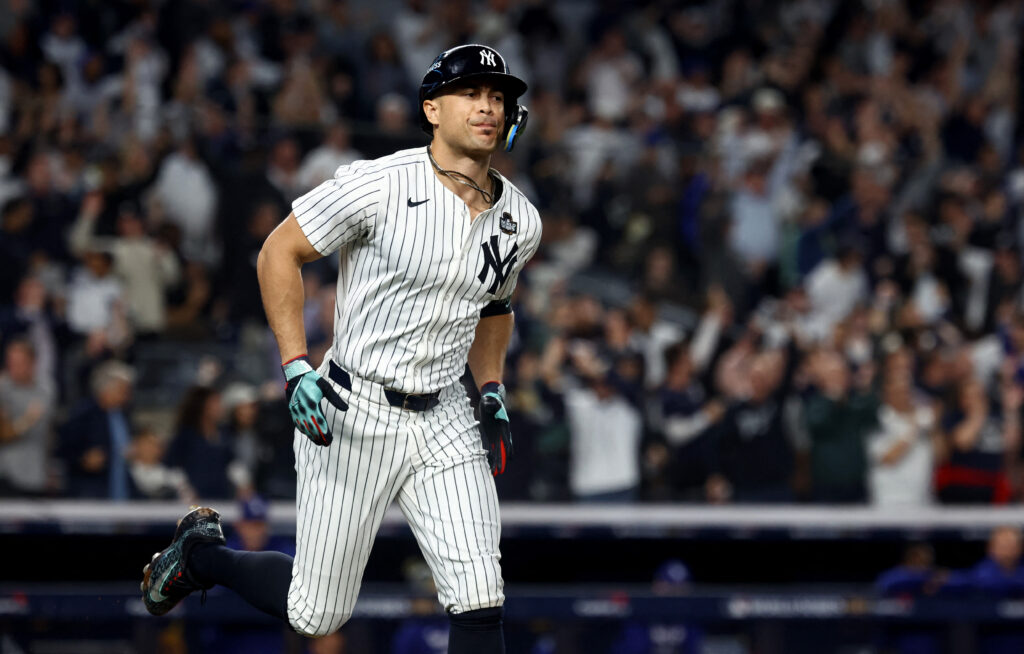
The New York Yankees enter another offseason confronting a familiar yet increasingly uncomfortable reality surrounding designated hitter Giancarlo Stanton.
At 36, the once-dominant slugger no longer profiles as the same force who terrorized pitchers earlier in his career, and clubhouse respect alone may not secure his future in the Bronx.
Chris Kirschner of The Athletic laid out the organization’s dilemma in blunt terms.
Stanton remains a respected leader and a well-liked figure among teammates, yet his availability has eroded to the point that relying on him has become untenable.
The emergence of Ben Rice, who ranked among the league’s most productive hitters this past season, further complicates the picture.
With a viable everyday designated-hitter option already on the roster, retaining a player limited strictly to that role offers little practical value.
Logistically, the arrangement makes even less sense when the Yankees are responsible for $15 million of Stanton’s remaining salary while the Miami Marlins cover an additional $10 million.
The decline is stark when measured against Stanton’s peak. In 2017 with the Marlins, he posted a .281/.376/.631 slash line, a 1.007 OPS, 59 home runs and 132 RBIs across 159 games.
That season established him as one of the game’s premier power threats.
By contrast, his most recent campaign produced a .256/.302/.422 line, a .724 OPS, and just three home runs in 24 games—a fraction of the production that once defined him.
Stanton’s path to New York began with the Marlins, who selected him in the second round of the 2007 draft.
He reached the majors in 2010 and spent eight seasons in Miami before the December 2017 trade that sent him to the Yankees in exchange for Starlin Castro, José Devers, and Jorge Guzmán. This past year marked his ninth in pinstripes.
The broader context for the franchise adds urgency. Despite injuries and other disruptions, the Yankees compiled a 93-68 record that ranked fifth in baseball, only to finish second in the American League East behind the Tampa Bay Rays’ 98-64 mark.
Their postseason run ended in the ALDS, leaving the club to confront free agency and the trade market with limited margin for carrying unproductive contracts.
As the hot-stove period approaches, decisions about veterans whose production no longer matches their cost and role will shape how aggressively the Yankees can pursue upgrades elsewhere.
For Stanton, the combination of declining availability, a clear internal alternative, and the financial structure of his deal has turned what once looked like a long-term commitment into an open question heading into 2027.