
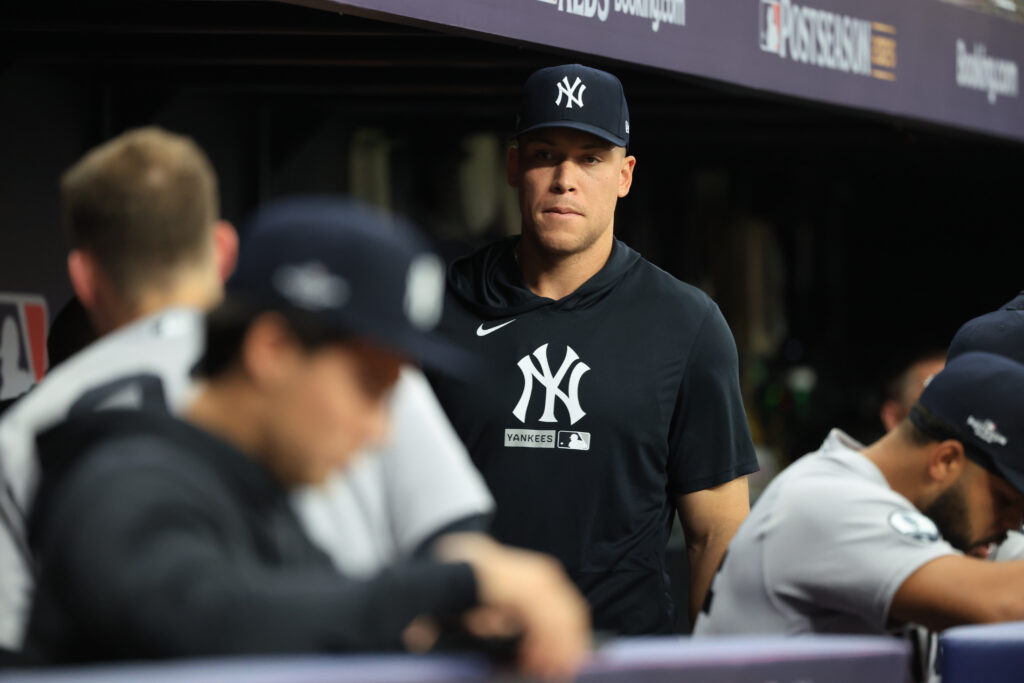
New York Yankees superstar Aaron Judge has built one of the most dominant careers in modern baseball by trusting his own instincts as much as any spreadsheet.
The 6-foot-7 captain has long preferred traditional markers—runs scored, RBI, and how he advances runners—over the dense layers of launch-angle charts and expected weighted on-base average that now dominate clubhouses.
That preference has rarely cost him. When healthy, Judge remains among the most dangerous hitters in the sport, capable of carrying an offense through sheer force of contact and plate discipline.
Yet a recent report has placed Judge’s old-school stance in a sharper light.
According to details published by The Athletic, Yankees manager Aaron Boone felt the team’s hitters were generally open to analytical input during the 2026 season.
Several players, however, showed little interest. Jazz Chisholm Jr., Trent Grisham, and Ryan McMahon were named as having little to no engagement with the club’s data staff.
Judge was described in similar terms: not inclined to dive deeply into the numbers and more traditional in his approach.
The distinction matters because Judge is not simply another veteran. As team captain he sets a visible example. Teammates watch how he prepares, what he dismisses, and which voices he privileges.
When three regulars who also resisted the analytics department posted uneven seasons, the contrast with the pitching staff—where veterans such as Gerrit Cole have embraced data-driven adjustments—became harder to ignore.
The Yankees’ offensive struggles contributed to an early postseason exit, and front-office figures have already signaled that changes are under discussion.
Judge’s own production softens the criticism. Few players generate the quality of contact he does even in a down stretch, and his track record of refining his swing through private instruction long predates the current analytics era. Still, the report raises a fair question about leadership culture.
If the most respected voice in the lineup treats extensive data as optional, others may feel free to do the same even when the numbers identify clear areas for improvement.
Chisholm’s walk year, Grisham’s decline, and McMahon’s struggles at the plate all coincided with limited buy-in; whether that resistance was decisive or merely coincidental is now part of the offseason conversation.
Judge has also clashed with the organization on other fronts, including his return timeline from injury and the club’s roster construction.
Those tensions do not erase his value, but they complicate the picture of a captain expected to model the habits the front office wants adopted. The Yankees do not need Judge to become a numbers obsessive.
They may, however, benefit if the player whose example carries the most weight at least listens before deciding which advice to keep. As free agency and roster decisions approach, that balance between individual excellence and collective process sits near the center of New York’s planning.