
The New York Mets’ 2026 season has unraveled into one of the more disappointing campaigns in recent franchise history, leaving the club buried in last place in the National League East and facing hard questions about the rest of the year.
As of Monday, the Mets sat at 44-62, a full 18.5 games behind the first-place Atlanta Braves and 10.5 games in back of the fourth-place Miami Marlins. What began with lofty preseason expectations has instead produced a lost cause defined by underperformance from several high-salaried contributors.
Shortstop Bo Bichette has seen his production drop sharply from previous levels, while Francisco Lindor has battled injuries and posted modest numbers in the games he has managed to play. Those shortcomings have placed even greater pressure on the rest of the lineup to generate offense.
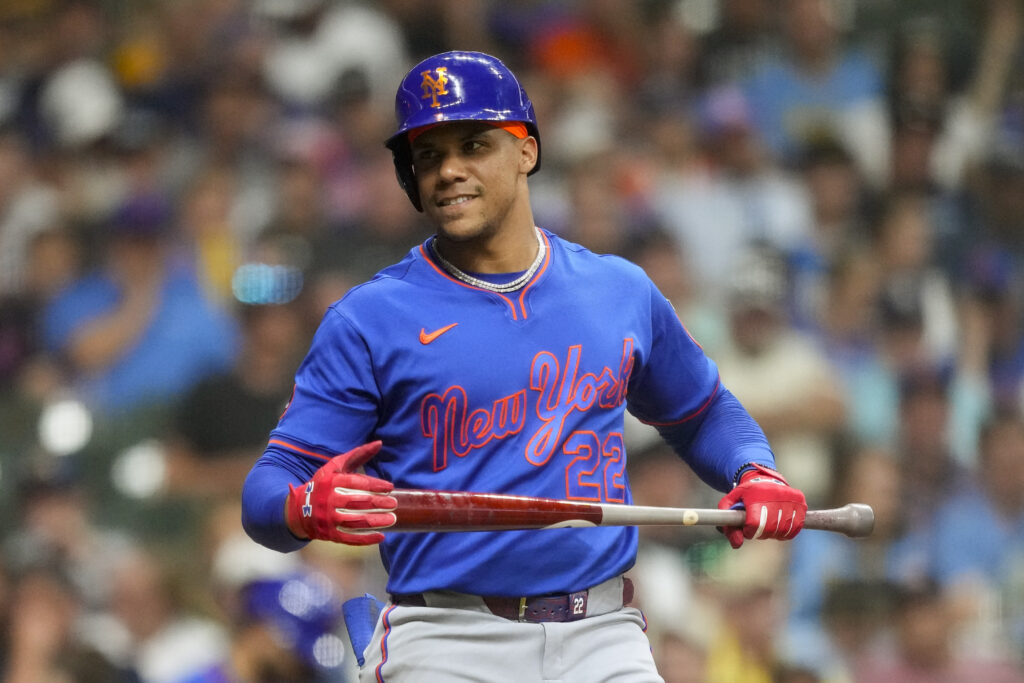
The lone bright spot in an otherwise stagnant attack has been left fielder Juan Soto. Entering the second year of his landmark 15-year, $765 million contract with New York, Soto has carried the Mets’ offense almost single-handedly.
Through 84 games, Soto is hitting .283 with a .408 on-base percentage and .539 slugging percentage, good for a .947 OPS. He has belted 21 home runs and driven in 52 runs. No other Mets hitter approaches those figures in the key statistical categories.
New York’s overall team OPS of .686 ranks 28th in Major League Baseball. That mark would almost certainly sink to last place if Soto’s production were replaced by that of an average major-league hitter, underscoring how heavily the club has leaned on its star outfielder.
Amid widespread reports that the Mets are preparing for a fire sale ahead of the trade deadline, the team suffered another significant blow when Soto, its primary offensive engine, went down with injury. The 27-year-old sustained a Grade 2 left calf strain during Friday’s game against the Los Angeles Dodgers.
With the Mets firmly out of postseason contention, speculation quickly arose that Soto might shut down for the remainder of the season to protect his long-term health. MLB.com’s Anthony DiComo put the question directly to the All-Star on Monday.
Soto responded that he will “definitely” return before the year is over.
This is not the first time calf trouble has sidelined the left fielder in 2026. Soto previously spent time on the injured list in April with a Grade 1 strain in his right calf, an absence that cost him roughly two and a half weeks. Recovery from a Grade 2 strain is generally projected at four to six weeks.
In Soto’s absence, the Mets must identify an everyday option in left field. Rookie A.J. Ewing has started there since Friday’s injury, though the young outfielder has primarily manned center field this season and performed at a high level in that role.
How the club ultimately structures its outfield in the short term will hinge in large part on the status of center fielder Luis Robert Jr. The first-year Met has missed portions of the season due to injury and is widely reported to be available via trade. Whether Robert remains with the team or is moved will dictate New York’s immediate plans for both center and left field.
For a franchise that entered the year with championship aspirations, the combination of a last-place standing, key injuries and potential roster overhaul has created an unusually quiet and uncertain stretch of summer.
Soto’s determination to return offers one of the few remaining points of optimism, yet the broader challenges confronting the Mets appear unlikely to resolve quickly.