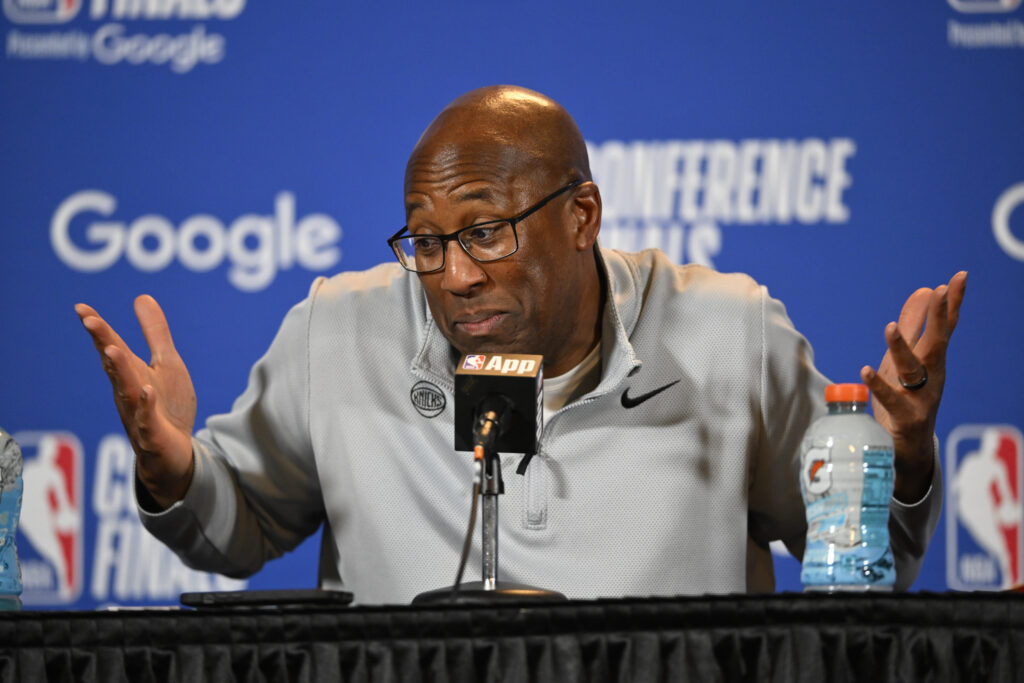
The New York Knicks enter another high-stakes season with championship aspirations and a payroll that leaves little room for error.
Mikal Bridges remains one of the most reliable two-way wings on the roster, a player who can lock down opposing scorers and stretch the floor.
Yet, his four-year, $150 million contract sits at the center of growing questions about whether the franchise can keep its current group intact while navigating the NBA’s second-apron restrictions.
Sean Deveney of Heavy.com recently noted that a Bridges trade possibility, while not incredibly likely, is a possibility due to financial ramifications.
“It would make sense for the Knicks to give them flexibility going forward, so we’ll slide him on this list,” Deveney wrote. “But the Knicks appear determined to try to hammer the team under the second apron for as long as it can stay there–there will be a breaking point, though.”
Bridges arrived in New York with a reputation as a high-character professional who rarely misses games and accepts whatever role is asked of him. Those qualities make him attractive to other teams that need a ready-made starter without the drama that sometimes accompanies star acquisitions.
At the same time, his contract is not an easy one to absorb. Any team that takes him on would have to match significant salary, limiting the pool of realistic suitors to clubs that either have matching outgoing contracts or are willing to take on long-term money in exchange for Bridges’ two-way production.
The Knicks’ front office has shown a willingness to be patient. Officials have repeatedly signaled they prefer to let the current group compete rather than tear it apart in search of cap space. That approach worked last season when New York remained competitive deep into the playoffs.
Repeating that success, however, becomes harder if injuries or declining production from supporting pieces force the team over the apron threshold. In that scenario, Bridges could become the most logical chip to move because his value remains high enough to return useful assets without requiring the Knicks to surrender a foundational player.
Whether a deal materializes this season or next depends on how the standings unfold and how other teams manage their own books. For now the Knicks are betting they can keep Bridges and still stay on the right side of the luxury-tax line.
Deveney’s observation that a breaking point exists is a reminder that even well-constructed rosters eventually collide with the league’s financial realities.
If that collision comes, Bridges may be the player New York uses to reset the books while trying to remain a contender.