
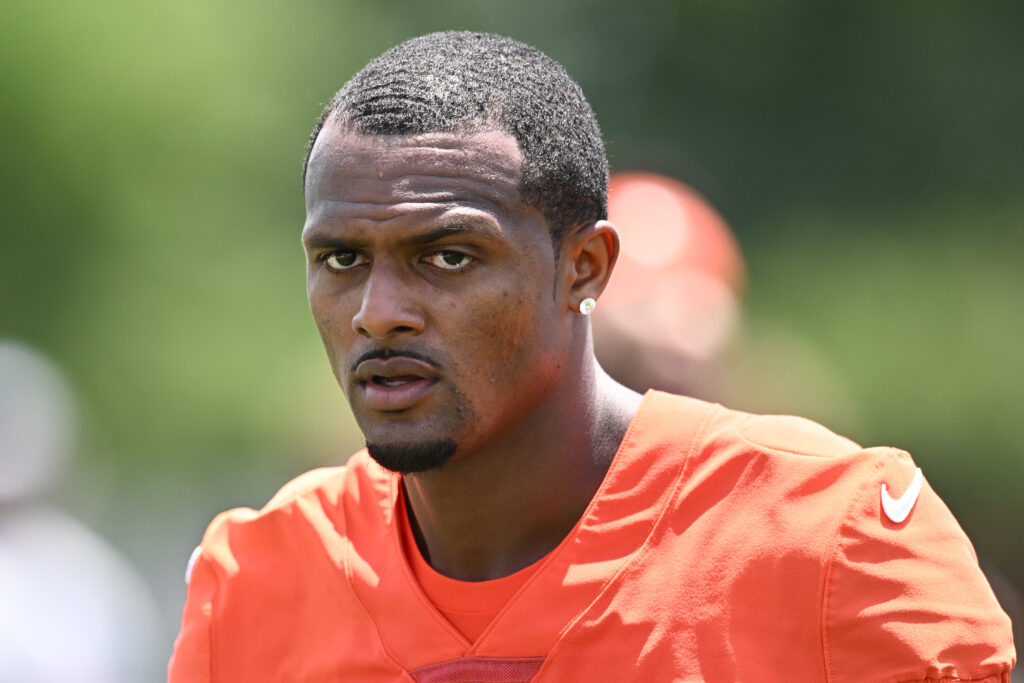
In the Cleveland Browns’ ongoing quarterback competition, the sudden emergence of Dillon Gabriel has shifted the conversation in a way that places Deshaun Watson’s future under sharper scrutiny than at any point since his arrival in the franchise.
What once appeared to be a two-man race between Watson and rookie Shedeur Sanders has expanded, with head coach Todd Monken allocating more first-team repetitions to Gabriel.
That development alone raises uncomfortable questions about the player once viewed as the franchise’s long-term answer at the position, and Austin Bundy of FanSided has explained why he feels that Watson — a former Pro Bowler — is “cooked” in the Browns’ quarterback battle.
Watson has not taken a meaningful snap in regular-season action for multiple years. His last full season of production came during his final year with the Houston Texans in 2020. Since then, a combination of injuries, legal matters, and inconsistent performance has kept him on the periphery.
The Browns remain contractually obligated to a massive financial commitment—roughly $41 million in the current structure—that was designed around the assumption Watson would eventually return to something resembling his earlier form. When a team begins elevating a third-string quarterback in training camp, it signals that those expectations are no longer being met on the practice field.
Bundy notes that Monken’s comments make the shift explicit. The coach has stated that Gabriel has earned additional opportunities through consistent performance and that the distribution of snaps is not guaranteed to any player. In other words, Watson is no longer being handed the first-team work simply by virtue of his contract or his prior résumé.
For a quarterback still recovering from a long absence and attempting to reestablish rhythm in a new offensive system, fewer high-quality repetitions create a difficult cycle. The less he practices with the starters, the harder it becomes to demonstrate the command necessary to reclaim the job.
Gabriel’s own résumé from the previous season was modest: limited production, a low QBR, and visible struggles with progressions. That he is now receiving preferential treatment suggests either meaningful improvement on his part or, more critically for Watson’s case, that the veteran and the rookie are failing to separate themselves in Monken’s evaluation.
Bundy’s analysis frames this as a potential indictment of Watson’s current level. A quarterback carrying such a large salary typically does not lose first-team snaps unless the coaching staff has concluded that the gap between expectation and reality has grown too wide to ignore.
There remains time for Watson to reverse the trend. The Browns have publicly maintained that the competition will not be settled until after the second week of the preseason. Yet the early movement toward Gabriel already carries symbolic weight.
It indicates that Monken is prioritizing present performance over sunk costs, and that Watson’s path back to relevance requires more than simply staying healthy. He must now outperform a player who was never expected to challenge him in the first place.
For a franchise still trying to extract value from one of the largest quarterback contracts in recent memory, the optics are striking. The rise of a young, lower-salaried option does not merely complicate the depth chart; it underscores how far Watson has drifted from the standard that justified the investment.
Whether he can close that gap in the coming weeks will determine if the Browns continue to treat him as a foundational piece or begin treating the contract as a problem to be managed around.