
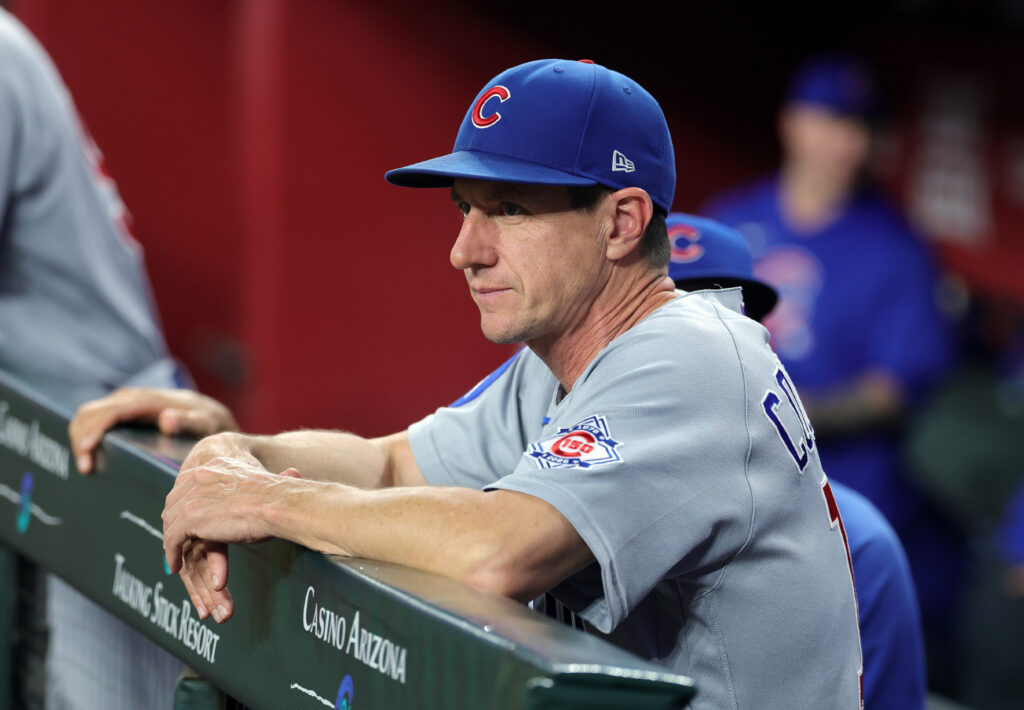
Chicago Cubs catcher Carson Kelly has declined his $7.5 million mutual option for the 2027 season, taking a $1.5 million buyout and becoming a free agent.
The decision, reported by Associated Press writer Ronald Blum, closes out the two-year, $11.5 million contract Kelly signed with Chicago before the 2025 season and sends the 32-year-old back onto the open market.
Kelly served as the Cubs’ primary catcher in 2026, starting 120 games. He finished the year with a .258/.336/.376 slash line, 10 home runs, and 58 RBI for a .712 OPS.
Those numbers represented a modest step back from his stronger 2025 output, yet he remained a steady presence behind the plate while backup Miguel Amaya handled the remaining work.
Across his two seasons in Chicago, Kelly has batted .254/.334/.402 in more than 800 plate appearances, giving the organization consistent production at a premium position.
His value is most apparent against left-handed pitching. In 121 at-bats versus southpaws in 2026, Kelly hit .298 with a .496 slugging percentage and six of his home runs, producing an .871 OPS.
That split aligns with a career mark that has long exceeded .800 against lefties, making him an attractive option for clubs seeking a right-handed-hitting complement or platoon partner.
Defensively, his blocking ranked in the 89th percentile among major-league catchers, while framing was roughly average and his arm and pop time ranked below average.
He also limited chase, whiff, and strikeout rates to the upper percentiles, suggesting a disciplined approach at the plate.
The catching market he enters includes names such as Ryan Jeffers, Tyler Stephenson, Jonah Heim, and Austin Hedges.
Industry observers generally view a two-year deal covering Kelly’s age-32 and age-33 seasons as the most likely outcome, with a longer commitment possible only if multiple clubs show strong interest.
He remains free to discuss a return to Chicago in the meantime, though the Cubs face broader roster questions this winter, particularly on the pitching side.
Kelly’s decision arrives as the sport approaches the December 1 expiration of the current collective bargaining agreement. Should owners and the players’ association fail to reach a new deal, a lockout could delay free-agent negotiations.
For a veteran catcher coming off a full season as a regular, the timing adds another variable to an already competitive market for backstops.
How aggressively teams pursue him once the market formally opens will determine whether he lands another multi-year commitment or settles for a shorter, higher-average-annual-value pact.