
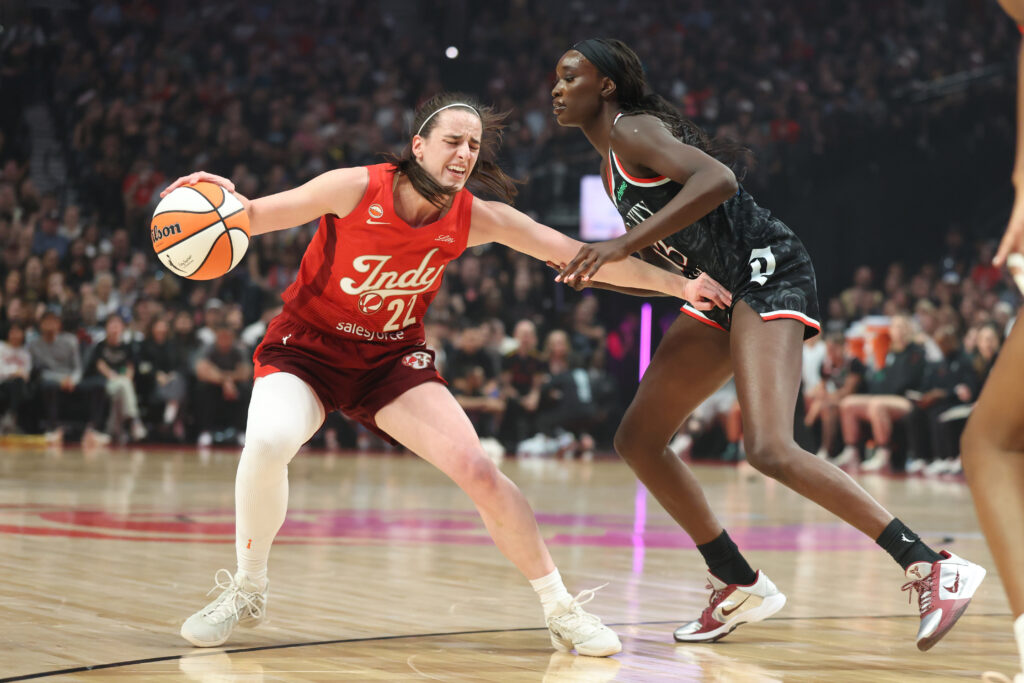
Sports analyst Jason Whitlock has again taken aim at Indiana Fever guard Caitlin Clark, labeling her an emotional train wreck and a whiner amid ongoing debate over the 2026 WNBA Most Valuable Player race.
The longtime commentator and host responded to a supporter who accused him of fixating on criticism of Clark while questioning whether she ranks as the Fever’s top player.
Whitlock made clear he wants Clark to claim the award on merit rather than popularity or commercial considerations.
“I hope Caitlin earns MVP and isn’t handed it for business purposes,” he said.
He acknowledged progress in one area of her game before delivering a sharp assessment of her demeanor.
“She’s improved with shot selection this year. But she’s been an emotional train wreck and a whiner. She walked off the court in the middle of a game and disappeared for 9 days… You can objectively root for Caitlin without destroying everyone. And you can criticize her immaturity and constant whining. It’s not betrayal. It’s a concern that she’s going to blow this amazing opportunity,” Whitlock said.
The remarks continue a pattern in which Whitlock has mixed praise for Clark’s talent with repeated concerns about her on-court reactions and maturity.
Clark is posting strong numbers this season, averaging 21.6 points, 8.0 assists and 4.1 rebounds while helping the Fever to a 19-10 record, fourth-best in the league.
Indiana has gone 4-0 in contests Clark has missed, a detail Whitlock has previously cited when elevating teammates such as Kelsey Mitchell in discussions of the team’s hierarchy.
Whitlock also addressed content creators who strongly defend Clark, arguing that some of their narratives frustrate observers and that he views elements of her fan base as cult-like.
Other standout performers remain firmly in the MVP conversation and present clear competition.
Four-time winner A’ja Wilson continues to dominate for the Las Vegas Aces with averages of 26.8 points, 9.8 rebounds and 3.2 assists. Paige Bueckers has lifted the Dallas Wings back into playoff contention while averaging 20.8 points, 6.0 assists and 4.2 rebounds. Minnesota Lynx rookie Olivia Miles has guided her team to the league’s best record, posting 19.4 points, 4.7 rebounds and 5.8 assists per game.
Clark’s production keeps her in the discussion, yet several rivals hold superior statistical profiles or stronger team records.
Whitlock maintains that objective evaluation of Clark’s play and temperament should not be viewed as disloyalty.
He frames his critique as genuine concern that emotional inconsistencies could undermine the rare platform she has built in women’s basketball.
The exchange underscores the intense scrutiny surrounding Clark as the WNBA season advances and award races intensify.