
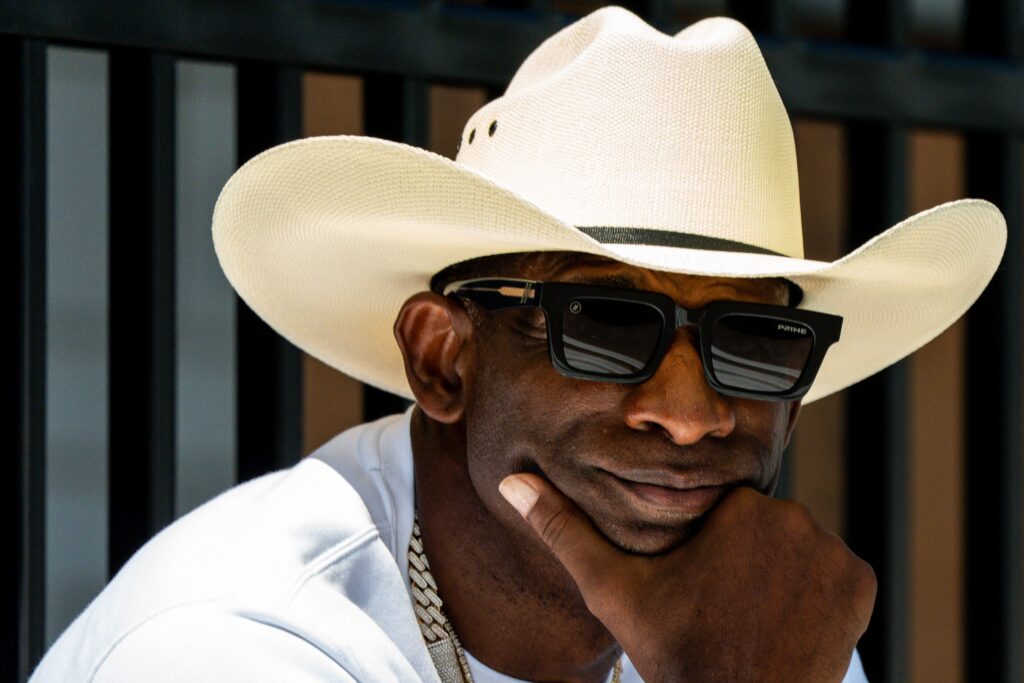
Could Deion Sanders be in line for a new head-coaching job in the ACC?
Clemson football has spent nearly two decades defined by Dabo Swinney’s presence on the sideline, a run that delivered two national championships and turned Death Valley into one of the most consistent destinations in the sport. That history still matters deeply on campus and among the fan base.
Yet the early weeks of the 2026 season have reopened conversations that once felt unthinkable, as the Tigers try to recapture the edge that once separated them from the rest of the ACC.
In a recent piece for Heavy.com, Jonathan Adams listed Colorado’s Sanders among the names that would surface if Clemson ever reached the point of considering a change.
Adams framed Sanders as a candidate who could deliver a hard reset, citing the coach’s track record of lifting a program back into national conversation even through uneven results in Boulder. The mention lands at a sensitive moment.
Swinney remains bound to a contract that runs through 2031 and carries a buyout reported in the tens of millions, a figure that makes any conversation about succession more theoretical than imminent. Still, the mere appearance of Coach Prime’s name next to the Clemson job forces supporters to weigh what the program values most.
From the Tigers’ perspective, Sanders represents both possibility and disruption. His ability to command attention, attract elite talent, and reframe a program’s identity is obvious.
Clemson has watched other schools use personality and portal aggression to stay relevant in the current era, and some inside the fan base wonder whether a figure of Sanders’ stature would instantly restore the national spotlight that has dimmed since the last playoff run. The counterargument is equally Clemson-specific.
The program Swinney built prizes continuity, a particular brand of culture, and a recruiting approach that long favored high-school development over constant roster turnover. Importing a coach whose public style and methods differ so sharply would amount to more than a coaching hire. It would be a statement that the old model had run its course.
That is why the rumor, however distant, stings. Many Tigers supporters still see Swinney as the architect who took a middling program and made it a power, and they are not ready to treat his tenure as disposable.
Others, worn down by recent results and the sense that the sport has shifted around Clemson, are willing to at least imagine a different future.
Sanders sitting on a speculative list does not mean the university is preparing to make that leap. It does mean the conversation has moved from private frustration to public speculation, and that alone changes the atmosphere around a program that once felt insulated from it.
Whether Clemson ultimately stays the course or someday looks outside its own lineage, the Sanders mention underscores the stakes. The Tigers are no longer discussing how to stay on top.
They are discussing whether the man who put them there can still get them back.