
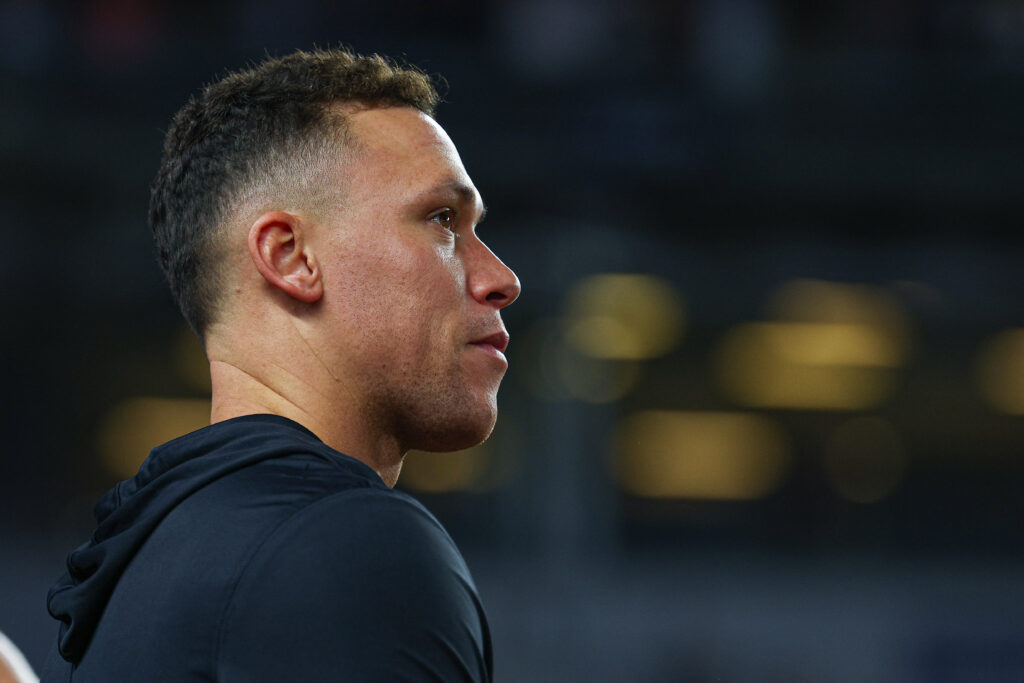
Aaron Judge has been absent from the New York Yankees lineup since the final day of May, sidelined by a stress fracture in his right first rib. The injury has kept one of baseball’s most dominant hitters on the shelf for more than two months, fueling ongoing questions about when the three-time American League MVP might return to the field.
On Aug. 5, manager Aaron Boone provided a modest update that offered a flicker of optimism. Judge had undergone recent scans and received clearance to begin light activity.
That clearance covers outdoor running and upper-body resistance training, marking the first meaningful step forward in a recovery that has required significant patience. Judge himself also said he plans on returning this season.
Sports medicine physician Jesse Morse, who has followed the case closely, responded to the news with a measured assessment that tempered any expectations of an imminent return.
“Aaron Judge update. He’s dealing with a stress fracture in his first rib. He’s finally been cleared for upper body resistance training, and outdoor running. That means, that over the past 2.5 months Aaron Judge hasn’t been able to run or resistance train. He hasn’t been able to throw. And most importantly, he hasn’t been able to swing a bat,” Morse posted on X.
He continued with a realistic outlook on the remaining timeline.
“Do I expect him to return this season? Hopefully yes. But I don’t think it’s two weeks away. I think mid-to-late September is the most realistic return to play. He’s not out of the woods yet.”
A return in that window would place Judge back in the lineup as the regular season winds down and the postseason approaches. For a Yankees team that has already navigated life without its most productive offensive force, the prospect of waiting several more weeks carries clear implications.
In Judge’s absence, the club moved aggressively at the trade deadline. New York acquired first baseman Luis García Jr. from the Washington Nationals, adding a bat that has produced 24 home runs and 78 RBI this season.
The Yankees also brought in outfielder Heliot Ramos, who has posted a .260 average with nine home runs in limited action. Shortly after the deadline, the organization called up highly regarded prospect George Lombard Jr., who announced his arrival with a solo home run in his major league debut.
Those reinforcements have provided some depth, yet none can fully replicate the impact Judge generates when healthy. The captain’s combination of power, plate discipline, and leadership has long defined the Yankees’ offensive identity. His prolonged absence has tested the roster’s resilience and forced the front office to seek external help while internal options develop.
Morse’s assessment underscores the careful progression required for a stress fracture in this location. The rib must heal sufficiently before a player of Judge’s size and swing velocity can resume the violent rotational forces of hitting, throwing, and fielding without risk of setback.
The clearance for light activity represents progress, but the gap between running and resistance work and full game readiness remains substantial. Yankees fans and the organization itself will continue monitoring the next stages of Judge’s recovery. If the mid-to-late September window holds, he could still contribute meaningfully in October.
Until then, the team must continue finding ways to score runs and win games without its most dangerous hitter in the middle of the order. The path back is underway, yet the finish line is still some distance away.